
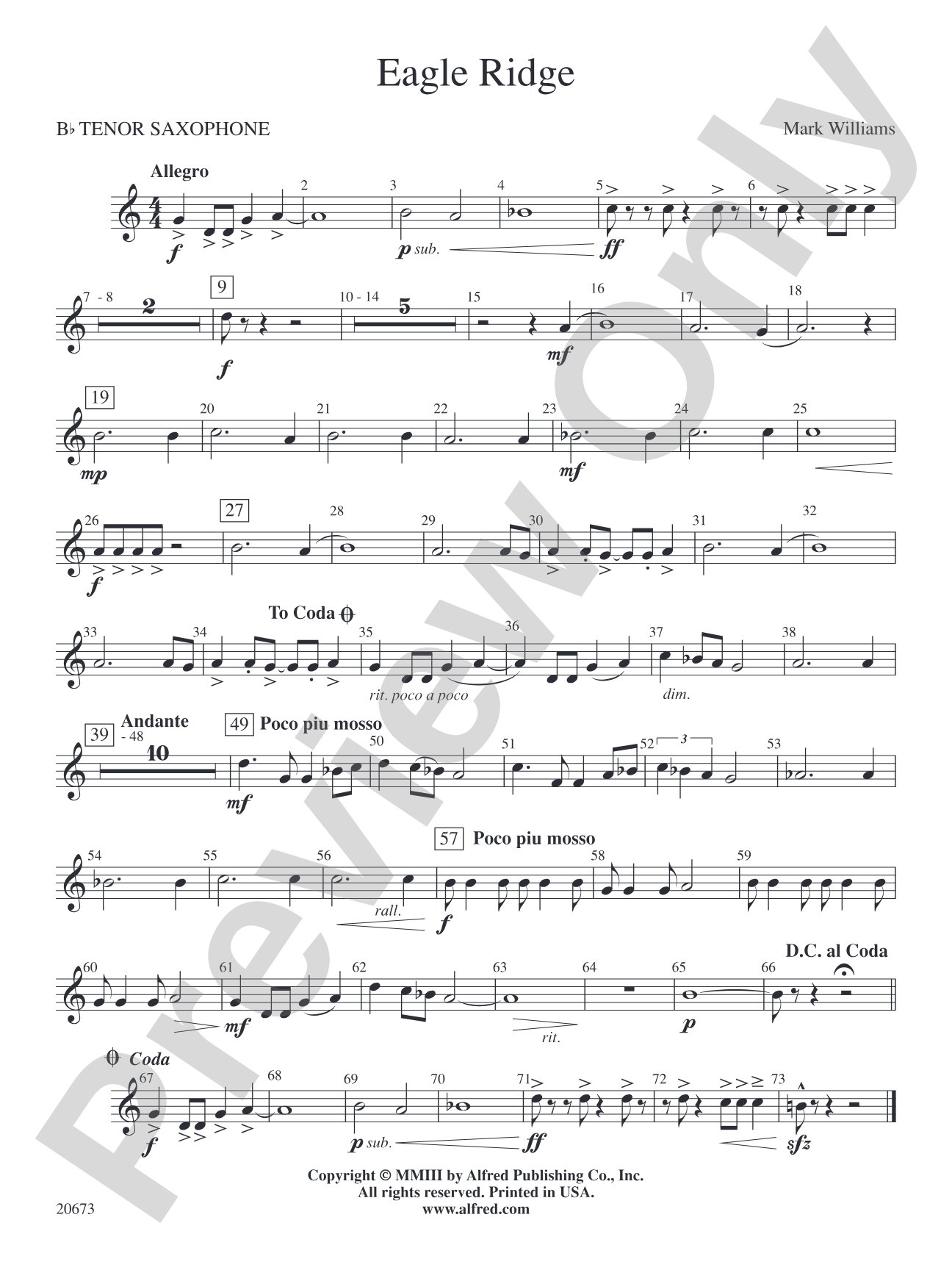

Eagle Ridge: B-flat Tenor Saxophone
By Mark Williams
Grade: 1.5 (Easy)
Item: 00-PC-0000427_TX1
$3.00
Pickup currently not available
Description
This original concert/contest overture utilizes a variety of rhythms to produce an interesting and solid selection for young bands. Both the opening five-note motif and a secondary theme utilizing a dotted quarter, eighth rhythm are developed throughout the piece, providing all of the major thematic material. Your students will enjoy this excellent and enriching musical selection. This title is available in MakeMusic Cloud.


Don't just read it, hear it, play along with it, and watch your students grow with it. In MakeMusic Cloud, Eagle Ridge: B-flat Tenor Saxophone comes alive with professional accompaniment, adjustable tempo, and built-in practice tools that turn solo practice into real progress.
Open in the Player
Jump straight in and assign it today.
Start Your Free Trial
Open this title and explore the full library in minutes.
Sample Audio
1
Audio File
--:--
0:00
0:00
Sample Video
No sample videos found.
Additional Details
Series:
Challenger Band Series
Publisher:
Alfred Music
Page Count:
120
SKU:
00-PC-0000427_TX1
More about this title
About the Composer: Mark Williams

Mark Williams composed over 200 works for school bands, orchestras, and choirs, establishing himself as a trusted voice in music education. His collaboration on the Accent on Achievement Band Method shaped how countless young musicians learned their instruments. A bassoon player and arranger who served with the 560th Air Force Band, Williams brought both compositional sophistication and practical knowledge of what student musicians could achieve.
Throughout his career, Williams worked extensively in Washington state schools, focusing on elementary band instruction and building strong foundational programs. He guest conducted and clinicked across 34 U.S. states, five Canadian provinces, and Australia, earning recognition through competitions like the Western International Band Clinic's Gralia Competition and multiple ASCAP Special Awards. Beyond composing and teaching, he served as conductor and artistic director for the Spokane British Brass Band, remaining active as a performer and mentor.
Why we love this
Williams wrote this overture with real awareness of what young bands need: clear thematic material that develops logically, rhythmic variety that keeps everyone engaged, and technical demands that stay manageable. The two main ideas (that opening five-note motif and the dotted quarter-eighth pattern) give your band something to sink their teeth into without overwhelming them, and they recur enough that students hear how development actually works in real time.
What to expect
Eagle Ridge has the forward motion and character of a genuine overture, with enough rhythmic interest to keep the piece from feeling predictable. The landscape implied by the title suggests something open and expansive, and the music delivers that sense of space and movement without ever becoming cluttered or overly complex.
Who it's for
Young bands working at the early intermediate level who are ready for a concert or contest piece that doesn't rely on technical gymnastics. This works perfectly for groups that have solid fundamentals but are still building confidence with phrasing, articulation, and ensemble balance.
How to get the most out of it
- Establish the five-note opening motif with clarity and confidence; this is your thematic anchor, so lock the articulation and intonation before moving forward with development sections.
- Balance the secondary theme's rhythmic character by having students practice the dotted quarter-eighth figure separately until the rhythm feels natural rather than mechanical.
- Use dynamic contrast between thematic statements to help younger musicians recognize where ideas return throughout the piece.
- Give the ensemble time to hear how sections build from simple statements into fuller textures; rehearse by function (melody, harmony, accompaniment) before bringing full sections together.
How to use it
Ideal as a concert opener or as a contest selection where a Grade 1.5 piece that sounds substantial matters. This works well on programs alongside slightly more challenging pieces because it establishes your band's solid fundamentals and gives the audience an immediate sense of confidence. It's also a natural fit for festival play-throughs or end-of-year concerts where showcasing honest musicianship is the goal.
Skills your students will build
- Recognizing and performing thematic development across multiple sections
- Articulating dotted rhythms cleanly and consistently as a section
- Balancing melody and accompaniment roles within harmonic textures
- Responding to dynamic and rhythmic variety to shape phrasing
- Reading mixed rhythmic figures at a comfortable tempo