
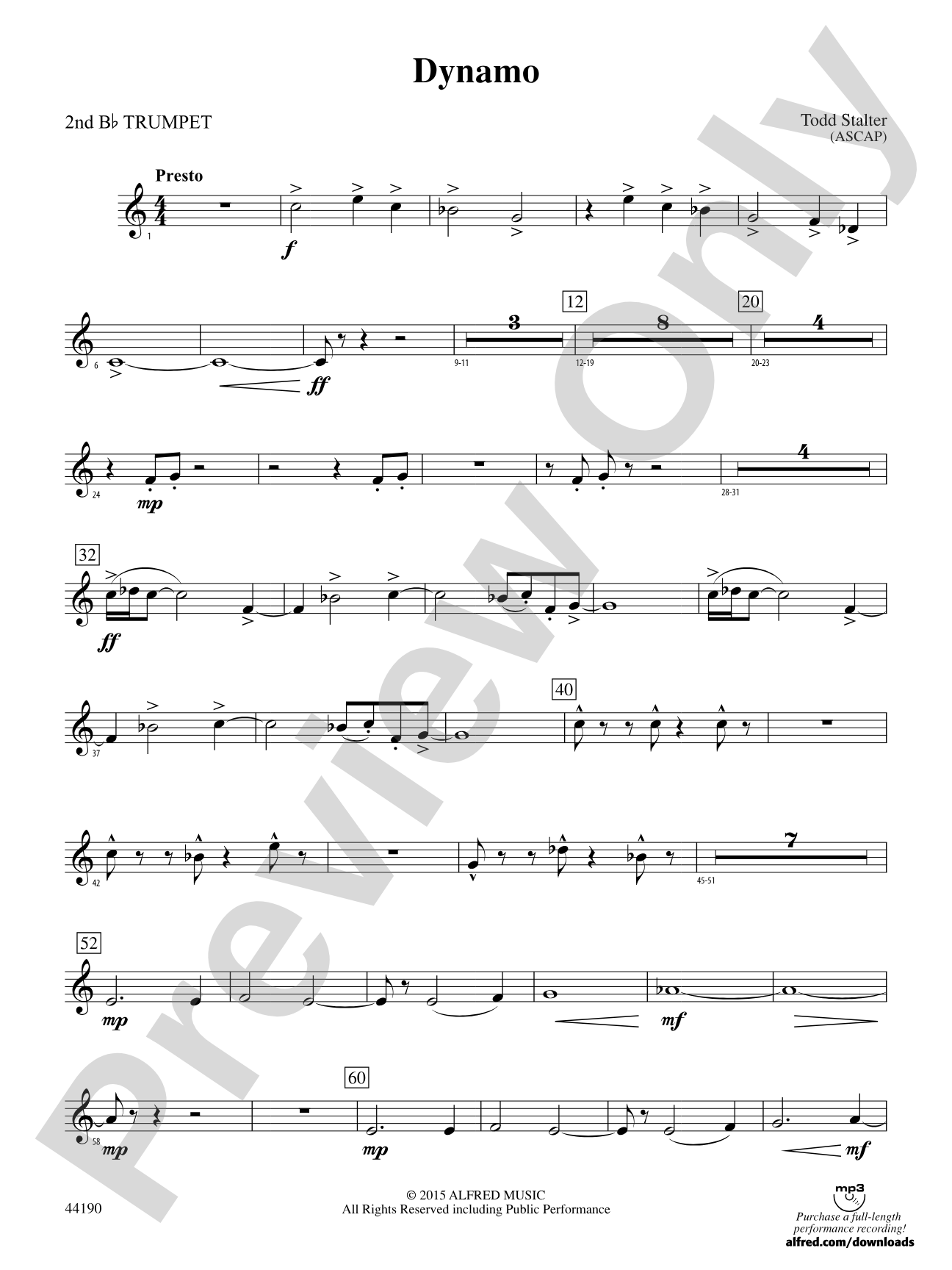

Dynamo: 2nd B-flat Trumpet
By Todd Stalter
Grade: 2.5 (Medium Easy)
Item: 00-PC-0017040_T2
$3.00
Pickup currently not available
Description
"Dynamo" was written in celebration of the career of an administrator who was a staunch supporter of music, and known for being highly energetic and always "on the move." The piece mimics these characteristics by opening with a large release of energy, and the melodic modal Mixolydian motives that follow, bounce around the ensemble unexpectedly. (2:50)


Don't just read it, hear it, play along with it, and watch your students grow with it. In MakeMusic Cloud, Dynamo: 2nd B-flat Trumpet comes alive with professional accompaniment, adjustable tempo, and built-in practice tools that turn solo practice into real progress.
Open in the Player
Jump straight in and assign it today.
Start Your Free Trial
Open this title and explore the full library in minutes.
Sample Audio
1
Audio File
--:--
0:00
0:00
Sample Video
No sample videos found.
Additional Details
Series:
Young Symphonic
Publisher:
Alfred Music
Page Count:
262
SKU:
00-PC-0017040_T2
More about this title
About the Composer: Todd Stalter

Todd Stalter built one of Illinois's most decorated band programs during 34 years as Director of Bands at Eureka High School. His concert ensembles earned consistent Superior ratings at IHSA contests, while the marching band claimed 16 Class 1A state championships and earned induction into the Illinois State Marching Band Championships Hall of Fame. Beyond his tenure in Eureka, Stalter has conducted All-State Bands in Georgia and Delaware, led numerous honor bands across Illinois and the Midwest, and maintained an active schedule as a clinician and adjudicator for both solo and large group contests.
Stalter holds a Bachelor of Music Education (cum laude) and Master of Music in Trumpet Performance from Illinois State University, where he studied with Richard Lehman (Solo Cornet of The President's Own United States Marine Band) and Dr. James Buckner. His compositions for band and string orchestra are performed nationally and appear on state contest lists across the United States. Several works are featured in the GIA publication Teaching Music Through Performance in Band, establishing his voice as both an educator and composer who understands what student ensembles need to develop musically.
Why we love this
Stalter captures personality in music here with genuine flair. The piece opens with unrestrained energy and then uses bouncing Mixolydian melodic ideas to keep the ensemble and audience perpetually off balance, making it an engaging contest or concert choice that doesn't rely on complexity to hold attention. At Grade 2.5, the writing remains accessible while delivering the kind of character-driven piece that makes students feel like they're playing something real.
What to expect
Dynamo moves with purposeful restlessness. The opening burst sets an almost nervous anticipation, and the Mixolydian melodies that follow feel less predictable than traditional major key writing, creating a sense of playful unpredictability. It's a piece that mirrors the personality of someone who never sits still, channeling that motion into musical momentum.
Who it's for
Band directors looking for a Grade 2.5 concert piece that delivers genuine character and energy without oversimplification. This works equally well for a spring concert, festival performance, or contest setting where you want the ensemble to play something spirited and memorable.
How to get the most out of it
- Lean into the opening energy release. This isn't a gentle warm-up piece; bring the dynamics and articulation clarity from the downbeat to establish the energetic personality the title promises.
- Treat the Mixolydian motives as conversation within the ensemble rather than as strict melodic statements. Let sections respond to each other with rhythmic buoyancy and slight agogic flexibility to highlight the 'bouncing around' character.
- Balance brightness with control in the modal harmony. The raised seventh scale degree characteristic of Mixolydian can easily sound thin if the harmonic foundation (low brass and woodwinds) doesn't anchor the sound with clear vertical alignment.
How to use it
Program this as a concert opener or mid-set energy boost where you need a crisp transition between slower work and other full-ensemble pieces. At 2:50, it fits naturally into most concert formats and serves as strong festival or contest material that shows musicianship across the band without requiring advanced technical facility.
Skills your students will build
- Secure intonation in modal harmony (Mixolydian scale degree tendencies)
- Rhythmic independence when melodic ideas shift across sections
- Dynamic control and articulation clarity at tempo
- Listening for harmonic color and vertical balance in non-traditional harmonic contexts