Dvorák's 8th Symphony, 4th Movement: 3rd B-flat Trumpet Sheet Music Preview

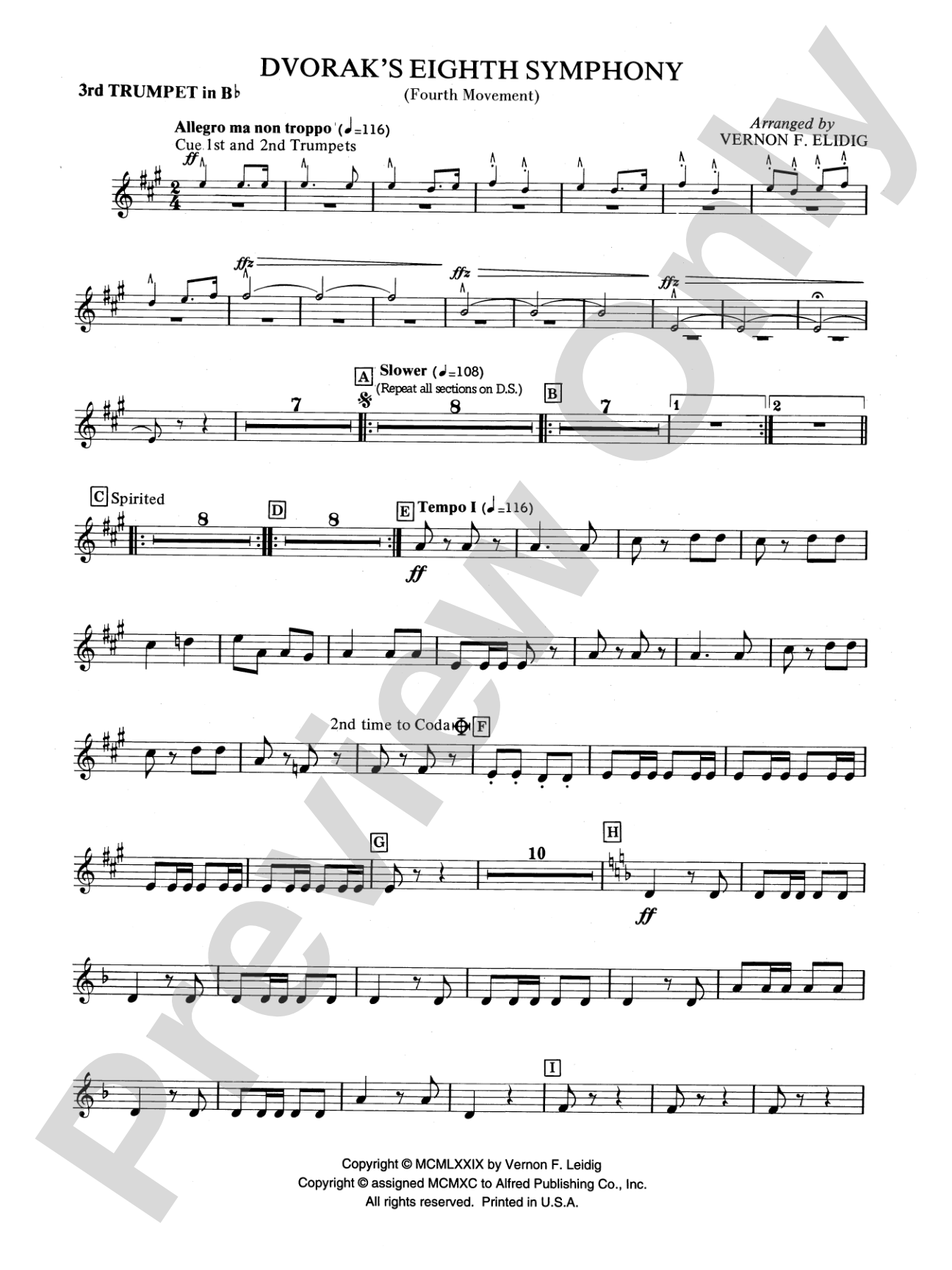
Dvorák's 8th Symphony, 4th Movement: 3rd B-flat Trumpet

[Antonín Dvorák] / arr. Vernon Leidig

Grade: 3

Item: 00-PC-0000063_T3

Digital Download
$3.00
Description
From the Czech composer Antonín Dvorák.

Don't just read it, hear it, play along with it, and watch your students grow with it. In MakeMusic Cloud, Dvorák's 8th Symphony, 4th Movement: 3rd B-flat Trumpet comes alive with professional accompaniment, adjustable tempo, and built-in practice tools that turn solo practice into real progress.

Sample Audio
No sample audio found.
Sample Video
Additional Details
Series: Symphonic Classics
Publisher: Alfred Music
Page Count: 2
SKU: 00-PC-0000063_T3

More about this title

Why we love this

This arrangement opens Dvorák's architectural mastery to orchestras that might not have the resources for the full symphony. Leidig's Grade 3 scoring preserves the movement's propulsive energy and harmonic richness while keeping the part demands accessible, making it genuinely playable without sacrificing the work's character.

What to expect

Triumphant and propulsive. The fourth movement erupts from the symphony's introspection with Dvorák's characteristic vigor—Czech folk energy coursing through Romantic orchestration. There's a sense of arrival and affirmation that makes this a natural closer for any program.

Who it's for

Orchestras working at Grade 3 who want substantial repertoire beyond pops arrangements. This is ideal for ensembles with mixed experience levels; the part writing allows developing musicians to contribute meaningfully while advanced players find musical satisfaction in the symphonic context.

How to get the most out of it

  • Shape the main theme with a clear arc from the opening; this finale needs forward momentum, so resist the urge to dwell on individual phrases at the expense of the larger line.
  • Balance the brass entries carefully. The fanfare character is built into this movement, but clarity depends on blend rather than volume; let the strings and woodwinds breathe around the brass.
  • Lock the rhythmic foundation early in rehearsal. This movement sits squarely in Dvorák's Romantic idiom with driving accompaniment figures; precision in the lower voices frees the principal melodic lines to sing.

How to use it

Program this as a finale to a concert built around Romantic orchestral works, or use it to bridge a themed program about national identity in classical music. At two pages, it works equally well as a standalone showpiece or as part of a larger symphonic suite.

Skills your students will build

  • Balancing multiple melodic lines in a full orchestral texture
  • Reading and performing in Romantic-era harmonic language
  • Coordinating sectional entries with clear ensemble synchronization
  • Sustaining musical energy across a complete movement
  • Responding to a conductor's interpretive choices within a known symphonic context

You May Also Like