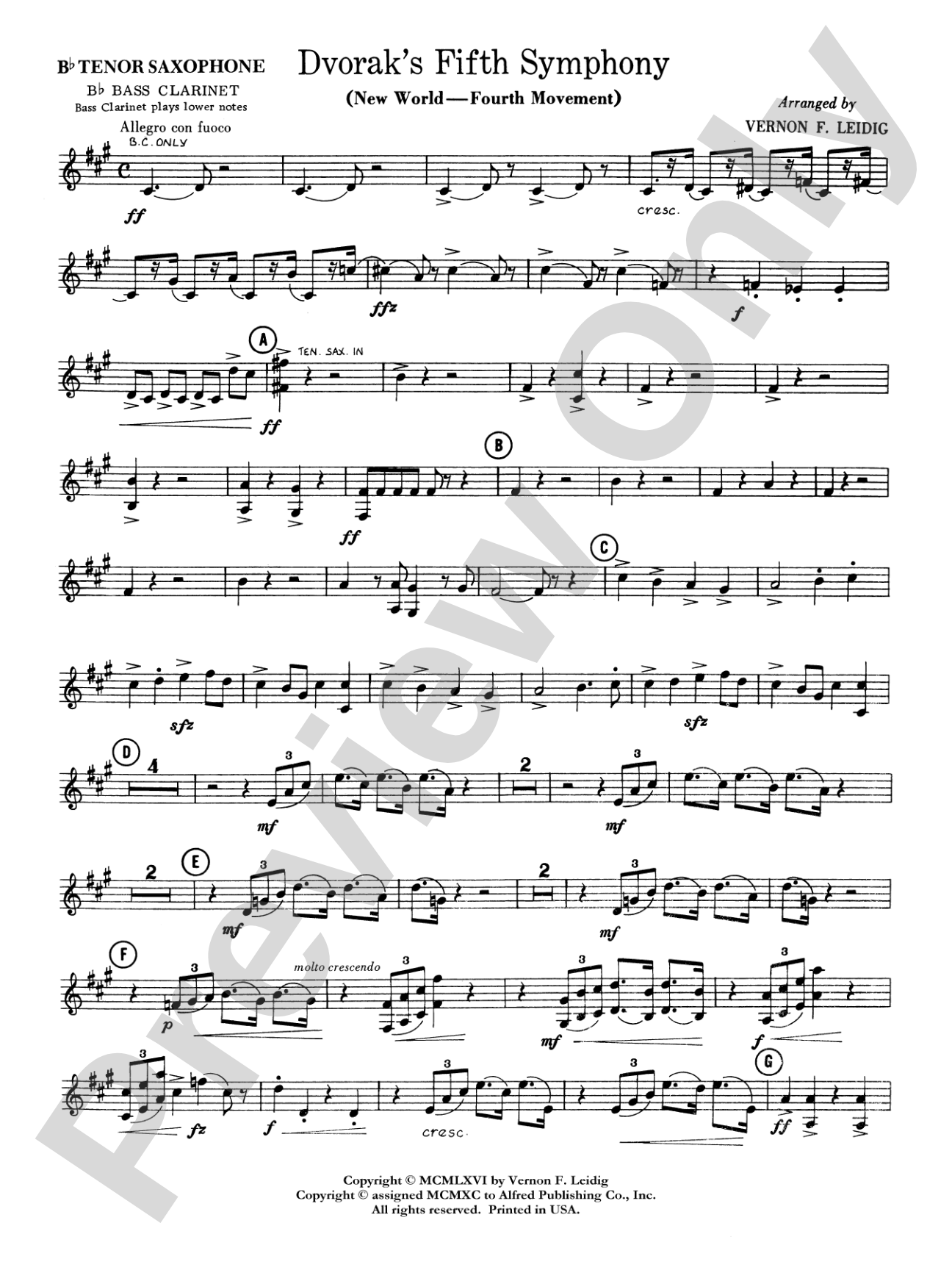
Dvorák's 5th Symphony ("New World," 4th Movement): B-flat Tenor Saxophone Sheet Music Preview

Dvorák's 5th Symphony ("New World," 4th Movement): B-flat Tenor Saxophone

By Antonín Dvorák / arr. Vernon Leidig

Grade: 3

Item: 00-PC-0000062_TX1

Digital Download
$3.00
Description

Don't just read it, hear it, play along with it, and watch your students grow with it. In MakeMusic Cloud, Dvorák's 5th Symphony ("New World," 4th Movement): B-flat Tenor Saxophone comes alive with professional accompaniment, adjustable tempo, and built-in practice tools that turn solo practice into real progress.

Sample Audio
No sample audio found.
Sample Video
Additional Details
Series: Highland/Etling Full Orchestra
Publisher: Alfred Music
Page Count: 202
SKU: 00-PC-0000062_TX1

More about this title

About the Arranger: Vernon Leidig

Vernon Leidig built a distinguished career as a composer and arranger for school orchestras, with a particular gift for making standard repertoire accessible to younger ensembles. His arrangements in the Highland/Etling series have become staples in music education, known for preserving the integrity of original masterworks while respecting the technical realities of developing musicians.

Why we love this

This arrangement makes one of the world's most recognizable symphonic movements accessible to developing orchestras without sacrificing the emotional weight of Dvorák's original. Grade 3 scoring opens the fourth movement to ensembles that couldn't otherwise tackle this repertoire, and Leidig's orchestration preserves the sweeping melody and harmonic architecture that make this movement unforgettable. Programming a Romantic-era masterwork at this level builds student confidence and repertoire knowledge in a single performance.

What to expect

Yearning, noble, and contemplative. The fourth movement trades the drama of earlier sections for introspection, building toward moments of quiet transcendence. Students feel the gravitas of the original while discovering that accessible arrangements need not sacrifice artistry.

Who it's for

Orchestra directors working with Grade 3 ensembles who want to program substantial Romantic-era repertoire. This works for schools with developing orchestras, festival and contest submissions, and programs seeking high-recognition masterworks at achievable difficulty levels.

How to get the most out of it

  • Shape the famous "Goin' Home" melody with long, singing lines; resist the urge to rush even when playing faster passages, as the beauty lies in the legato quality Dvorák built into every phrase.
  • Balance the accompaniment parts carefully so they support rather than overshadow the melody, particularly in the strings and woodwinds that carry the secondary material.
  • Work section by section to lock in ensemble precision before drilling the full piece; Grade 3 parts require clear articulation and rhythmic accuracy to sound polished.
  • Use the conductor score to mark cues and sight lines for younger players; this length and complexity benefits from advance planning and rehearsal mapping.

How to use it

This movement stands alone as a complete concert piece and works beautifully on programs celebrating Romantic composers or featuring orchestral highlights. It pairs well with other arranged masterworks or simpler contemporary pieces in contests and festivals where thematic programming matters. The 202-page score and parts support a full rehearsal process, making it ideal for mid-to-late season programming.

Skills your students will build

  • Balancing melodic and accompanimental textures across full orchestra
  • Sustaining long, singing phrases without losing ensemble alignment
  • Reading and executing Grade 3 orchestral complexity in a extended work
  • Responding to expressive conducting and achieving dynamic shape across movements
  • Collaborating within sectional and full-ensemble contexts on Romantic-era repertoire

You May Also Like