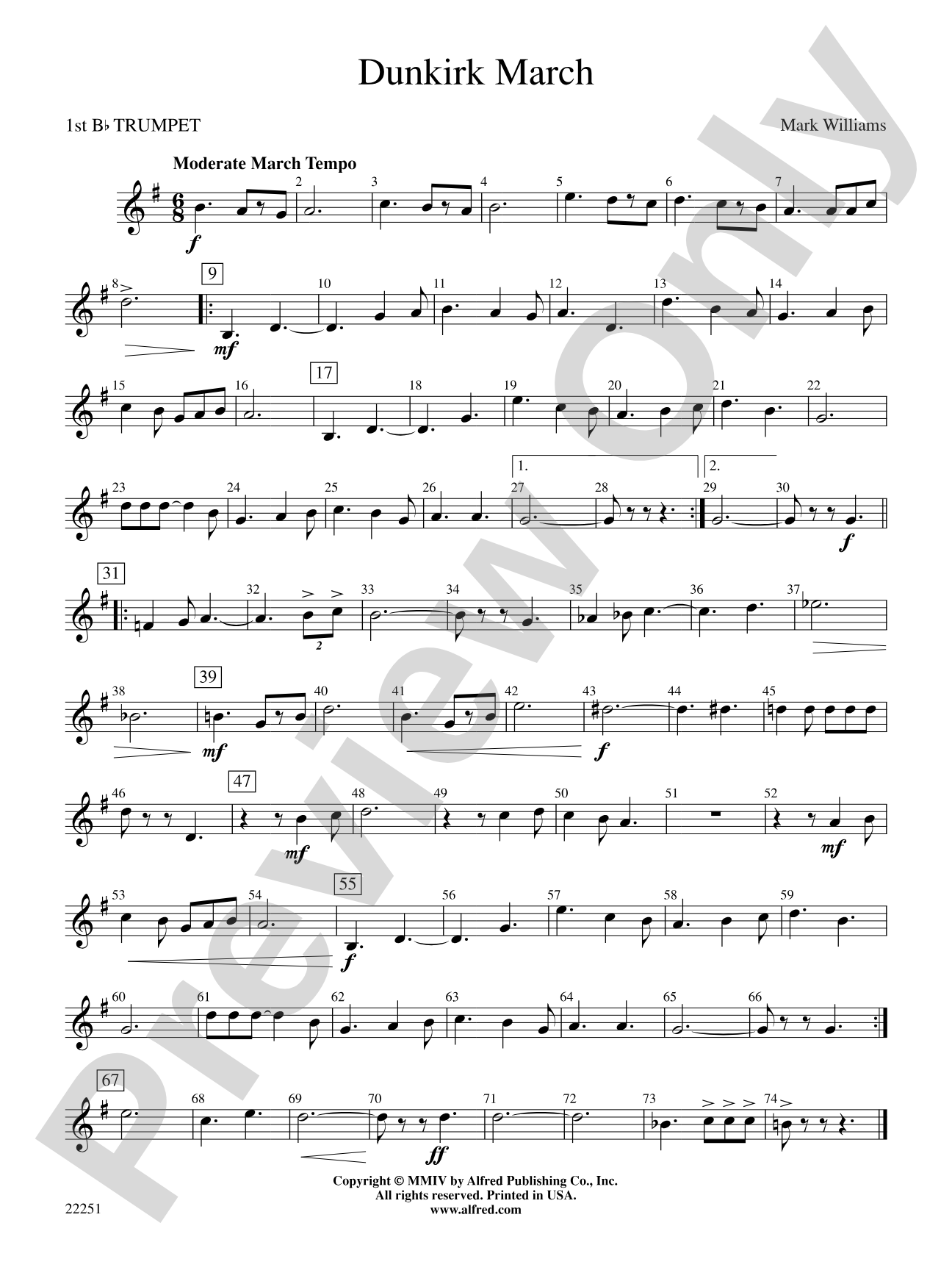
Dunkirk March: 1st B-flat Trumpet Sheet Music Preview

Dunkirk March: 1st B-flat Trumpet

By Mark Williams

Grade: 1.5 (Easy)

Item: 00-PC-0000505_T1

Digital Download
$3.00
Description
This march commemorates a daring sea rescue during World War II in which over 300,000 French and British soldiers, surrounded by German forces, were evacuated from Dunkirk by a huge volunteer flotilla consisting of every imaginable type of boat-from tiny fishing boats to yachts. This work presents a unique opportunity for musical learning, as well as cross-curricular study in social studies/history.

Don't just read it, hear it, play along with it, and watch your students grow with it. In MakeMusic Cloud, Dunkirk March: 1st B-flat Trumpet comes alive with professional accompaniment, adjustable tempo, and built-in practice tools that turn solo practice into real progress.

Sample Audio
0:00
0:00
Sample Video
Additional Details
Series: Challenger Band Series
Publisher: Alfred Music
SKU: 00-PC-0000505_T1

More about this title

About the Composer: Mark Williams

Mark Williams

Mark Williams composed over 200 works for school bands, orchestras, and choirs throughout his career. A native of Chicago who spent formative years in Spokane, Washington, he taught elementary band in Washington schools while building a reputation as a clinician and guest conductor; his work took him to 34 states, five Canadian provinces, and Australia. Williams held degrees in music education from Eastern Washington University and served as woodwind performer and arranger for the 560th Air Force Band.

Beyond the concert hall, Williams earned recognition including the Western International Band Clinic's Gralia Competition and multiple ASCAP Special Awards. He performed regularly on bassoon and directed the Spokane British Brass Band as conductor and artistic director. His Accent on Achievement Band Method became a standard resource in music education, reflecting his deep understanding of how young musicians learn.

Why we love this

Williams captures the scale and emotion of the Dunkirk evacuation without overwhelming a Grade 1.5 ensemble. The march structure gives students access to programmatic music that connects meaningfully to history curriculum, and the manageable instrumentation and range make it a genuine confidence builder rather than a struggle.

What to expect

The march unfolds with dignity and purpose, honoring both the courage of soldiers and the resourcefulness of the civilian rescue fleet. Melodic lines are direct and memorable, supported by purposeful harmony that feels accessible without sacrificing musical substance.

Who it's for

This work suits Grade 1.5 concert bands, including school ensembles with developing readers and blended instrumentation. It also serves music teachers seeking repertoire with historical relevance that sparks meaningful classroom connections beyond the rehearsal room.

How to get the most out of it

  • Balance the melody across sections as it moves; younger players tend to play heavily on exposed lines, so guide them toward a singing, supported tone rather than forced volume.
  • Establish steady march tempo early in rehearsal and lock it in with a metronome before adding dynamics; the narrative arc depends on rhythmic integrity.
  • Shape phrases in two or four-bar units to help students hear the musical story unfold rather than playing note-to-note.
  • Highlight the ensemble sections where parts move together (particularly in the trio) to build confidence and blend.

How to use it

Program this in spring concert settings where historical or patriotic themes resonate, or pair it with social studies units on World War II to demonstrate how music documents human experience. Its moderate length and clear structure make it ideal for a concert opener that engages both young musicians and audiences in something beyond purely entertainment-driven programming.

Skills your students will build

  • Executing march form and section repetition
  • Balancing melody against harmonic accompaniment
  • Sustaining steady tempo across full ensemble
  • Reading and responding to dynamic and articulation markings at Grade 1.5 level
  • Understanding how programmatic intent shapes musical phrasing and expression

You May Also Like