Dunbar 1838: Bassoon Sheet Music Preview

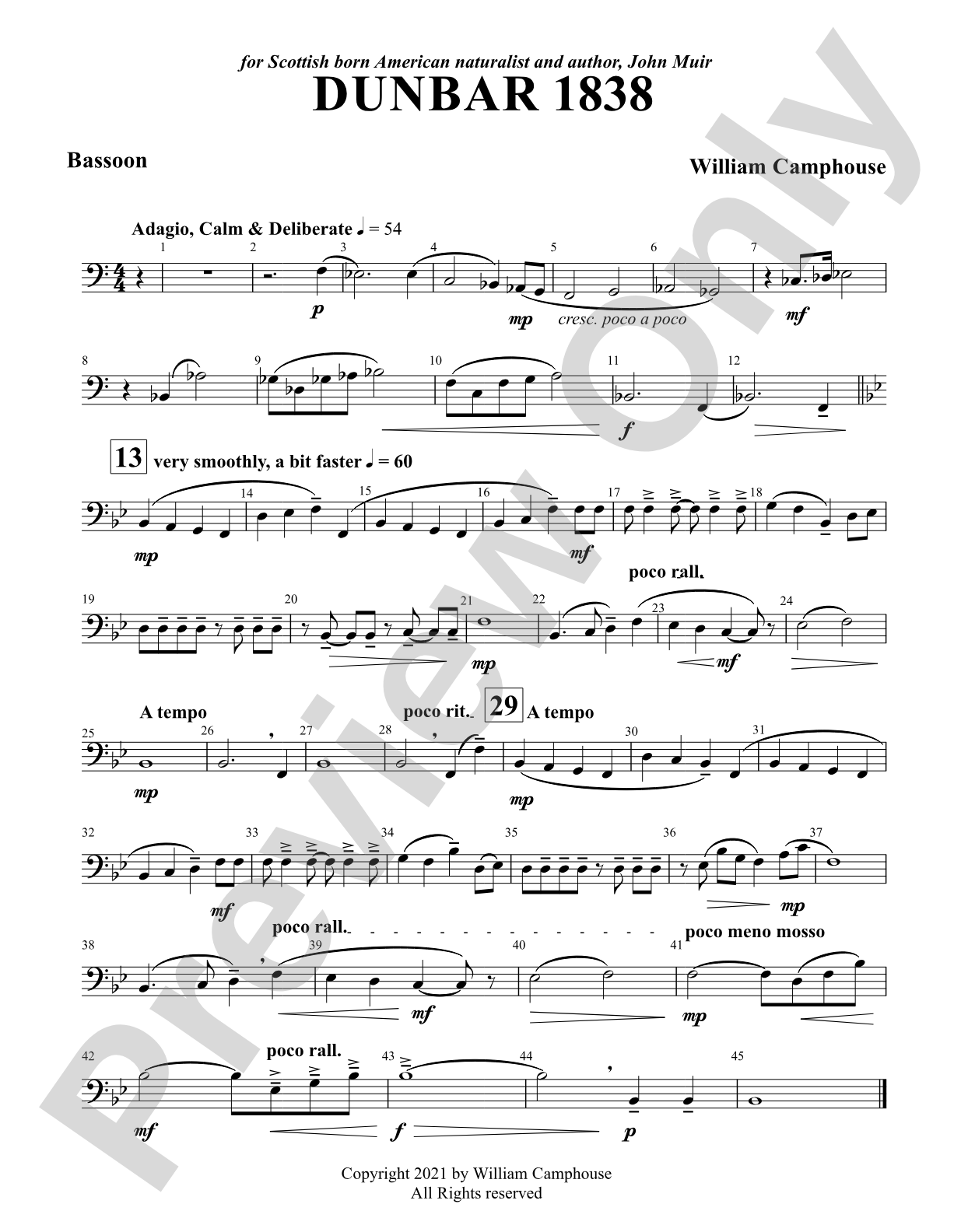
Dunbar 1838: Bassoon

By William Camphouse

Grade: 2.5

Item: 00-PC-0018740_B1

Digital Download
$3.00
Description
Dunbar 1838 marks the year and place of birth of John Muir: naturalist, author, and "Father of the U.S. National Parks." A Scot by birth, an immigrant mid-westerner in his teens and early adulthood, and a Californian for most of his life, Muir embarked on a self-described journey as a lifelong student studying at "the university of the wilderness." His love of and advocacy for the conservation of an unspoiled natural world is legendary. He was often quoted as saying "when we try to pick out anything by itself, we find it hitched to everything else in the universe." Likewise, as a nod to Muir's heritage and outlook on life, this music by William Camphouse is a simple ballad based largely on the pentatonic scale and use of a "Scotch snap" (sixteenth/dotted eighth) rhythm pattern, akin to a traditional Scottish folk tune. It is to be performed in a flowing, sustained style by all musicians on each assigned part, with lots of energy; care and control; accuracy; attention to dynamics and phrasing; and full, rich tone quality. All those elements "hitched" together make great music for musicians and audience alike! (3:35)

Dunbar 1838: Bassoon isn't in MakeMusic Cloud just yet...but it could be. Let us know you'd like to see it, and you'll help shape what comes next. In the meantime, start a free trial and dive into thousands of interactive titles your students can play along with today.

Sample Audio
1 Audio File --:--
2 Audio File --:--

Audio File

0:00
0:00
Sample Video
Additional Details
Series: Alfred Digital Concert Band
SKU: 00-PC-0018740_B1

More about this title

About the Composer: William Camphouse

William Camphouse is a prolific composer of concert band and wind ensemble music whose works span from educational to professional levels. His compositions often blend accessible harmonic language with engaging melodic writing, making his music a staple in school and community band repertoires.

Why we love this

Camphouse crafts a piece that respects the Grade 2.5 ensemble without condescending to it. The pentatonic-based melody and Scotch snap rhythms give the band something distinctive to sink their teeth into, while the programmatic connection to John Muir provides a meaningful entry point for students to understand what they're playing and why it matters.

What to expect

A contemplative Scottish ballad rooted firmly in the American experience. The pentatonic idiom and folk-tune rhythms evoke Muir's heritage, while the flowing, energetic interpretation asks the band to honor both introspection and forward motion, much like Muir's own restless journey from Scotland to the American wilderness.

Who it's for

Concert bands at the Grade 2.5 level seeking a programmatic piece that challenges musicianship without overwhelming technical demands. Directors programming patriotic or American landscape-themed concerts will find Dunbar 1838 both musically substantive and thematically relevant.

How to get the most out of it

  • Shape the pentatonic melody with careful attention to phrase direction; resist the urge to let it flatten out, even at moderate tempos.
  • Lock the Scotch snap rhythm pattern across the ensemble early in rehearsal so the characteristic snap feels organic rather than forced.
  • Balance dynamics across all voices to maintain the flowing, sustained character; a single exposed part playing too loudly will break the ballad's cohesion.
  • Let the 3:35 duration breathe without dragging; sustained style means legit legit, not slow.

How to use it

Position this as a concert opener or interlude to establish a reflective mood, or pair it with other works celebrating American conservation and the natural world. Its moderate length and Grade 2.5 accessibility make it ideal for festival seasons when you want a solid, meaningful offering without a technical bottleneck.

Skills your students will build

  • Reading and executing Scotch snap rhythms (sixteenth/dotted eighth patterns)
  • Sustaining melodic line through pentatonic writing
  • Balancing dynamics across ensemble voices in ballad style
  • Phrasing and shaping sustained passages with musical intent
  • Understanding programmatic music and connecting narrative to performance

You May Also Like