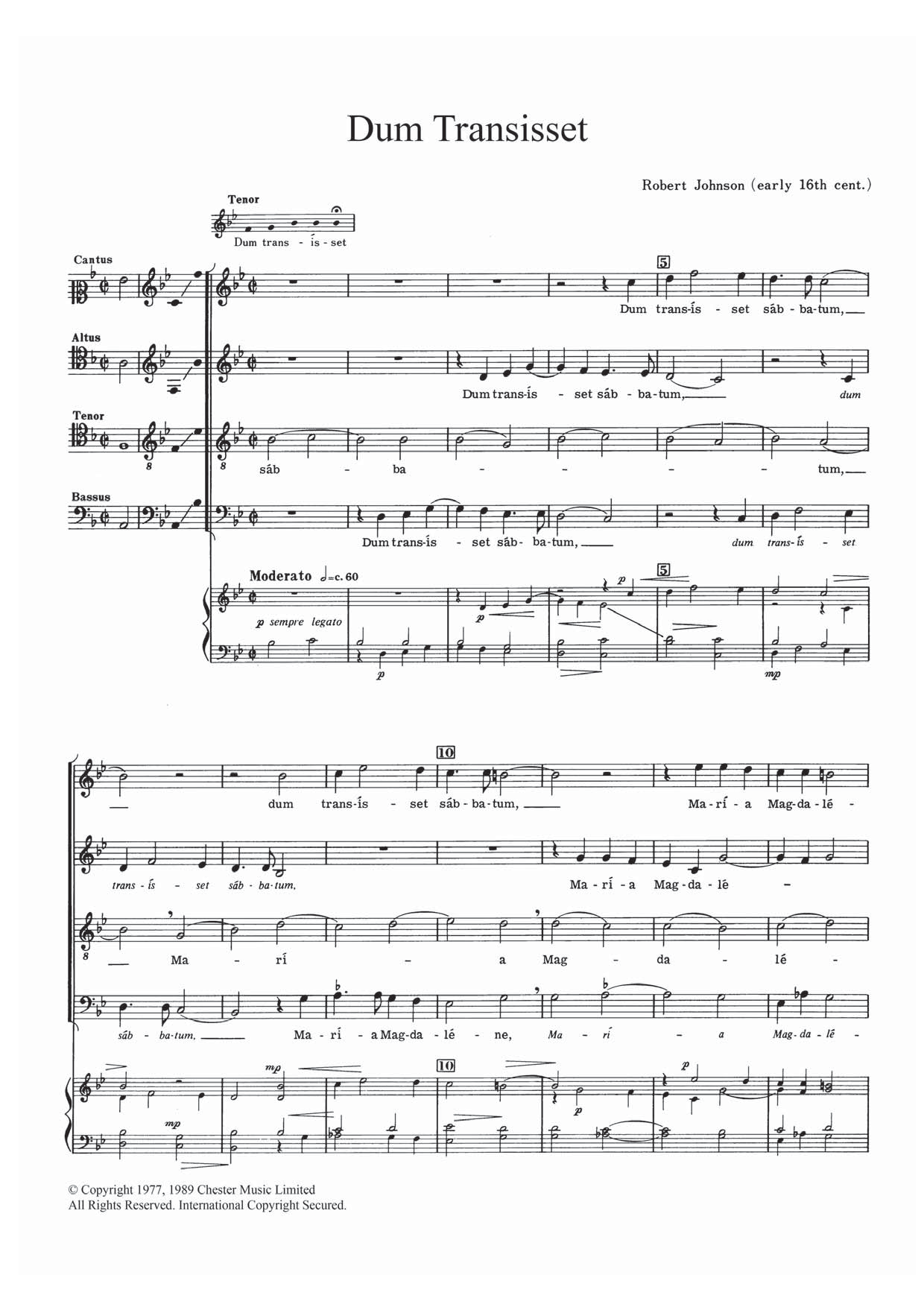
Dum Transisset Sheet Music Preview

Dum Transisset: SATB Choral Octavo

As performed by Robert Johnson (16th Century)

Item: 35-DS00366824

Digital Download
$2.99
Description

Dum Transisset: SATB Choral Octavo isn't in MakeMusic Cloud just yet...but it could be. Let us know you'd like to see it, and you'll help shape what comes next. In the meantime, start a free trial and dive into thousands of interactive titles your students can play along with today.

Sample Audio
No sample audio found.
Sample Video
Additional Details
Publisher: Hal Leonard
Page Count: 4
SKU: 35-DS00366824

More about this title

About the Artist: Robert Johnson (16th Century)

Robert Johnson stands as one of the most prolific English composers of the late 16th century, with a catalog spanning sacred motets, secular vocal works, and instrumental music. His compositional voice bridges the traditions of earlier English polyphony and the emerging cosmopolitan style of the Renaissance, making his work essential to understanding Tudor musical culture.

Johnson's sacred works circulated widely in manuscript and printed sources, establishing him as a trusted voice for both church and private devotional use. His technical command of counterpoint and gift for memorable melodic lines earned him lasting influence among his contemporaries and successors.

Why we love this

This motet sits at the sweet spot between musical substance and rehearsal practicality. The text setting is elegant without being florid, the voice leading rewards careful attention without demanding virtuosic ranges, and the four-part texture allows each singer to hear their own line while contributing to rich harmonic color.

What to expect

Dum Transisset has the contemplative stillness characteristic of Renaissance sacred polyphony, with text painting that feels inevitable rather than showy. The harmonic language moves with gentle inevitability, creating moments of transcendent consonance that reward listeners who sit quietly with the music.

Who it's for

This octavo works beautifully for intermediate to advanced choirs seeking repertoire that connects to Renaissance vocal traditions without overwhelming rehearsal schedules. College choirs, community ensembles, and accomplished high school groups will find both musical satisfaction and pedagogical value here.

How to get the most out of it

  • Shape each phrase by feeling the text's natural emphasis points rather than imposing regular metric stress. Renaissance prosody rewards flexibility.
  • Balance the soprano line without letting it dominate. Johnson's magic happens when all four voices occupy similar acoustic weight.
  • Sing with minimal vibrato and allow space between phrases to breathe. The acoustic clarity of this period's style depends on clean releases and brief silence.
  • Rehearse the alto and tenor parts together early. These inner voices carry crucial harmonic motion and often need isolated attention.

How to use it

Pair this with other Renaissance sacred works for a focused concert segment, or use it as an encore that shifts the room's acoustic and emotional temperature. Its moderate length and accessible performance difficulty make it ideal for including in a mixed repertoire concert without requiring disproportionate rehearsal time.

Skills your students will build

  • Singing independent melodic lines within four-part polyphonic texture
  • Responding to text-driven phrasing rather than metric regularity
  • Balancing individual voice parts to achieve unified ensemble sonority
  • Interpreting Renaissance notation and performance conventions
  • Sustaining accurate intonation across longer phrases with minimal accompaniment

You May Also Like