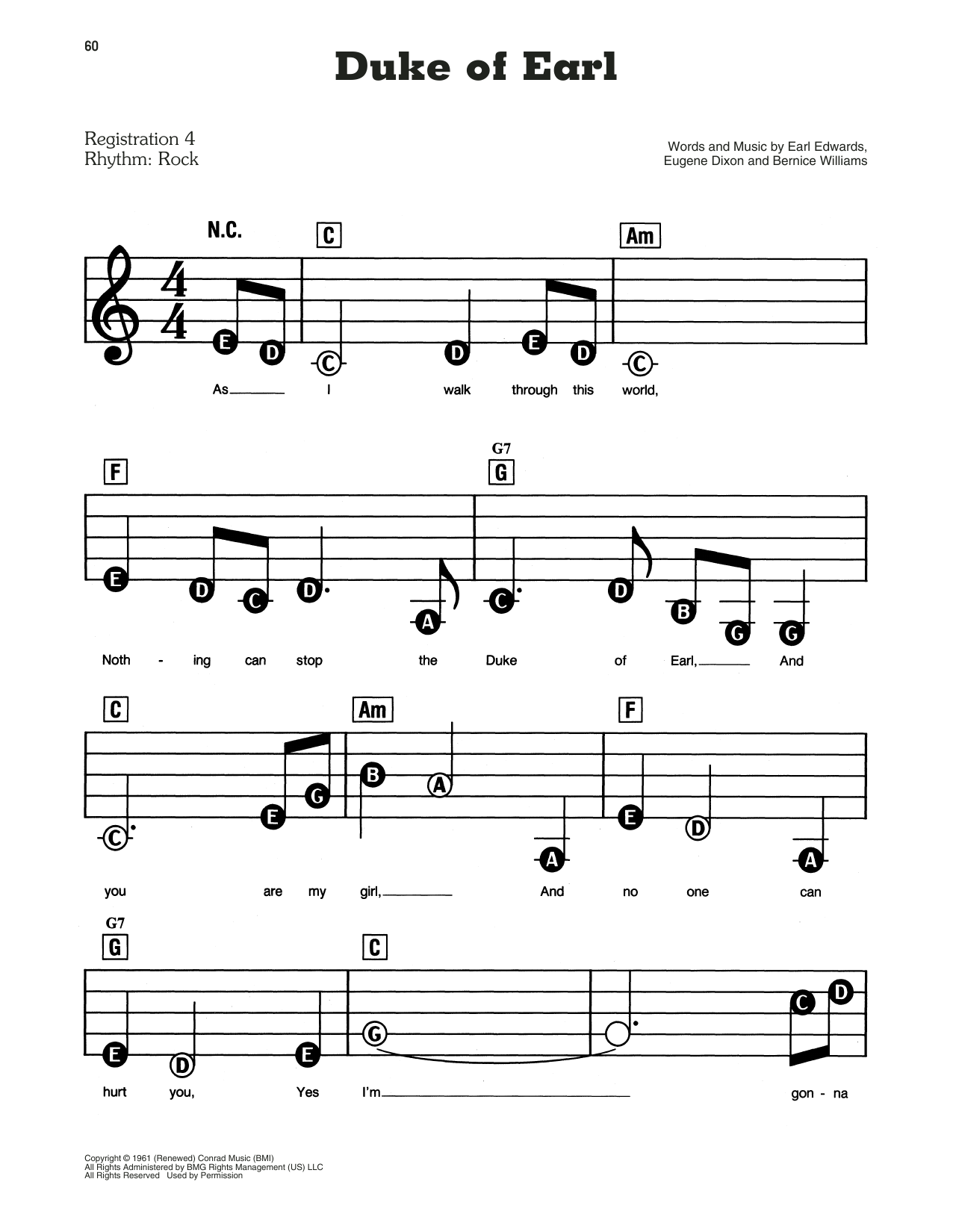
Duke Of Earl Sheet Music Preview

Duke Of Earl: E-Z Play Today

As performed by Gene Chandler

Item: 35-DS00447881

Digital Download
$4.99
Description

Duke Of Earl: E-Z Play Today isn't in MakeMusic Cloud just yet...but it could be. Let us know you'd like to see it, and you'll help shape what comes next. In the meantime, start a free trial and dive into thousands of interactive titles your students can play along with today.

Sample Audio
No sample audio found.
Sample Video
Additional Details
Publisher: Hal Leonard
Page Count: 3
SKU: 35-DS00447881

More about this title

About the Artist: Gene Chandler

Gene Chandler rose to fame in 1962 with "Duke of Earl," a doo-wop influenced pop hit that became one of the era's most recognizable songs. His smooth vocal delivery and the track's infectious groove made it a crossover success, earning substantial radio play across pop and R&B stations. The song remains a staple of 1960s music education and popular culture.

Why we love this

This arrangement captures the joy and infectious energy that made the original such a radio staple, giving pianists an opportunity to explore the song's harmonic simplicity while maintaining its irresistible charm. The E-Z Play format opens the piece to developing pianists who want to play something immediately recognizable and fun, rather than struggling through dense notation.

What to expect

Stepping into a 1960s sock hop with the piano as your entry point. The groove feels playful and unhurried, with enough rhythmic bounce to keep things moving forward while the harmony sits firmly in comfortable, open territory.

Who it's for

This arrangement suits developing pianists drawn to pop and rock standards, particularly those who benefit from simplified notation but want to play a song with real cultural currency. It also works well for teachers seeking accessible material that builds ear and hand coordination through a melody students already know.

How to get the most out of it

  • Lean into the rhythmic swing of the accompaniment pattern; the groove depends on subtle push-and-pull rather than metronomic precision.
  • Keep the melody bright and conversational, as if singing the lyric even without words. This prevents the right hand from sounding mechanical.
  • Balance the left hand so it sits comfortably behind the melody; players often drive the accompaniment too hard and lose the song's lightness.

How to use it

Pair this with other 1960s pop standards in a "Decades in Song" recital, or feature it in a pop music unit that spans decades of influence. It also works as a confident encore that audiences will recognize and enjoy, breaking up a formal concert with something joyful and familiar.

Skills your students will build

  • Reading simplified notation and developing independence from note names
  • Balancing melody and accompaniment in popular song arrangements
  • Internalizing groove and swing feel through repetitive harmonic patterns
  • Managing left-hand rhythmic patterns that support rather than dominate

You May Also Like