
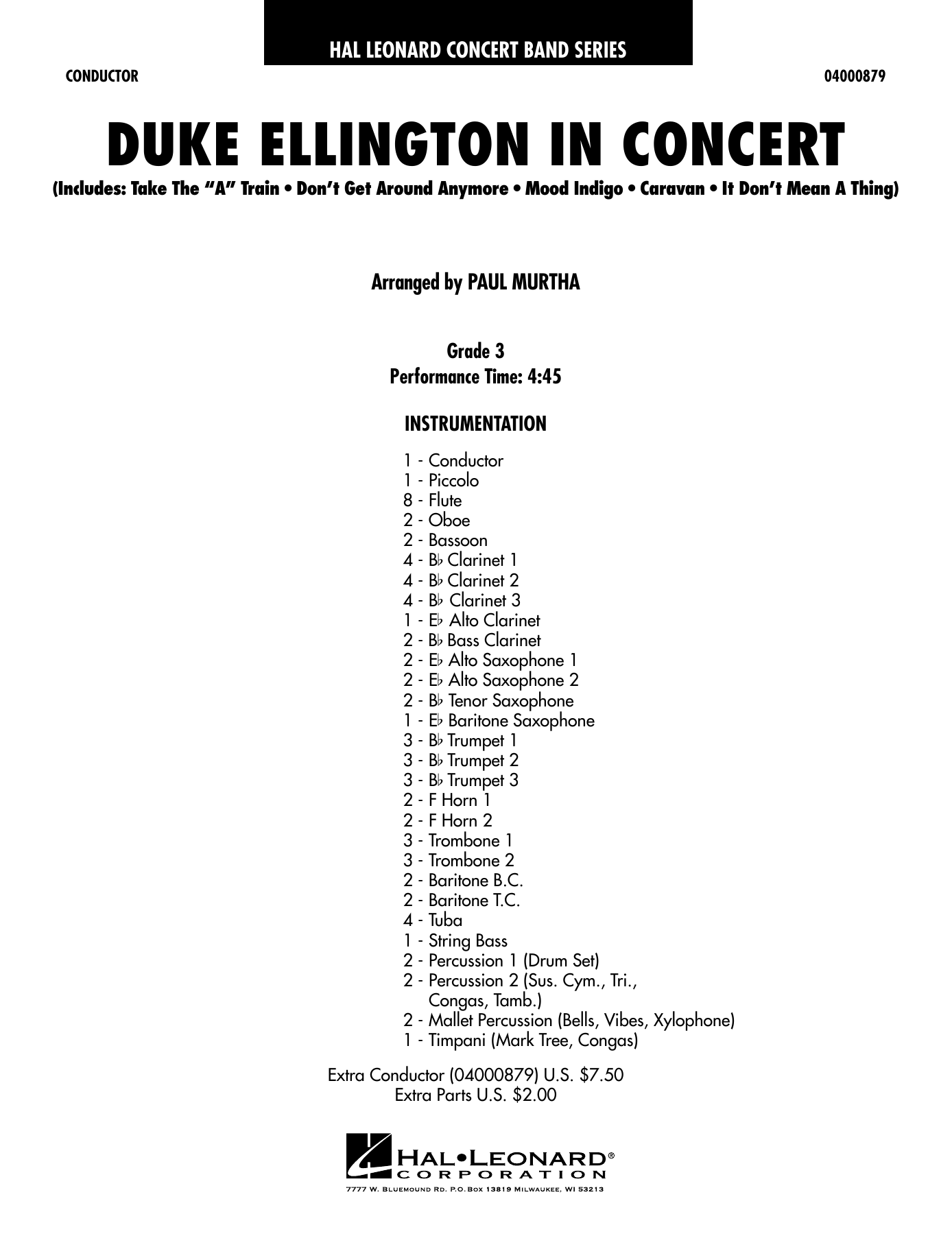

Duke Ellington in Concert: Concert Band Conductor Score & Parts
As performed by Duke Ellington / Arranged by Paul Murtha
Grade: 3
Item: 35-PK01388405
$80.00
Pickup currently not available
Buy Extra Parts (Digital PDF Download)
Parts Added to Cart!
Description
The music of the Duke Ellington Orchestra helped define the role of jazz in America. Here is a swingin' medley for young bands including the memorable titles: Take The "A" Train, Don't Get Around Much Anymore, Caravan, Mood Indigo and It Don't Mean A Thing (If It Ain't Got That Swing).


Discover MakeMusic Cloud: thousands of interactive titles your students can play along with today.
Sample Audio
No sample audio found.
Sample Video
No sample videos found.
Additional Details
Publisher:
Hal Leonard
SKU:
35-PK01388405
More about this title
About the Artist: Duke Ellington
Duke Ellington (1899–1974) was a composer, bandleader, and pianist whose orchestra became one of the most influential ensembles in American music history. His sophisticated harmonies, innovative orchestrations, and prolific output across seven decades established him as a central figure in jazz while earning him respect in classical music circles.
Ellington's approach to composition treated the jazz orchestra as a legitimate concert medium rather than merely a dance band. His works remain essential repertoire for understanding how American music developed, and his melodies have become standards that every musician encounters. For young musicians, his music offers an accessible entry point into jazz vocabulary and the expressive possibilities of the concert band.
Why we love this
Paul Murtha's arrangement captures five signature Ellington moments in a single medley that flows naturally from one theme to the next, giving young ensembles authentic repertoire without sacrificing playability. The Grade 3 level keeps the technical demands manageable while preserving the swing and sophistication that made these compositions endure, and students will recognize these titles immediately once they hear them in performance.
What to expect
Sophisticated yet approachable. The medley moves through moments of intimate elegance (Mood Indigo), driving swagger (Take The A Train), and relaxed grooviness, showcasing Ellington's range within a single performance arc. Students experience the genre's emotional breadth while their audiences enjoy the immediate appeal of melodies that have outlasted their original era.
Who it's for
Grade 3 concert bands and upper middle school ensembles ready to tackle authentic jazz repertoire with harmonic color and rhythmic sophistication. Directors seeking engaging program material that connects students to American musical heritage without requiring specialized jazz training.
How to get the most out of it
- Establish the swing eighth-note feel early in rehearsal by isolating the rhythm section; even young players can sense when the pulse sits behind the beat rather than riding it directly.
- Balance the ensemble so the melody voices project clearly over the harmonic foundation. These melodies are meant to sing, and clarity makes the medley structure obvious to listeners.
- Record a run-through and listen back to hear where transitions between tunes drag or feel rushed. Confident tempo work makes the difference between a collection of songs and a coherent medley.
- Let the soloists own their moments. Whether it's a trumpet line or a saxophone passage, these fragments deserve personality that lifts them above background accompaniment.
How to use it
Schedule this for a concert celebrating American composers or as the centerpiece of a jazz-focused concert set. The medley format works especially well in the middle of a program where it can shift the energy and mood before returning to classical or contemporary works, offering both stylistic variety and a crowd-pleasing moment.
Skills your students will build
- Swing eighth-note interpretation and rhythmic placement
- Jazz articulation and phrasing within a concert band context
- Balancing melody and accompaniment in ensemble texture
- Executing clean sectional transitions within medley structures
- Listening for and responding to harmonic movement in jazz voicings