
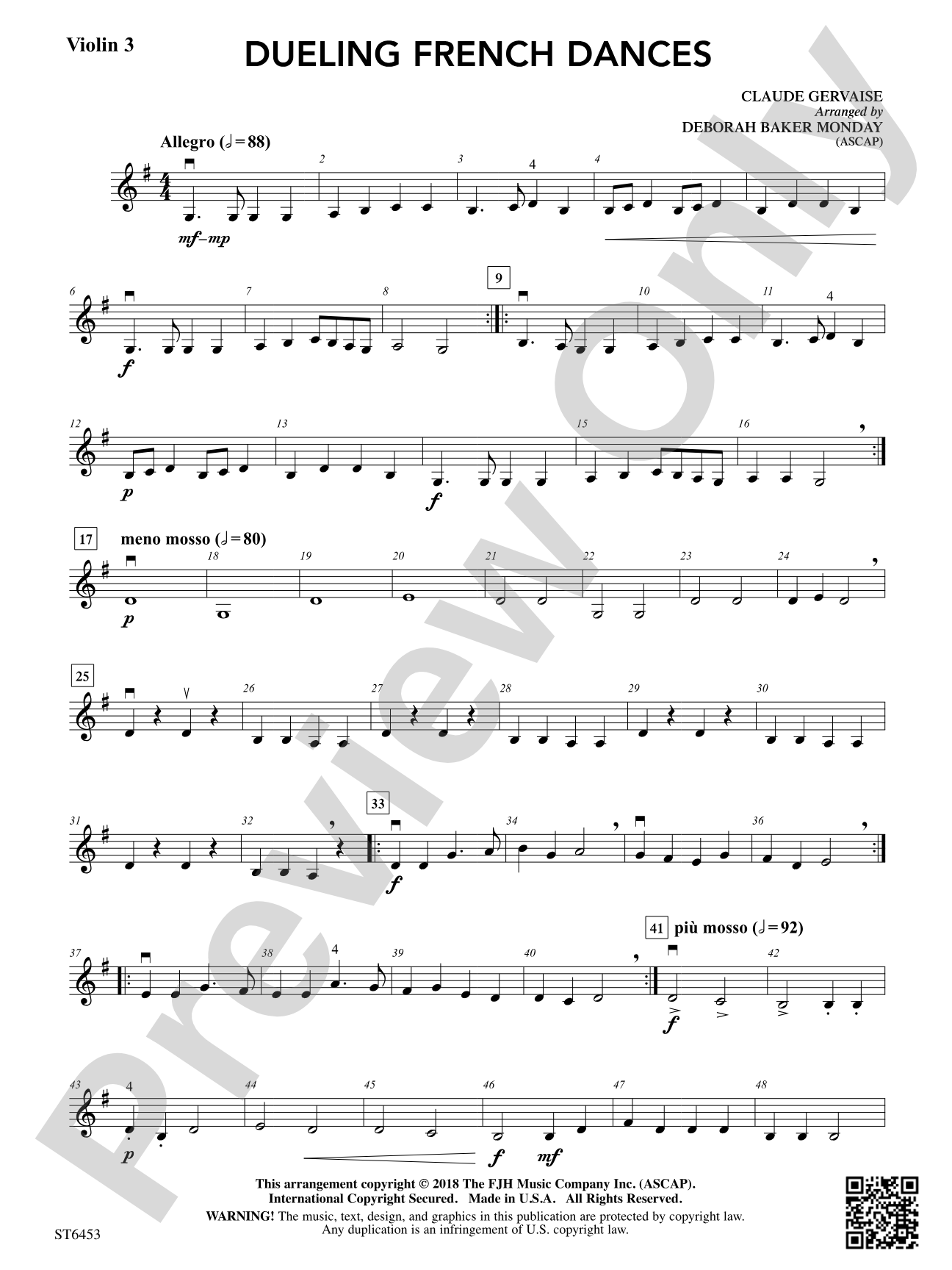

Dueling French Dances: Violin 3 (Viola T.C.)
By Claude Gervais / arr. Deborah Baker Monday
Grade: 2
Item: 98-PC-DST6453_VN3
$7.00
Pickup currently not available
Description
These vibrant and lively French Renaissance dances have a wealth of teaching material and will be a huge hit with your students. In the friendly keys of G and D, the music features simple rhythms and bowings so your students will have a stunning performance. Fantastic music that will complement any concert or festival program.


Dueling French Dances: Violin 3 (Viola T.C.) isn't in MakeMusic Cloud just yet...but it could be. Let us know you'd like to see it, and you'll help shape what comes next. In the meantime, start a free trial and dive into thousands of interactive titles your students can play along with today.
Request This Title
Tell us you want it.
Start Your Free Trial
Explore everything that's ready to play right now.
Sample Audio
1
Audio File
--:--
0:00
0:00
Sample Video
Additional Details
Series:
FJH Developing Strings
Publisher:
The FJH Music Company, Inc.
SKU:
98-PC-DST6453_VN3
More about this title
About the Composer: Claude Gervais
Claude Gervais was a French Renaissance composer whose dance music embodied the courtly elegance and rhythmic vitality of 16th-century French musical life. Though details of his biography remain sparse, his compositions survived in manuscript collections and became foundational examples of the French dance tradition, influencing generations of musicians across Europe.
For music educators, Gervais represents an accessible entry point into Renaissance style. His clear melodic writing and straightforward rhythmic structures make his work ideal for developing orchestras learning to balance historical authenticity with technical accessibility.
Why we love this
Deborah Baker Monday's arrangement captures the rhythmic energy and melodic character of Renaissance France while keeping the technical demands reasonable for developing orchestras. The pairing of two contrasting dances gives your ensemble a chance to explore different moods and textures within a single performance, and the straightforward key centers mean students can focus on ensemble balance and articulation rather than wrestling with complex tonality.
What to expect
Picture a Renaissance fair in sound: spirited and good-natured, with bouncing rhythms that invite your students to dance along even as they sit with their instruments. The melodies have a folk-like quality that feels immediate and warm, and the harmonies are transparent enough that every student can hear their part contributing to the texture.
Who it's for
String orchestras at the Grade 2 level will find these dances accessible without being trivial. This arrangement works equally well for school orchestras preparing for festivals, chamber groups seeking short ensemble pieces, or any director looking for genuine Renaissance repertoire that students actually want to play.
How to get the most out of it
- Shape the phrasing in each dance distinctly. The first and second dances should feel like genuine contrasts, so work with your ensemble to identify the character of each and adjust tempo, dynamics, and articulation accordingly.
- Emphasize the rhythmic clarity through precise bow attacks. Simple rhythms can flatten if students don't commit to clean articulation; use these pieces to strengthen rhythmic definition across the section.
- Balance the melody across your violin sections rather than concentrating it all in the firsts. Many developing orchestras benefit from redistributing lines so that the emotional weight stays collective rather than soloistic.
- Let the middle sections breathe. Even though these dances are lively, resist the urge to rush through quieter moments; a slight relaxation in tempo can make the return to full energy feel more theatrical.
How to use it
These dances make an ideal opening for a spring concert or festival appearance because they establish energy and liveliness without demanding a long warm-up period. You might pair them with a contrasting slower work to showcase your orchestra's range, or use them as an energetic finale to a program built around world music or dance traditions.
Skills your students will build
- Articulation clarity in simple rhythmic figures
- Ensemble balance with shared melodic material
- Bow control and consistency across repeated patterns
- Phrase shaping and structural contrast between two distinct dance forms
- Reading in G and D major with confident intonation