
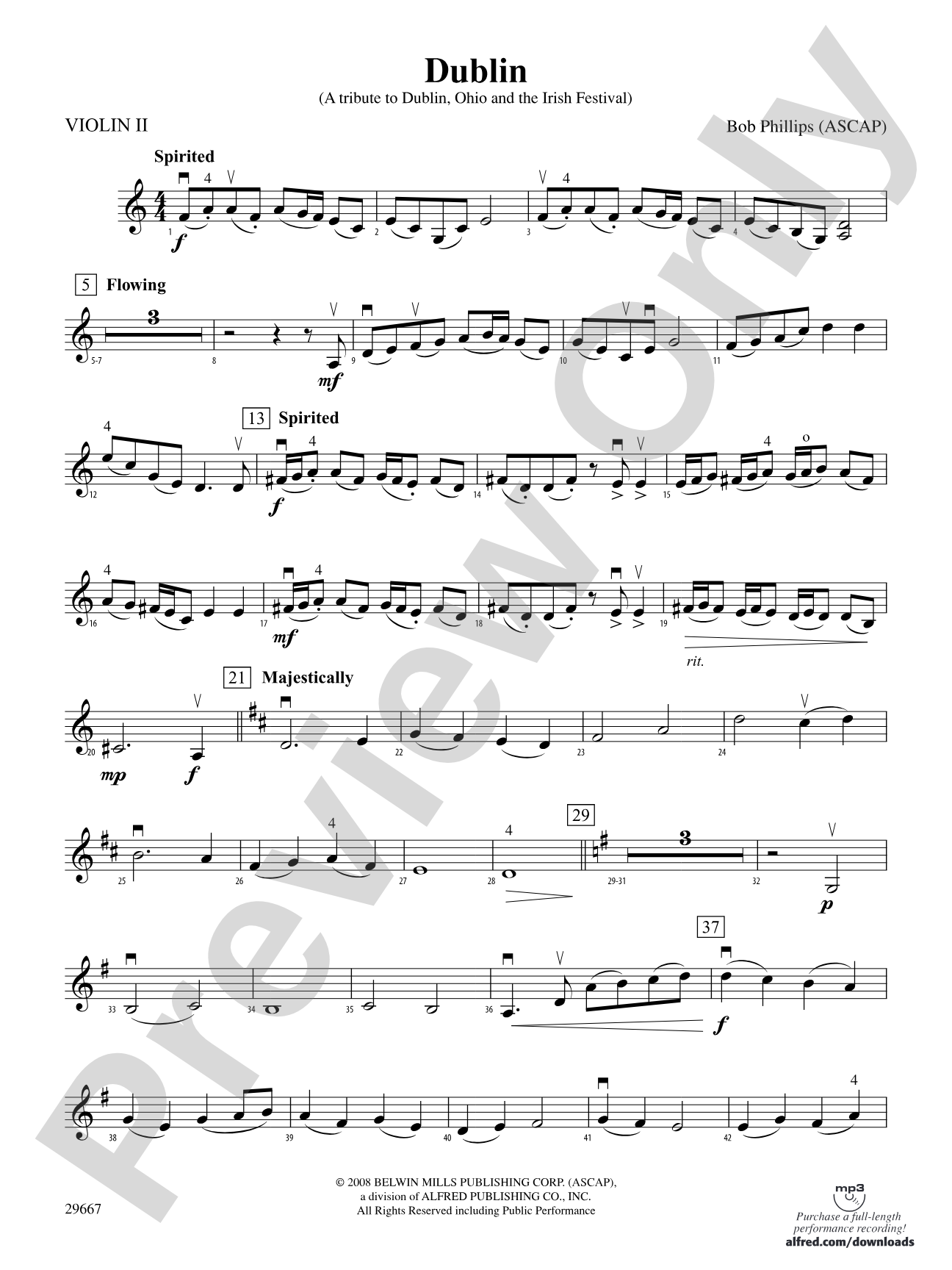

Dublin (A tribute to Dublin, Ohio and the Irish Festival): 2nd Violin
By Bob Phillips
Grade: 3
Item: 00-PC-0001542_VN2
$5.99
Pickup currently not available
Description
Highly rhythmic parts as well as a lush lyric section! Fabulous contrasting styles set the stage for a rhythmic and energetic opening followed by a gorgeous and rich lyric fantasia on the traditional Irish tune The Minstrel Boy. Each section is featured on the melody, building to a high-energy conclusion. Great teaching opportunities, particularly for 3rd position in the first violins and 4th position in the cellos. (3:30) This title is available in MakeMusic Cloud.


Don't just read it, hear it, play along with it, and watch your students grow with it. In MakeMusic Cloud, Dublin (A tribute to Dublin, Ohio and the Irish Festival): 2nd Violin comes alive with professional accompaniment, adjustable tempo, and built-in practice tools that turn solo practice into real progress.
Open in the Player
Jump straight in and assign it today.
Start Your Free Trial
Open this title and explore the full library in minutes.
Sample Audio
1
Audio File
--:--
0:00
0:00
Sample Video
No sample videos found.
Additional Details
Series:
Belwin Intermediate String Orchestra
Publisher:
Alfred Music
Page Count:
144
SKU:
00-PC-0001542_VN2
More about this title
About the Composer: Bob Phillips

Bob Phillips (b. 1953) is a composer, conductor, and string education specialist who has shaped how thousands of young musicians engage with diverse musical styles. Over a 27-year tenure in Saline, Michigan, he built a string program of over 700 students recognized nationally for excellence in both classical and genre-crossing repertoire. His published works exceed 200 titles for orchestras and bands, and he has authored more than 25 instructional series, including Sound Innovations and the genre-expanding Fiddlers Philharmonic, Jazz Philharmonic, Rock Philharmonic, and Mariachi Philharmonic collections.
Phillips is an award-winning ASCAP composer whose pieces are regularly performed at the Midwest Clinic. He founded the Saline Fiddlers Philharmonic, an ensemble that performed internationally and at venues including the White House. His conducting work spans all-state orchestras at Interlochen, Blue Lake Fine Arts Camp, and honors programs across multiple states. He also served as resident conductor and arranger for the Wintergrass Festival in Seattle for 12 years.
Why we love this
Phillips crafts a compositional arc that keeps young orchestras engaged across contrasting musical worlds. The opening rhythm section establishes infectious energy, then the ensemble settles into a rich exploration of The Minstrel Boy, giving every section its moment on the melody and building genuine satisfaction. The pedagogical scaffolding around third position and fourth position work means students are solving real technical challenges while performing something genuinely musical.
What to expect
An energetic Irish celebration unfolds into something genuinely tender, then surges back with even greater vitality. The piece captures both the exuberance of a folk festival and the quiet beauty of a traditional melody, creating moments where the whole orchestra feels like it's breathing together.
Who it's for
Grade 3 orchestras ready to command both rhythmic precision and sustained lyricism in a single piece. This work rewards ensembles with solid intonation habits and players comfortable navigating extended positions, particularly first violins and cellists developing facility above first position.
How to get the most out of it
- Secure the rhythmic foundation in the opening section before adding lyric color; clarity in the rhythm section makes the contrast with the fantasia section land with more impact.
- Give the first violins time to acclimate to third position passages before concert week; Phillips writes idiomatically for that shift, and comfort there unlocks the melodic shape.
- Shape the Minstrel Boy section with attention to the harmonic movement supporting each section's solo; cello players especially benefit from understanding how their fourth position work anchors the harmonic changes.
- Balance the high-energy conclusion by maintaining separation between rhythmic layers rather than simply playing louder; the contrast between ostinato figures and the soaring melody creates the real excitement.
How to use it
Program this as a festival or concert opener to establish immediate ensemble energy, or slot it later in a concert to showcase your orchestra's range of styles and technical maturity. Its length (3:30) makes it an ideal complement to a longer classical work or a suite of contrasting pieces.
Skills your students will build
- Reading and executing third position in first violins
- Reading and executing fourth position in cellos
- Maintaining rhythmic precision in syncopated, Irish-influenced figures
- Sustaining lyric tone quality while moving through multiple positions
- Ensemble balance when multiple sections share the melody
- Contrast and style shift between rhythmic and lyric musical material