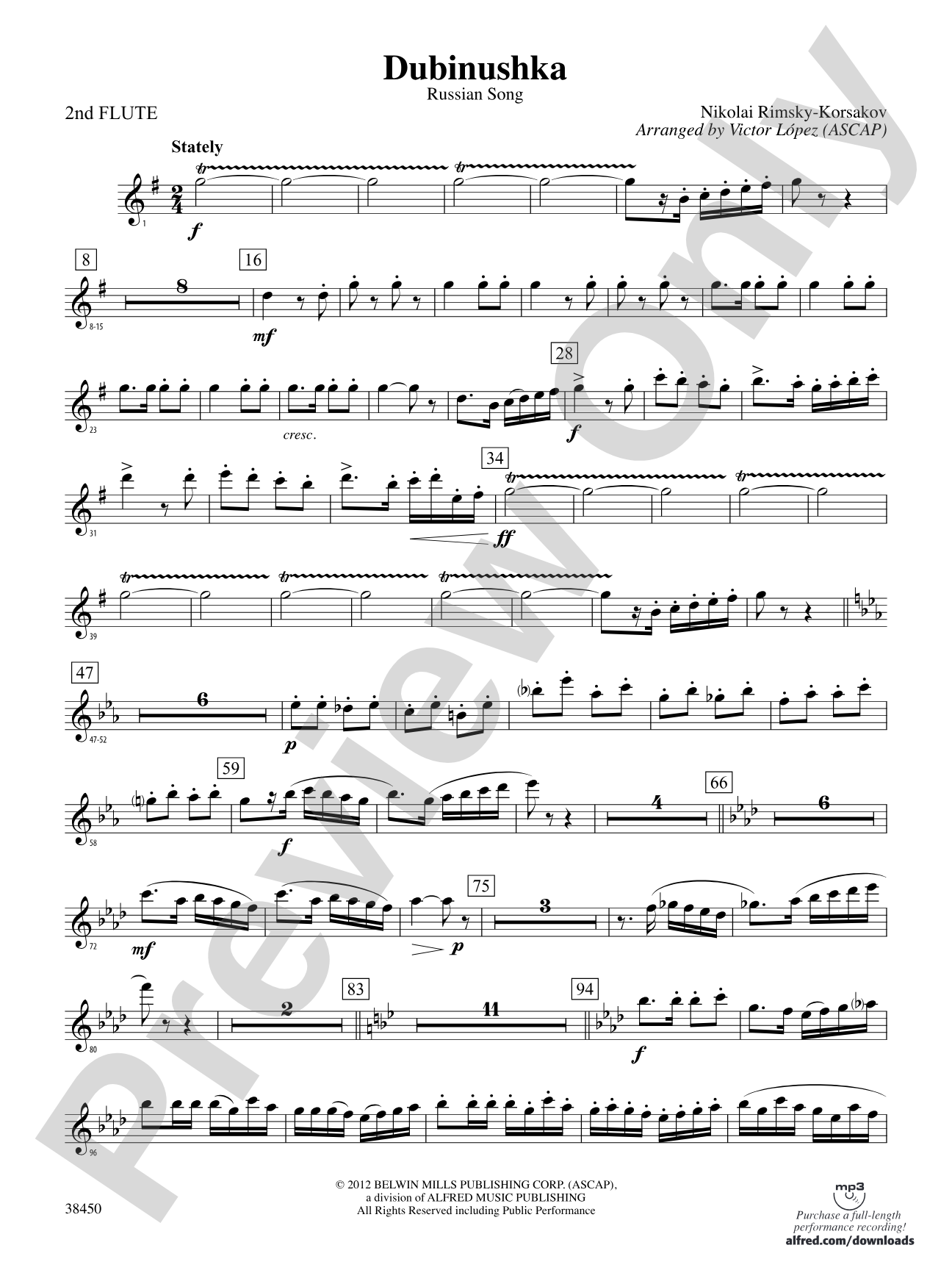
Dubinushka: 2nd Flute Sheet Music Preview

Dubinushka: 2nd Flute

Russian Song

By Nikolai Rimsky-Korsakov / arr. Victor López

Grade: 4

Item: 00-PC-0015506_F2

Digital Download
$3.00
Description
A full orchestra transcription of this brilliant Russian tone poem that features a new introduction and simplifications, yet maintains the feel of the original. Perfect for contest or festival!

Don't just read it, hear it, play along with it, and watch your students grow with it. In MakeMusic Cloud, Dubinushka: 2nd Flute comes alive with professional accompaniment, adjustable tempo, and built-in practice tools that turn solo practice into real progress.

Sample Audio
0:00
0:00
Sample Video
Additional Details
Series: Belwin Concert Full Orchestra
Publisher: Alfred Music
Page Count: 232
SKU: 00-PC-0015506_F2

More about this title

About the Composer: Nikolai Rimsky-Korsakov

Nikolai Rimsky-Korsakov (1844-1908) was a Russian composer and orchestrator whose command of instrumental color shaped the sound of late 19th-century music. A member of the nationalist Russian Five, he drew deeply from folk traditions while mastering the orchestra with a precision that influenced generations of composers. His gift for orchestration remains a cornerstone of music education, offering students an unmatched model of how instruments combine to create vivid, shifting landscapes of sound.

Beyond his concert works, Rimsky-Korsakov served as a conductor, teacher, and mentor to younger Russian composers. His willingness to revise and refine his own scores reflected a belief that music should evolve with each performance context, a philosophy that makes arrangements of his work particularly valuable in educational settings.

Why we love this

Victor López's transcription captures the rhythmic vitality and orchestral color of the original while reshaping it for a school orchestra context. The new introduction draws your ensemble in immediately, and the strategic simplifications keep the Rimsky-Korsakov magic intact without overwhelming developing musicians. You get a genuine masterwork that sounds complete and professional, not a watered-down approximation.

What to expect

Dubinushka radiates the energy and spirit of Russian folk celebration. Buoyant melodies unfold over rhythmic, almost dance-like accompaniment, and the orchestration sparkles with the kind of colorful detail that makes Rimsky-Korsakov instantly recognizable. There's a sense of inevitability to its momentum; once it begins, it carries you forward.

Who it's for

Intermediate-to-advanced full orchestras ready to tackle a piece with orchestral sophistication and authentic cultural character. Your ensemble needs secure rhythmic players, especially in strings and winds, but the adaptive orchestration means no section is buried beyond recovery.

How to get the most out of it

  • Balance the folk melody against the supporting orchestration; the tune should sing even when surrounded by busy figuration. Resist overplaying the rhythmic accompaniment.
  • Lock in the meter with your brass section during the energetic passages. Rimsky-Korsakov's syncopations can feel slippery if the foundation wavers.
  • Use the woodwind color changes to build momentum through the form. Each orchestration shift signals a structural point; bring students' attention to how the same musical idea transforms.
  • Bring out the Russian character through articulation and phrasing rather than tempo extremes. Crisp rhythmic definition and legit singing lines will do the heavy lifting.

How to use it

Program this as a concert centerpiece or as a confident contest selection. It pairs well with other Romantic-era masterworks and gives your orchestra a showstopper that demonstrates both musical maturity and orchestral control. The clear structure and accessible energy make it ideal for a spring concert or festival where you want impact without excessive preparation time.

Skills your students will build

  • Reading exposed orchestral lines and balancing independent parts
  • Responding to conductor gesture through rhythmically complex figures
  • Understanding orchestration as a compositional tool, not mere instrumentation
  • Sustaining ensemble focus through multi-section forms with recurring themes
  • Executing articulation and phrasing that convey cultural and stylistic authenticity

You May Also Like