
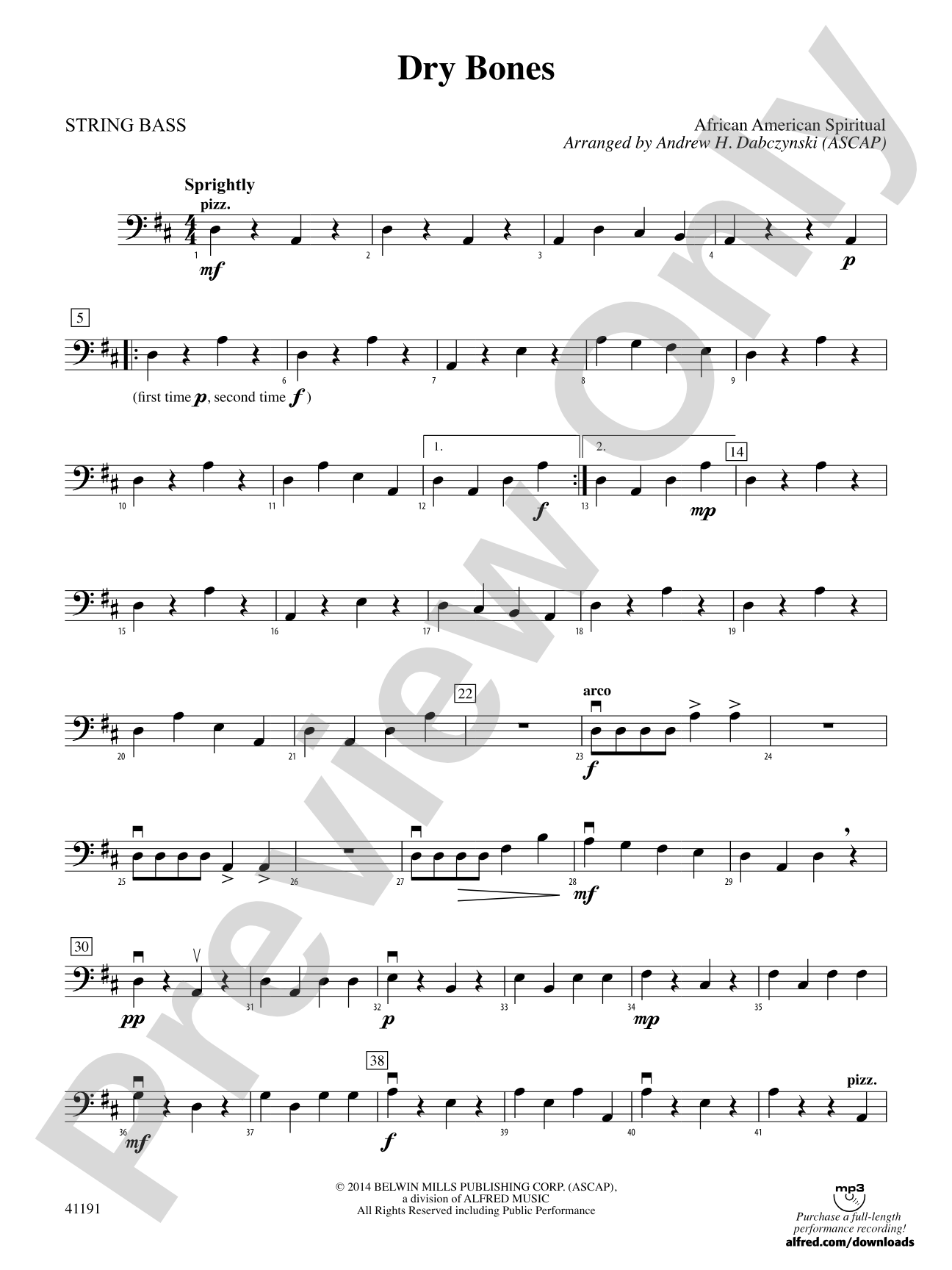

Dry Bones: String Bass
African American Spiritual / arr. Andrew H. Dabczynski
Grade: 1.5
Item: 00-PC-0016319_SB
$7.99
Pickup currently not available
Description
Each student has a chance to play the melody with their "finger-bones connected to their . . . hand bones," in this bone-rattling arrangement of a well-known spiritual. Perfect for Halloween or any time of year, simple optional percussion provides the crazy sounds of the bones. (3:00) This title is available in MakeMusic Cloud.


Don't just read it, hear it, play along with it, and watch your students grow with it. In MakeMusic Cloud, Dry Bones: String Bass comes alive with professional accompaniment, adjustable tempo, and built-in practice tools that turn solo practice into real progress.
Open in the Player
Jump straight in and assign it today.
Start Your Free Trial
Open this title and explore the full library in minutes.
Sample Audio
1
Audio File
--:--
0:00
0:00
Sample Video
No sample videos found.
Additional Details
Series:
Belwin Beginning String Orchestra
Publisher:
Alfred Music
Page Count:
160
SKU:
00-PC-0016319_SB
More about this title
About the Arranger: Andrew H. Dabczynski

Andrew H. Dabczynski served as Emeritus Professor of Music Education at Brigham Young University, where he founded and directed the "New Horizons Orchestra," a beginning string ensemble for adult learners that also functioned as a training laboratory for string teachers. His contributions to music education earned him BYU's Joseph E. White Fellowship for Teaching and Learning, and Utah ASTA recognized him as "Higher Education Teacher of the Year" in 2005 and again in 2014 for his outstanding contributions to the field.
Throughout his career, Dabczynski held teaching and leadership roles at the Eastman School of Music and in public school districts across New York and Michigan, while maintaining an active performance schedule as a violist with regional orchestras and the Colden String Quartet. His expertise in string pedagogy is evident in the String Explorer method series, which he co-authored, and his scholarly interests in folk music and traditional music transmission have shaped his approach to accessible, culturally grounded arrangements for young musicians.
Why we love this
Dabczynski's arrangement gives every string player a moment at the melody, rotating the spotlight across the section to keep engagement high and nerves low. The optional percussion parts transform what could be a straightforward spiritual into theater, turning practice into play while keeping the Grade 1.5 difficulty genuinely accessible.
What to expect
Playful and infectious. The melody walks a familiar path, giving young musicians a sense of mastery, while the rattling bones create a slightly spooky, entirely joyful atmosphere. There is humor here without condescension, and tradition without stuffiness.
Who it's for
String orchestra directors working with beginning ensembles who want to program something with immediate appeal and a genuine pedagogical payoff. Students thrive when they see themselves as performers of real music rather than exercises, and this spiritual gives them exactly that.
How to get the most out of it
- Establish the rhythm of the bone rattle pattern with your percussionists first; their steady click provides the rhythmic anchor that makes the string parts sit securely.
- Rotate melody soloists strategically through rehearsal rather than assigning them all at once, so each player gets comfortable with their entrance and the group learns to support individual players.
- Balance the optional percussion so it enhances rather than overshadows the string texture; these sounds should feel like a natural part of the arrangement, not a gimmick added on top.
- Use the three-minute duration as a rehearsal planning tool: this piece moves at a conversational pace that allows young players to breathe, phrase, and recover between sections without feeling rushed.
How to use it
Perfect for a fall concert, especially if you're building a Halloween program or a theme around cultural traditions and spirituals. It also works beautifully as an opener or lighter program piece in a winter concert, offering relief between weightier selections while maintaining musical substance.
Skills your students will build
- Playing sustained melodic lines with focus on tone production
- Rotating melody passages across multiple string parts and players
- Coordinating rhythmic accuracy with optional percussion accompaniment
- Phrasing in the call-and-response style characteristic of spiritual traditions
- Managing balanced ensemble sound when different sections share responsibility for the main tune