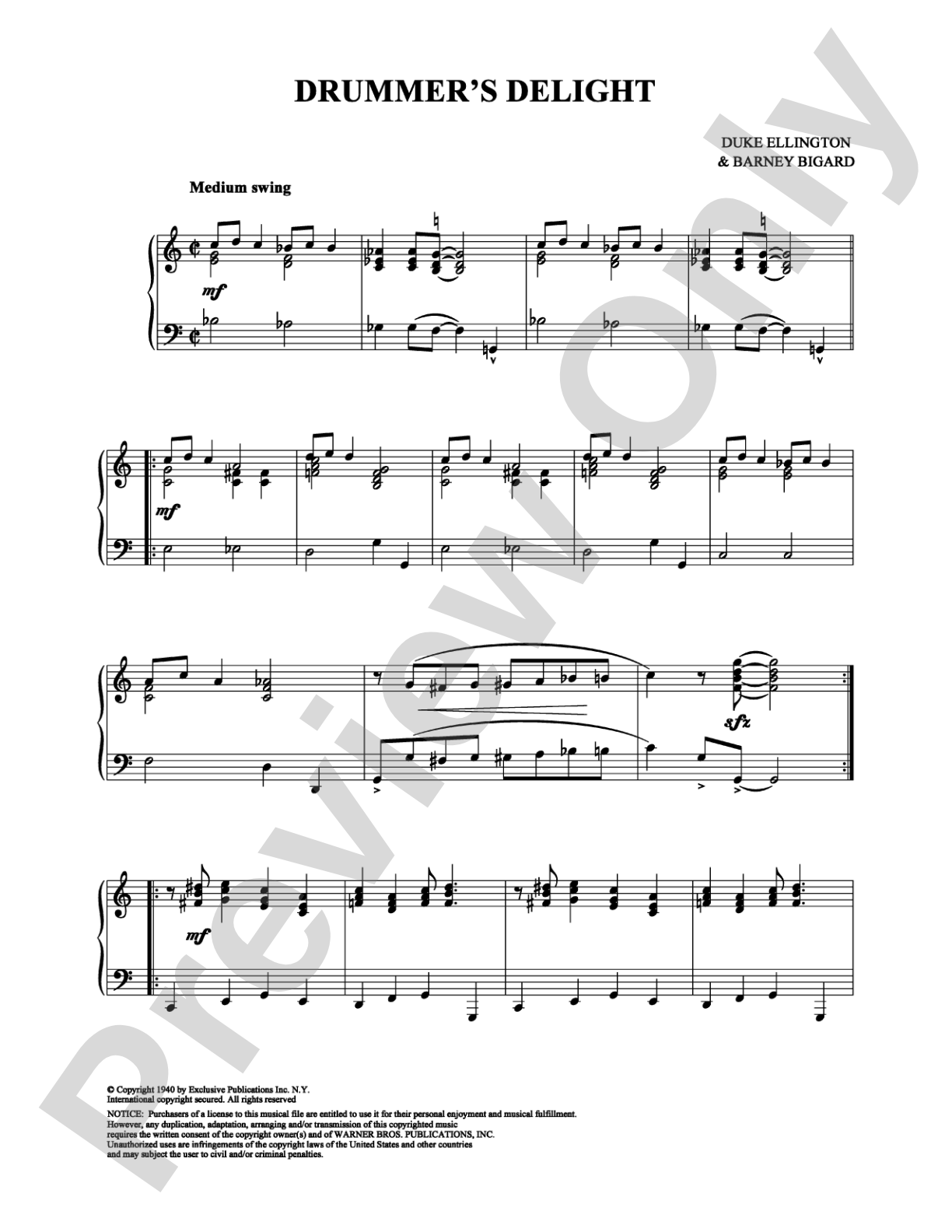
Drummer's Delight: Piano Digital Sheet Music

Drummer's Delight: Piano Digital Sheet Music

Duke Ellington, Barney Bigard

Item: 00-PS-0008206

Digital Download
$3.99
Description

Drummer's Delight: Piano Digital Sheet Music isn't in MakeMusic Cloud just yet...but it could be. Let us know you'd like to see it, and you'll help shape what comes next. In the meantime, start a free trial and dive into thousands of interactive titles your students can play along with today.

Sample Audio
No sample audio found.
Sample Video
Additional Details
SKU: 00-PS-0008206

More about this title

About the Artist: Duke Ellington

Duke Ellington (1899-1974) shaped American jazz and popular music across five decades, composing over one thousand works that ranged from three-minute standards to extended orchestral suites. His sophisticated harmonic language, innovative orchestration, and prolific output earned him recognition as one of the most significant composers of the 20th century, and his music remains central to jazz education and performance.

Why we love this

Ellington's compositions reward pianists with sophisticated voicings and rhythmic elasticity that demand both technical control and interpretive maturity. This piece showcases the kind of playful swing sensibility that makes Ellington's catalog essential for jazz piano study, offering students a direct connection to one of jazz's foundational voices.

What to expect

Drummer's Delight pulses with the understated humor and rhythmic swagger characteristic of Ellington's output. The piece swings with infectious buoyancy, balancing clever harmonic turns against straightforward melodic phrases that lodge themselves in memory.

Who it's for

Jazz pianists exploring the standard repertoire and students building facility with Ellington's harmonic language and swing idiom. Teachers seeking repertoire that illustrates how compositional sophistication and accessibility coexist in classic jazz writing.

How to get the most out of it

  • Shape the melody with subtle dynamic shifts rather than dramatic swells; Ellington's writing favors nuance over force, and restraint often lands the jokes more effectively.
  • Commit fully to the swing feel without forcing it; let the eighth-note triplet subdivision sit naturally in your hands rather than imposing it mechanically.
  • Experiment with comping textures and rhythmic displacement in sections marked for accompaniment, allowing space for the inherent wit in Ellington's harmony.

How to use it

Feature this in a jazz standards concert or recital celebrating Ellington's compositional range, or pair it with other short Ellington pieces to highlight his gift for memorable, unpretentious swing. It also serves as an excellent example of how to interpret a jazz standard at an intermediate-to-advanced level.

Skills your students will build

  • Swing eighth-note phrasing and the rhythmic elasticity that distinguishes jazz from classical interpretation
  • Reading and voicing jazz chords with harmonic sophistication appropriate to Ellington's style
  • Balancing written melody against improvised or liberated comping in the accompaniment
  • Maintaining forward momentum through harmonic movement without losing clarity

You May Also Like