Drop Me Off in Harlem: Piano Digital Sheet Music

Drop Me Off in Harlem: Piano Digital Sheet Music

Duke Ellington

Item: 00-PS-0009848

Digital Download
$3.99
Description

Drop Me Off in Harlem: Piano Digital Sheet Music isn't in MakeMusic Cloud just yet...but it could be. Let us know you'd like to see it, and you'll help shape what comes next. In the meantime, start a free trial and dive into thousands of interactive titles your students can play along with today.

Sample Audio
No sample audio found.
Sample Video
Additional Details
SKU: 00-PS-0009848

More about this title

About the Artist: Duke Ellington

Duke Ellington (1899, 1974) stands as one of the most prolific and influential composers in American music history. His work spanned from stride piano and dance band arrangements through extended concert works, all marked by sophisticated harmonic language, rich orchestration, and an unmistakable ear for melody. Ellington's legacy in music education extends far beyond jazz; his compositions have become standard texts for understanding twentieth-century harmony, form, and the possibilities of instrumental color.

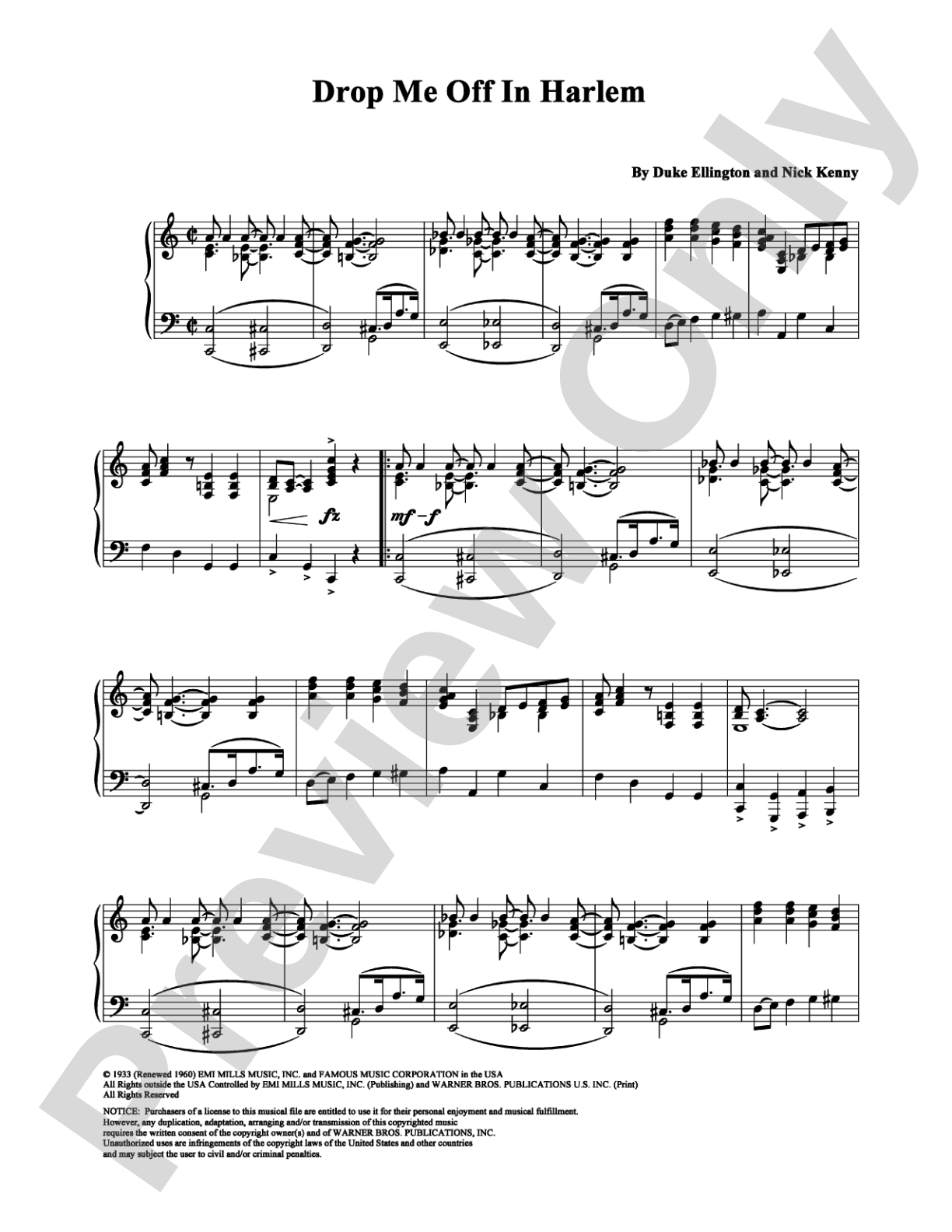
As a pianist, Ellington was himself a master of the instrument, and his compositions for solo piano reveal the depths of his harmonic thinking and rhythmic sophistication. "Drop Me Off in Harlem" exemplifies his gift for writing memorable themes that swing effortlessly while maintaining compositional integrity.

Why we love this

Ellington's compositions sit at the sweet spot between teachable and musically substantial. This piece gives piano students a genuine jazz standard with authentic harmonic movement and melodic grace, not a watered-down approximation. The melody itself is memorable enough to sing, yet the underlying changes reward careful listening and eventual improvisation.

What to expect

The piece evokes the sophisticated, urbane energy of 1940s Harlem nightlife without resorting to pastiche. Ellington's melody flows with natural ease, while the harmonies shift beneath it in ways that feel both inevitable and surprising. The overall mood is elegant and assured, with rhythmic bounce that propels the line forward.

Who it's for

Jazz pianists at the intermediate level and beyond will find genuine musical substance here. Advanced classical pianists exploring jazz idiom will appreciate the sophisticated harmonic language and the opportunity to apply their technical foundation to authentic standards literature.

How to get the most out of it

  • Shape the melody with the same attention to phrasing you'd bring to a Romantic-era piano sonata; Ellington's melodies are deceptively sophisticated in their contour and breathing.
  • Listen closely to the harmonic movement beneath the surface. Understanding the chord changes from the start will unlock expressive possibilities in dynamics and touch as you develop interpretations.
  • Use the stride or walking bass patterns if they're notated in your edition; these figures are part of the piece's rhythmic DNA and shouldn't be treated as optional accompaniment texture.
  • Record yourself and compare your interpretation to recordings by pianists like Bill Evans or Oscar Peterson to hear how different artists voice the same harmony and approach the swing feel.

How to use it

Pair this with other Ellington compositions or jazz standards in a recital focused on American songwriting across genres, creating a bridge between classical and jazz repertoire. It also serves as a cornerstone piece in a jazz piano unit where students are learning to internalize and eventually improvise on authentic standards.

Skills your students will build

  • Reading swing rhythms and jazz notation conventions
  • Understanding chord changes and functional harmony in a jazz context
  • Interpreting melody with phrasing and rubato appropriate to the jazz idiom
  • Recognizing and performing stride piano or walking bass patterns if present in the score

You May Also Like