
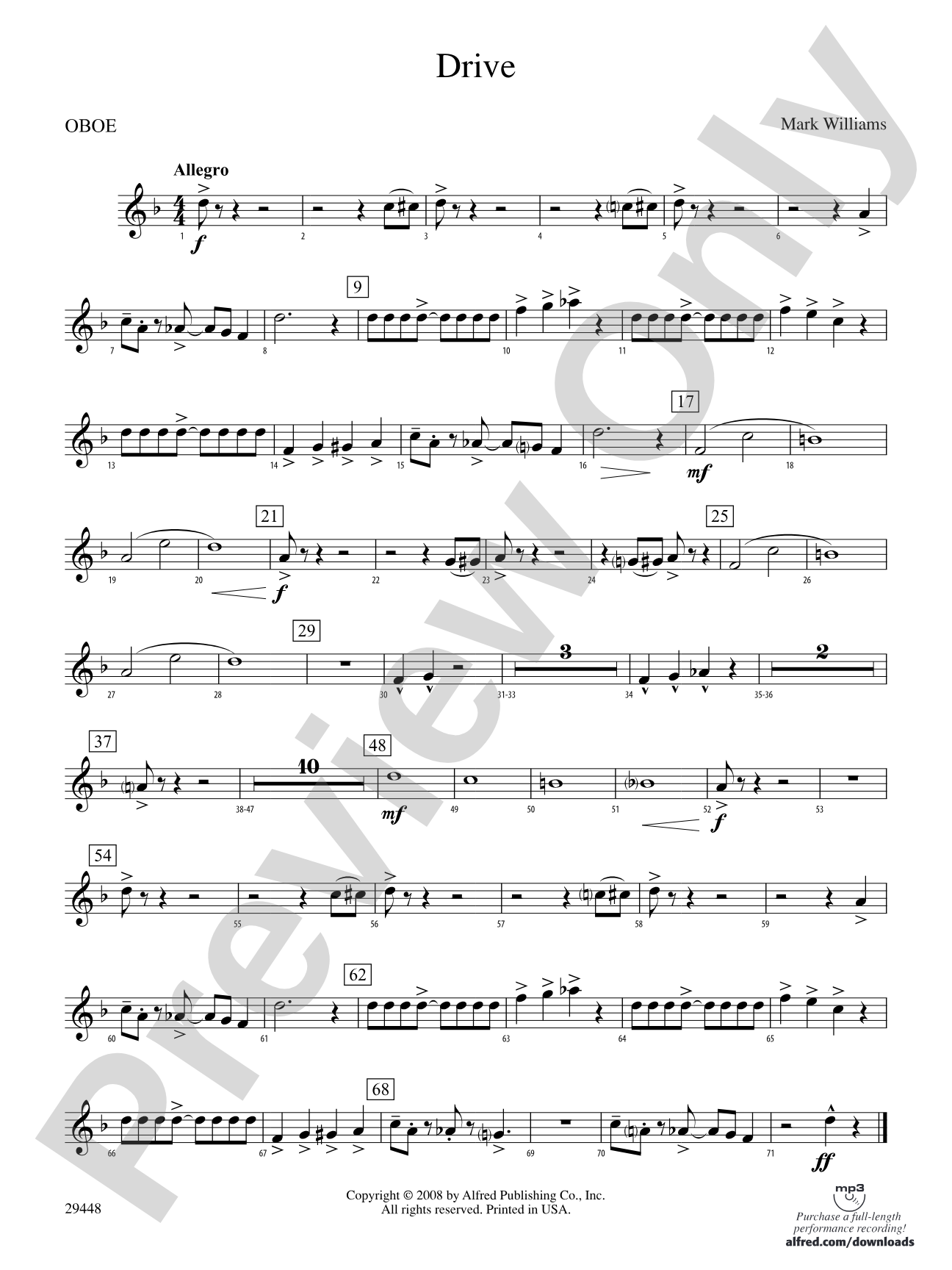

Drive: Oboe
By Mark Williams
Grade: 1.5 (Easy)
Item: 00-PC-0001405_O1
$3.00
Pickup currently not available
Description
The title says it all! Whether you're imagining the rhythmic energy that motivates this piece, or perhaps a trip in your car at high speeds, this blues-influenced piece just screams with excitement! Your students will love the powerful sounds and feelings of forward motion created by the music. Repeated ostinato patterns and "power-chord" open fifths contribute to the unique strength of this must-have addition to the young band repertoire. (2:00) This title is available in MakeMusic Cloud.


Don't just read it, hear it, play along with it, and watch your students grow with it. In MakeMusic Cloud, Drive: Oboe comes alive with professional accompaniment, adjustable tempo, and built-in practice tools that turn solo practice into real progress.
Open in the Player
Jump straight in and assign it today.
Start Your Free Trial
Open this title and explore the full library in minutes.
Sample Audio
1
Audio File
--:--
0:00
0:00
Sample Video
No sample videos found.
Additional Details
Series:
Challenger Band Series
Publisher:
Alfred Music
Page Count:
122
SKU:
00-PC-0001405_O1
More about this title
About the Composer: Mark Williams

Mark Williams built a prolific career writing for young musicians across North America and beyond. His output exceeded 200 published compositions for band, orchestra, and choir, and his work as clinician and guest conductor took him to 34 states, five Canadian provinces, and Australia. A Chicago native who spent his formative years in Spokane, Washington, Williams earned degrees from Eastern Washington University and brought deep pedagogical insight to everything he wrote.
Williams' contributions to music education extended beyond composition. He co-authored the Accent on Achievement Band Method, taught elementary band in Washington schools for many years, and served as woodwind performer and arranger for the 560th Air Force Band. His achievements earned recognition including the Western International Band Clinic's Gralia Competition and multiple ASCAP Special Awards. Outside the classroom and concert hall, he performed regularly on bassoon and directed the Spokane British Brass Band.
Why we love this
Williams understood what motivates young band students: concrete musical imagery paired with technically accessible writing that still sounds powerful and professional. The relentless ostinato patterns and open-fifth harmonies create an immediate sense of propulsion without requiring advanced technical facility, making this an excellent choice for building ensemble cohesion and confidence in Grade 1.5 ensembles.
What to expect
Kinetic and purposeful. Repetitive figures build momentum while open fifths and power chords create a muscular harmonic backdrop that feels both modern and grounded in blues tradition. The two-minute duration sustains interest without fatigue, keeping the energy crackling from downbeat to final chord.
Who it's for
Young concert bands at the Grade 1 to Grade 2 level who need repertoire that sounds impressive without overwhelming developing musicians. Students thrive on pieces with visual or narrative hooks, and this blues-influenced work with its "driving" concept gives them something tangible to connect to.
How to get the most out of it
- Anchor the repeated ostinato patterns with your rhythm section and bass voices; this foundation lets the rest of the band lock in confidently. Have them practice as a unit before adding upper voices.
- Shape the piece through dynamic contrast rather than tempo changes. The "power-chord" sonorities benefit from hitting the strong beats with clarity while letting shorter figures breathe between them.
- Encourage students to feel the forward motion conceptually. Ask them to imagine the energy they're describing musically, and that internal sense of direction will naturally translate to phrasing and articulation.
How to use it
Program this in a concert celebrating contemporary American concert band music, or pair it with other short, energetic works to create a high-impact opening section. Its novelty appeal and accessible difficulty make it an excellent fit for festivals and contests where younger ensembles want to make a musical statement.
Skills your students will build
- Ensemble rhythmic precision through repeated ostinato figures
- Balance and blend within homophonic, chord-based textures
- Sustaining tone quality and intonation in power-chord sonorities
- Shaping phrasing and articulation to create momentum