
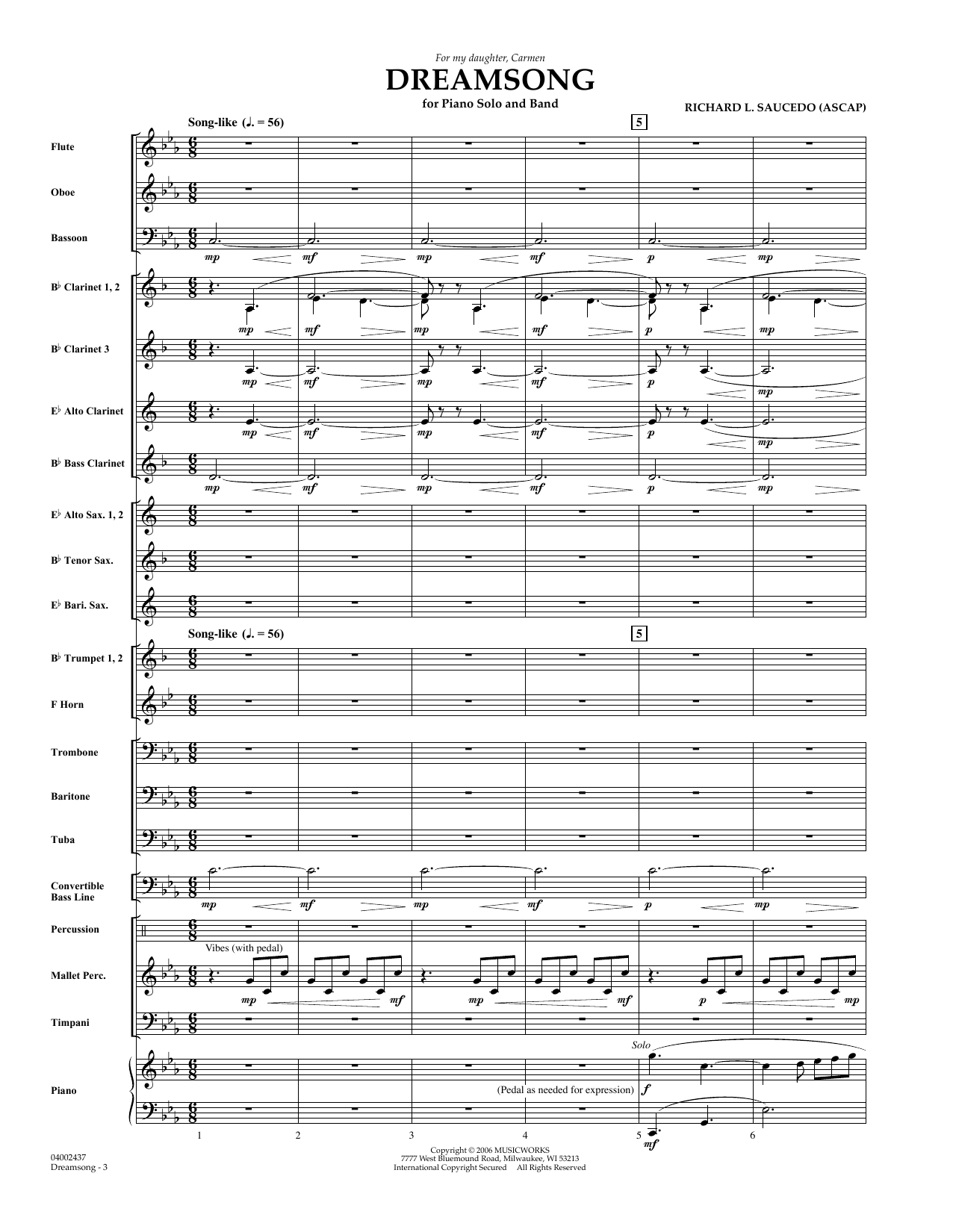

Dreamsong (Piano Feature With Band): Concert Band Conductor Score & Parts
By Richard Saucedo
Grade: 2
Item: 35-PK00320906
$65.00
Pickup currently not available
Buy Extra Parts (Digital PDF Download)
Parts Added to Cart!
Description
Here is a special composition that serves a very special purpose for young band programs an opportunity to feature a piano soloist with concert band. The piano part itself is lyrical and not technically demanding. The band parts are easy to learn and lend support for the soloist in addition to sharing in the melody at times. A wonderful change of pace for your next concert.
Dur: 3:00


Dreamsong (Piano Feature With Band): Concert Band Conductor Score & Parts isn't in MakeMusic Cloud just yet...but it could be. Let us know you'd like to see it, and you'll help shape what comes next. In the meantime, start a free trial and dive into thousands of interactive titles your students can play along with today.
Request This Title
Tell us you want it.
Start Your Free Trial
Explore everything that's ready to play right now.
Sample Audio
No sample audio found.
Sample Video
No sample videos found.
Additional Details
Publisher:
Hal Leonard
SKU:
35-PK00320906
More about this title
About the Composer: Richard Saucedo
Richard Saucedo has built a reputation as a composer who understands the practical needs of school music programs. His works consistently balance musical substance with accessibility, making him a trusted voice for directors seeking repertoire that engages both students and audiences.
Why we love this
Saucedo has written something genuinely rare here: a piece that allows a young pianist to shine without leaving your band behind. The piano writing sings naturally without demanding advanced technique, while your ensemble gets a supportive but musically satisfying role. It's the kind of programming move that builds confidence in soloists and reminds audiences why we love chamber combinations.
What to expect
Dreamsong lives up to its title. The music drifts rather than drives, with a gentle lyricism that feels introspective without being melancholy. It has the warmth of a well-told story, intimate even when the whole band enters.
Who it's for
Directors of young bands who want to feature a talented pianist without overwhelming them technically. This works equally well as a concert closer or a mid-program change of pace that keeps your audience engaged.
How to get the most out of it
- Balance the piano's lyrical line by asking the band to think of themselves as accompanists rather than equal voices; this isn't a power struggle for melody but a dialogue.
- Let the piano soloist set the tempo for the opening; their natural phrasing will guide where rubato belongs and where the band should lock in metrically.
- Mark the moments where the band shares the melody so those sections feel like collaborative statements rather than the soloist's material being borrowed.
How to use it
Schedule this where you need a shift in mood and texture. It pairs beautifully after a march or energetic opening movement, giving your audience a moment to breathe while showcasing your program's versatility. It's also an excellent choice for spring concerts or chamber ensemble showcases where individual musicians get their moment.
Skills your students will build
- Accompanying skills and awareness of supporting a solo voice
- Lyrical phrasing and musical shape without relying on technical velocity
- Balancing ensemble blend when piano is featured versus when band has melodic responsibility
- Listening to and responding to another musician's interpretation in real time