
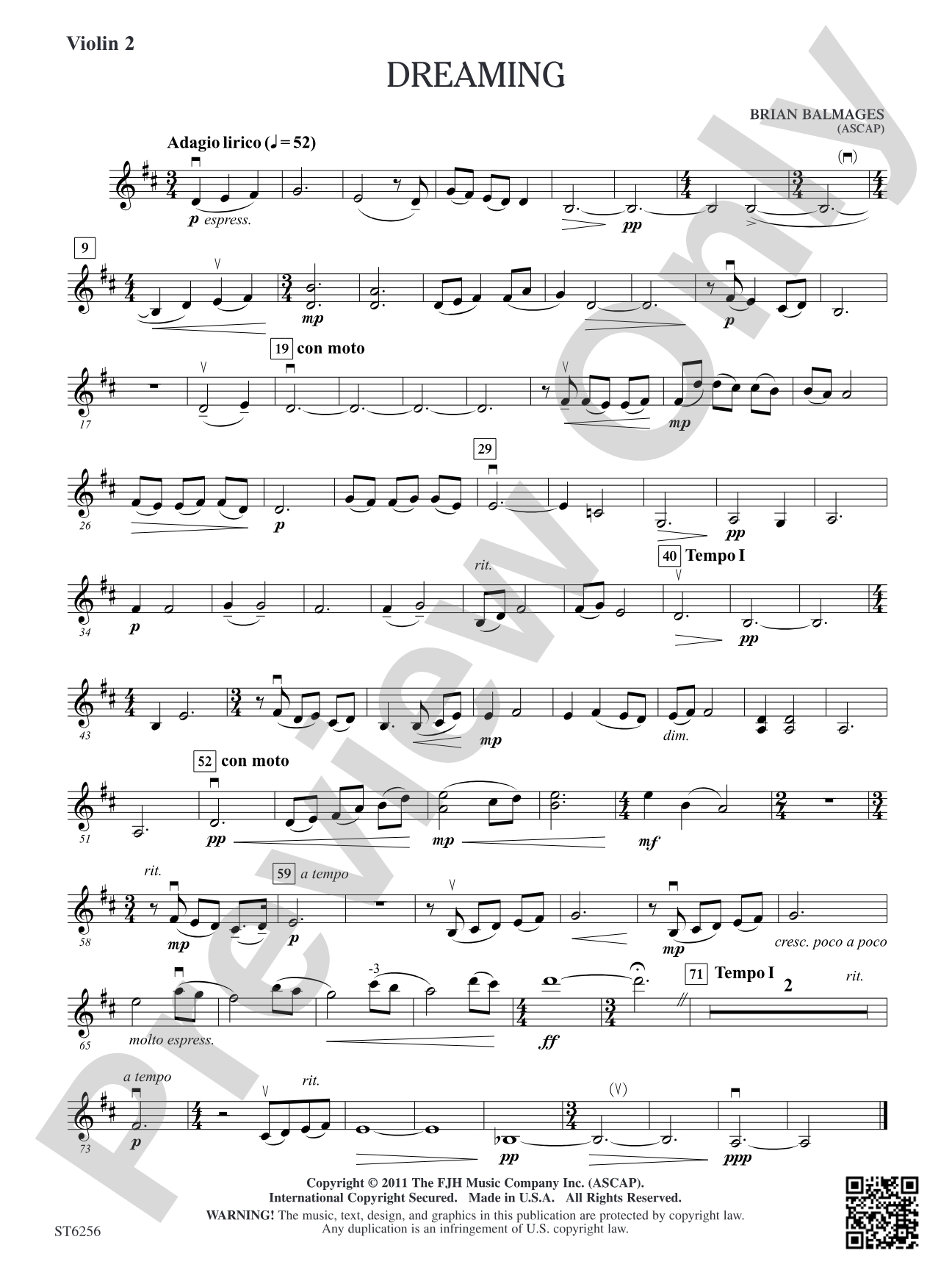

Dreaming: Violin 2
By Brian Balmages
Grade: 4
Item: 98-PC-DST6256_VN2
$7.00
Pickup currently not available
Description
Indulge in an expression of true lyricism with this incredibly beautiful work about the tranquility of sleep. Melodies constantly weave in and out of each other as the work develops both melodically and harmonically. A stunning climax provides a powerful contrast to the opening and closing sections, which beckon listeners to close their eyes and let the musical fabrics of the piece envelop them. This is a stunning and powerful work with incredible expressive potential.


Don't just read it, hear it, play along with it, and watch your students grow with it. In MakeMusic Cloud, Dreaming: Violin 2 comes alive with professional accompaniment, adjustable tempo, and built-in practice tools that turn solo practice into real progress.
Open in the Player
Jump straight in and assign it today.
Start Your Free Trial
Open this title and explore the full library in minutes.
Sample Audio
1
Audio File
--:--
0:00
0:00
Sample Video
No sample videos found.
Additional Details
Series:
FJH String Orchestra
Publisher:
The FJH Music Company, Inc.
SKU:
98-PC-DST6256_VN2
More about this title
About the Composer: Brian Balmages

Brian Balmages has established himself as a versatile voice in contemporary classical music, composing and conducting across orchestral, band, and chamber idioms with equal fluency. His works have reached audiences in premier venues including Carnegie Hall, the Kennedy Center, and the Sydney Opera House, performed by ensembles spanning from professional orchestras to school groups. Recognition of his contributions includes the A. Austin Harding Award from the American School Band Directors Association, the 2020 NBA William D. Revelli Composition Contest for Love and Light, and membership in the American Bandmasters Association.
Balmages holds degrees from James Madison University and the University of Miami, institutions that have honored him with distinguished alumni recognition and commissioning opportunities respectively. His music was performed during the 2013 Presidential Inaugural Prayer Service attended by President Obama and Vice President Biden. As a conductor, he maintains active engagements with all-state, regional, university, and professional ensembles worldwide, and currently serves as Director of MakeMusic Publications and Digital Education for Alfred and MakeMusic.
Why we love this
Balmages crafts a lyrical arc that asks orchestras to balance intimate, woven counterpoint with a commanding climactic moment, creating genuine expressive stakes for musicians at the Grade 4 level. The piece works brilliantly in festival programming because it showcases string writing that feels both accessible and sophisticated, leaving adjudicators and audiences impressed by the maturity of ensemble execution.
What to expect
The piece inhabits a dreamy, floating quality where individual melodic strands drift in and out of focus, creating a sense of drifting between wakefulness and sleep. The unexpected climactic surge breaks that reverie with visceral power before gently settling back into the opening's contemplative stillness, inviting performers and listeners alike into a shared moment of calm surrender.
Who it's for
String orchestras at the Grade 4 level seeking repertoire that combines technical accessibility with genuine musical substance. Directors preparing groups for festival performances or concert programs will find this work rewarding for both players and listeners.
How to get the most out of it
- Shape the opening melodies with sustained breath, allowing each voice to sing independently while maintaining overall textural cohesion; resist rushing the introduction.
- Identify where melodies transfer between sections early in rehearsal so players understand they're part of a continuous musical line, not isolated parts.
- Build the climax by gradually intensifying dynamics and vibrato across all voices; this passage rewards clarity about who has the primary voice at each moment.
- In the closing section, encourage players to listen inward and soften tone quality to match the piece's return to tranquility; this quiet playing demands as much focus as the peak.
How to use it
Program this as the centerpiece of a concert focused on lyrical works, or pair it with contrasting energetic pieces to highlight the dynamic range of your ensemble. It serves equally well as a festival selection or as part of a thematic program exploring texture and orchestration in contemporary string writing.
Skills your students will build
- Sustaining pure tone quality in soft dynamic ranges
- Following and executing independent melodic lines within a polyphonic texture
- Gradual dynamic control and ensemble balance across a long phrase arc
- Responding to textural transitions and understanding harmonic development across multiple voices