
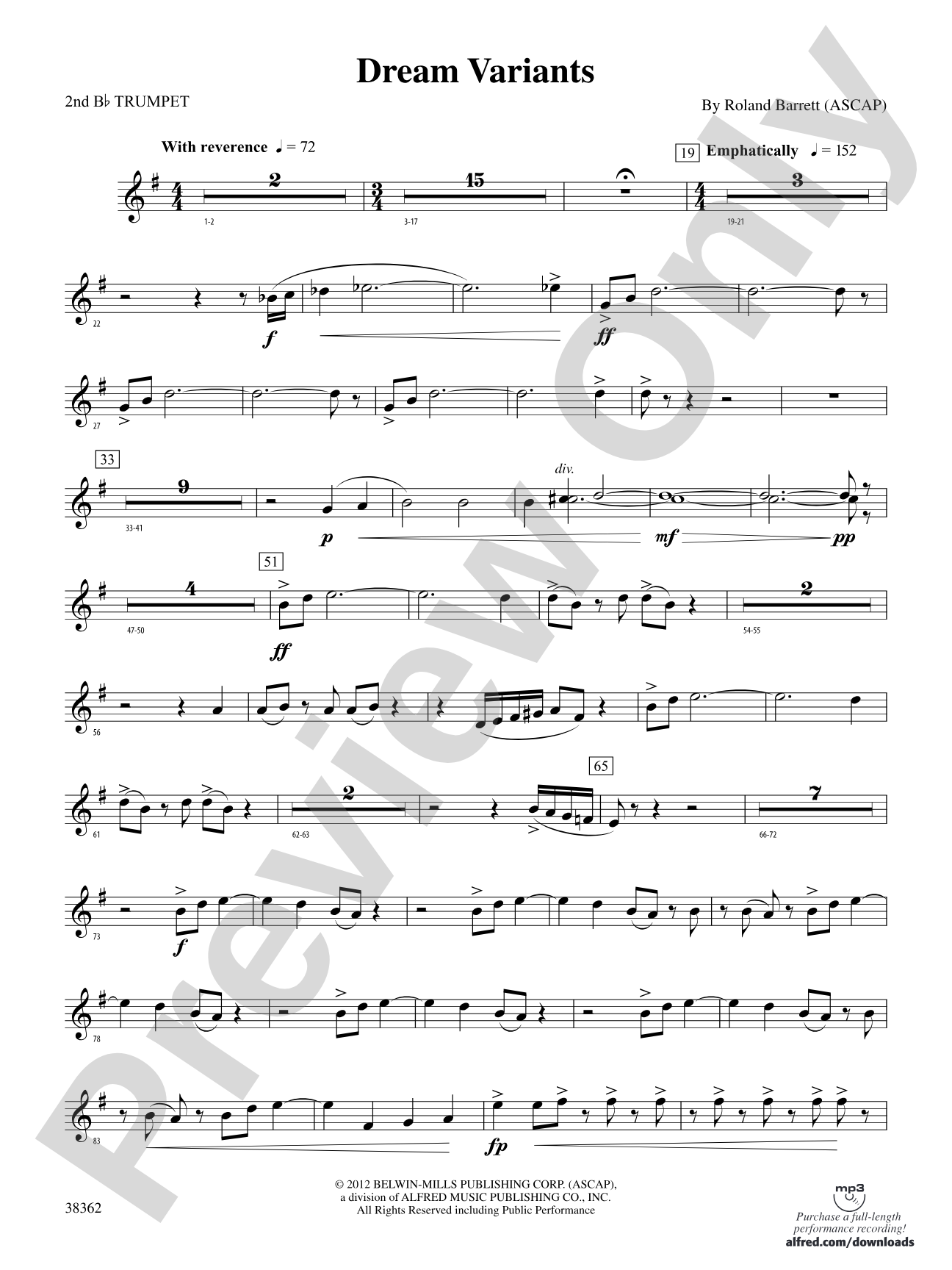

Dream Variants: 2nd B-flat Trumpet
By Roland Barrett
Grade: 3 (Medium Easy)
Item: 00-PC-0015448_T2
$5.99
Pickup currently not available
Description
Exploring the traditional Welsh folk melody, "The Milking Song," this diverse setting opens with a tranquil statement of the melody, and vividly transports the listener through a progression of different interpretations of elements derived from the original folk tune to a wild and boisterous conclusion. A dramatic addition to the serious concert band repertoire, this work is an exceptional choice for concert and contest alike! (5:15) This title is available in MakeMusic Cloud.


Don't just read it, hear it, play along with it, and watch your students grow with it. In MakeMusic Cloud, Dream Variants: 2nd B-flat Trumpet comes alive with professional accompaniment, adjustable tempo, and built-in practice tools that turn solo practice into real progress.
Open in the Player
Jump straight in and assign it today.
Start Your Free Trial
Open this title and explore the full library in minutes.
Sample Audio
1
Audio File
--:--
0:00
0:00
Sample Video
No sample videos found.
Additional Details
Series:
Belwin Concert Band
Publisher:
Alfred Music
Page Count:
268
SKU:
00-PC-0015448_T2
More about this title
About the Composer: Roland Barrett

Roland Barrett holds a faculty position at the University of Oklahoma, where he teaches music theory and composition with emphasis on 20th century techniques. His academic work spans both undergraduate and graduate levels, and he continues to arrange music for the Pride of Oklahoma marching band.
Both a prolific composer and arranger, Barrett has over two hundred published works for symphonic band, chamber ensembles, and marching band to his credit. His music has been performed by the Dallas Wind Symphony and countless All-State and All-Region Honor Bands, broadcast on NPR, and featured at major conventions including the Midwest Band & Orchestra Convention and the International Trumpet Guild convention. He is a multiple recipient of the ASCAPlus award.
Why we love this
Barrett's approach to folk melody transformation gives your band a chance to explore how a single musical idea can support wildly different emotional landscapes. The arc from tranquil opening through layered variations to an exuberant finale feels inevitable rather than arbitrary, and that compositional clarity makes the piece as rewarding to conduct as it is to perform. At Grade 3, it delivers genuine musical substance without demanding impossible technical feats.
What to expect
The piece opens like morning light on a hillside, unhurried and clear. As the variants unfold, the mood shifts through gentle dance-like reinterpretations before building toward something exuberant and almost primal. The arc feels both carefully crafted and genuinely spirited.
Who it's for
Concert bands at the Grade 3 level looking for a piece with real musical architecture and strong solo moments embedded in a larger form. This work suits programs that value folk tradition and contemporary concert writing equally, and it programs well for bands seeking substantive contest or festival repertoire.
How to get the most out of it
- Shape the opening statement with a singer's phrasing; the Welsh melody will carry if you let it breathe rather than pushing the tempo forward.
- Mark the transitions between variants clearly in rehearsal so the band understands that contrast is the point. Each new section should feel like a fresh interpretation, not a continuation.
- Balance the wild conclusion by ensuring the underlying folk tune remains audible beneath the textural density. The ending lands harder when the audience recognizes where you started.
- Use the extended length (5:15) strategically in your rehearsal schedule; break it into sections and work the variants independently before stitching them together.
How to use it
Position this as a centerpiece in a concert that pairs traditional and contemporary repertoire. Its five-minute length and sophisticated form make it an ideal bridge between lighter opening works and heavier closing pieces, and the folk-tune foundation gives audiences an immediate anchor while the compositional treatment impresses musicians and informed listeners alike.
Skills your students will build
- Stylistic contrast and mood transitions within a single work
- Phrasing and musical shape in folk melody performance
- Balance and independence among sections playing simultaneous themes
- Ensemble flexibility across multiple distinct musical contexts
- Concert and contest preparation with substantial published work