Dramatic Essay: String Bass Sheet Music Preview

Dramatic Essay: String Bass

By Mark Williams

Grade: 1

Item: 00-PC-0000024_SB

Digital Download
$5.99
Description
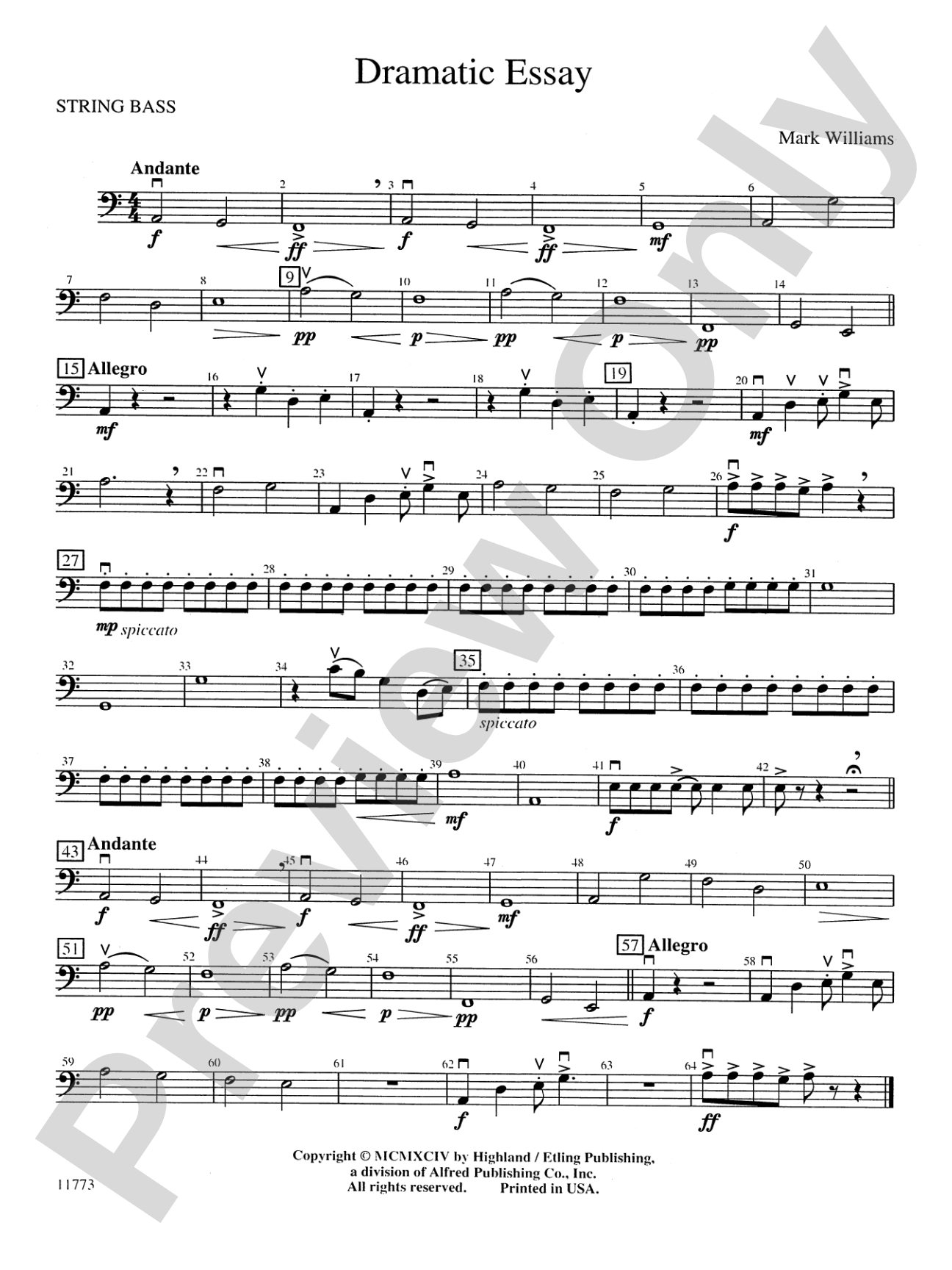
This remarkably simple, yet sophisticated sounding piece from Mark Williams allows for the development of many expressive possibilities in young players. Syncopation and spicatto are explored and developed in a context of changing moods. This is a must-do for second or third year ensembles. This title is available in MakeMusic Cloud.

Don't just read it, hear it, play along with it, and watch your students grow with it. In MakeMusic Cloud, Dramatic Essay: String Bass comes alive with professional accompaniment, adjustable tempo, and built-in practice tools that turn solo practice into real progress.

Sample Audio
0:00
0:00
Sample Video
Additional Details
Series: Highland/Etling Strictly Strings
Publisher: Alfred Music
Page Count: 72
SKU: 00-PC-0000024_SB

More about this title

About the Composer: Mark Williams

Mark Williams

Mark Williams established himself as one of the most prolific and respected composers for young ensembles, with over 200 published works across band, orchestra, and choir. Beyond the page, he shaped music education through his co-authorship of the Accent on Achievement Band Method and decades of teaching elementary band in Washington schools. His influence extended nationally and internationally as a clinician and guest conductor who visited 34 states, five Canadian provinces, and Australia.

A Chicago native who spent his formative years in Spokane, Williams brought both compositional sophistication and classroom expertise to his writing. He held degrees from Eastern Washington University and performed professionally on bassoon with the 560th Air Force Band while serving as conductor and artistic director of the Spokane British Brass Band. His contributions earned recognition including the Gralia Competition Award and multiple ASCAP Special Awards.

Why we love this

Williams crafts something deceptively clever here: a piece that sounds far more advanced than its Grade 1 designation suggests. Young orchestras get to explore genuine expressive nuance through syncopation and spiccato articulation without drowning in technical difficulty, making it an ideal stepping stone for ensembles ready to move beyond straightforward playing.

What to expect

The piece shifts between introspection and vitality with elegant control. Syncopated rhythms introduce a contemporary energy while spiccato articulations add sparkle and definition, all held together by Williams's gift for writing passages that feel substantial without overwhelming the ensemble.

Who it's for

Second and third year string orchestras ready to balance technical growth with musical expression. This works equally well for groups preparing festival submissions or simply seeking repertoire that respects young players' developing abilities while challenging them to think expressively.

How to get the most out of it

  • Shape the syncopated passages with slight articulation clarity; these rhythms gain character when attacked cleanly rather than blurred together.
  • Treat spiccato sections as an opportunity to refine bow control at the middle of the stick. Have students focus on a light, bouncy touch before adding dynamic variation.
  • Emphasize the mood shifts by allowing silence and space to register with the audience. Young players tend to rush between contrasting sections; deliberate tempo breathing transforms the effect.
  • Use the score's dynamic markings as emotional signposts for the ensemble. Discuss what each shift in volume actually represents musically before rehearsing.

How to use it

Feature this as a concert opener to signal your ensemble's musicality and control to an audience, or pair it alongside a more lyrical work to showcase programmatic contrast. Its contest-caliber craftsmanship makes it a smart choice for festival participation while the moderate length keeps rehearsal demands reasonable mid-season.

Skills your students will build

  • Syncopated rhythm reading in simple meters
  • Spiccato articulation and bow control
  • Dynamic shaping and expressive phrasing
  • Tempo independence within ensemble texture
  • Mood transition and musical communication

You May Also Like