
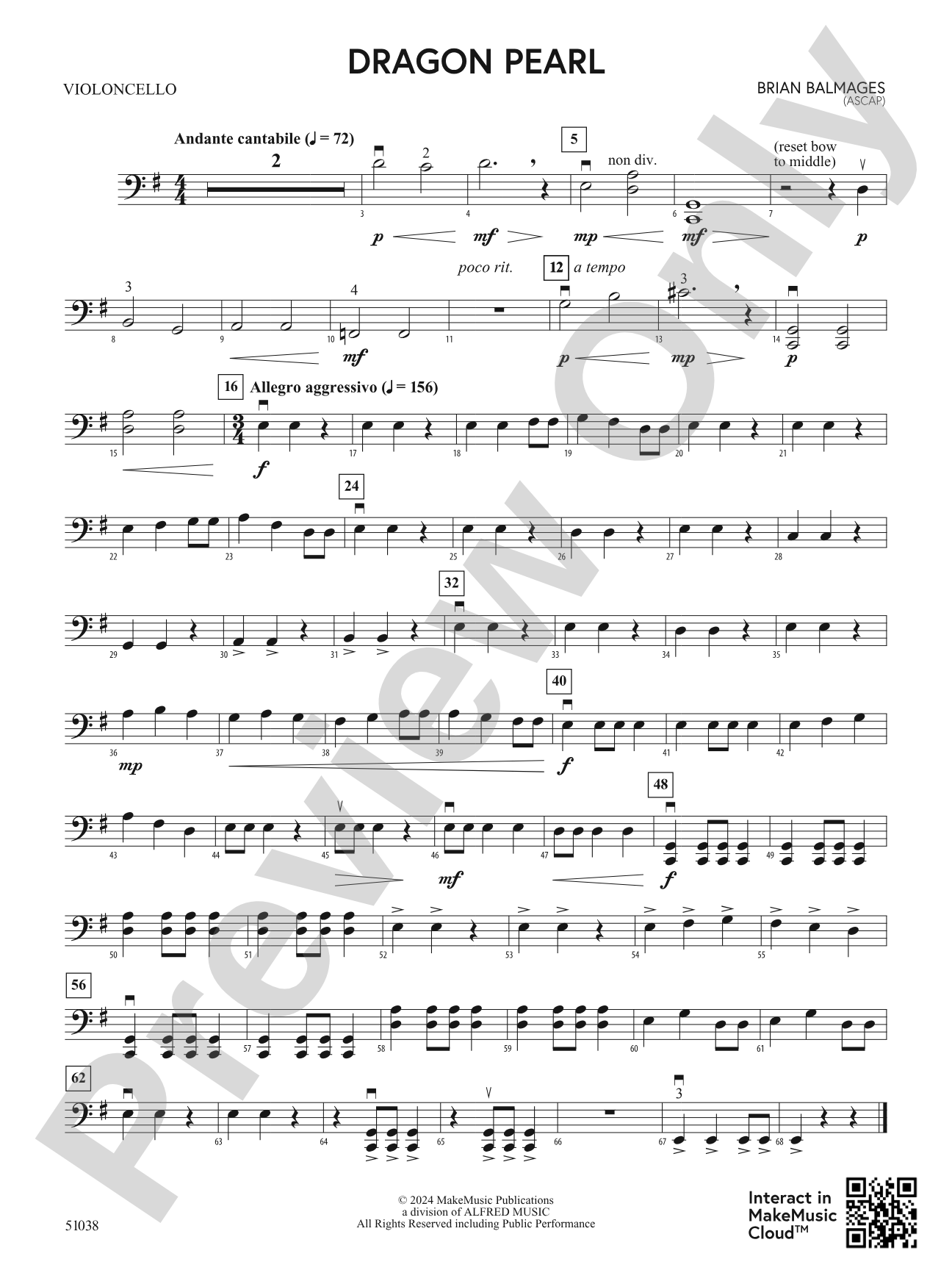

Dragon Pearl: Cello
By Brian Balmages
Grade: 1.5
Item: 00-PC-0019389_VC1
$7.99
Pickup currently not available
Description
Journey to a fantastical world where dragons defend a flaming pearl, representing everything from wisdom and power to prosperity and immortality. Dragon Pearl includes a stunning opening that reflects the gorgeous surface of the pearl. Soon after, the battle begins, highlighted by powerful rhythms, heavy accents, and aggressive harmonies. Incredibly playable yet stunning to hear, this work by Brian Balmages is sure to captivate students and audiences! (1:50)


Don't just read it, hear it, play along with it, and watch your students grow with it. In MakeMusic Cloud, Dragon Pearl: Cello comes alive with professional accompaniment, adjustable tempo, and built-in practice tools that turn solo practice into real progress.
Open in the Player
Jump straight in and assign it today.
Start Your Free Trial
Open this title and explore the full library in minutes.
Sample Audio
1
Audio File
--:--
0:00
0:00
Sample Video
Additional Details
Series:
MakeMusic Developing Strings
Publisher:
MakeMusic Publications
SKU:
00-PC-0019389_VC1
More about this title
About the Composer: Brian Balmages

Brian Balmages has built an international reputation as both composer and conductor, with performances spanning professional symphony orchestras, university ensembles, and school programs across venues including Carnegie Hall, the Kennedy Center, and Sydney Opera House. His compositional range encompasses orchestral, band, and chamber works, earning him the A. Austin Harding Award from the American School Band Directors Association and a 2020 NBA William D. Revelli Composition Contest win for Love and Light.
Balmages holds alumni status from both James Madison University, where he received the inaugural School of Visual and Performing Arts Distinguished Alumni Award, and the University of Miami, which commissioned him to compose for the institution's presidential inauguration. His work has been performed at significant national events, including the 2013 Presidential Inaugural Prayer Service. He currently serves as Director of MakeMusic Publications and Digital Education for Alfred and MakeMusic.
Why we love this
Dragon Pearl delivers theatrical programming gold at an accessible level. The piece opens with genuinely beautiful writing that captures the pearl's mystique before shifting into an energetic battle section filled with rhythmic drive and accent work that students find immediately rewarding to perform. At grade 1.5, it offers real musical substance without excessive technical demands, making it equally valuable for festival settings or concert programs where you need something that sounds far more advanced than its grade level.
What to expect
The piece opens with shimmering, luminous writing that evokes the pearl's treasured glow and mystery. When the battle erupts, the music transforms into a driving, visceral surge of power anchored by propulsive rhythms and sharp dynamic contrasts, creating vivid dramatic tension before the full arc resolves.
Who it's for
String orchestras in grades 1-3 seeking a short, programmatically engaging work that combines accessible technical demands with genuine musical substance. This piece works equally well for developing ensembles building rhythmic precision and for groups ready to explore character and storytelling through orchestration.
How to get the most out of it
- Shape the opening section with sustained, singing tone across all voices; this gorgeous material deserves space and resonance before the battle energy arrives.
- Layer the aggressive rhythms and heavy accents in the battle section so they land with clarity and ensemble unity; mark these dynamic peaks in rehearsal to prevent the texture from muddying.
- Balance the harmonic intensity during the battle by ensuring lower strings lock the rhythmic foundation while upper strings maintain melodic clarity over the accompaniment.
- Use the 1:50 duration as a rehearsal tool; the piece's concentrated arc rewards focused attention on transitions between the pearl's beauty and the dragon's power.
How to use it
Dragon Pearl fits naturally into a concert exploring mythological or fantasy themes, or pair it with other programmatic works as an entry point into storytelling through music. Its festival-friendly duration and grade level make it an excellent choice for contests where you want to program something imaginative without overshadowing more ambitious repertoire elsewhere on the same concert.
Skills your students will build
- Sustained legit playing over extended phrases
- Rhythmic precision and unison accuracy in heavily accented passages
- Dynamic layering and balance between melodic and accompanimental voices
- Character and tone contrast (lush vs. aggressive sections within a single work)