
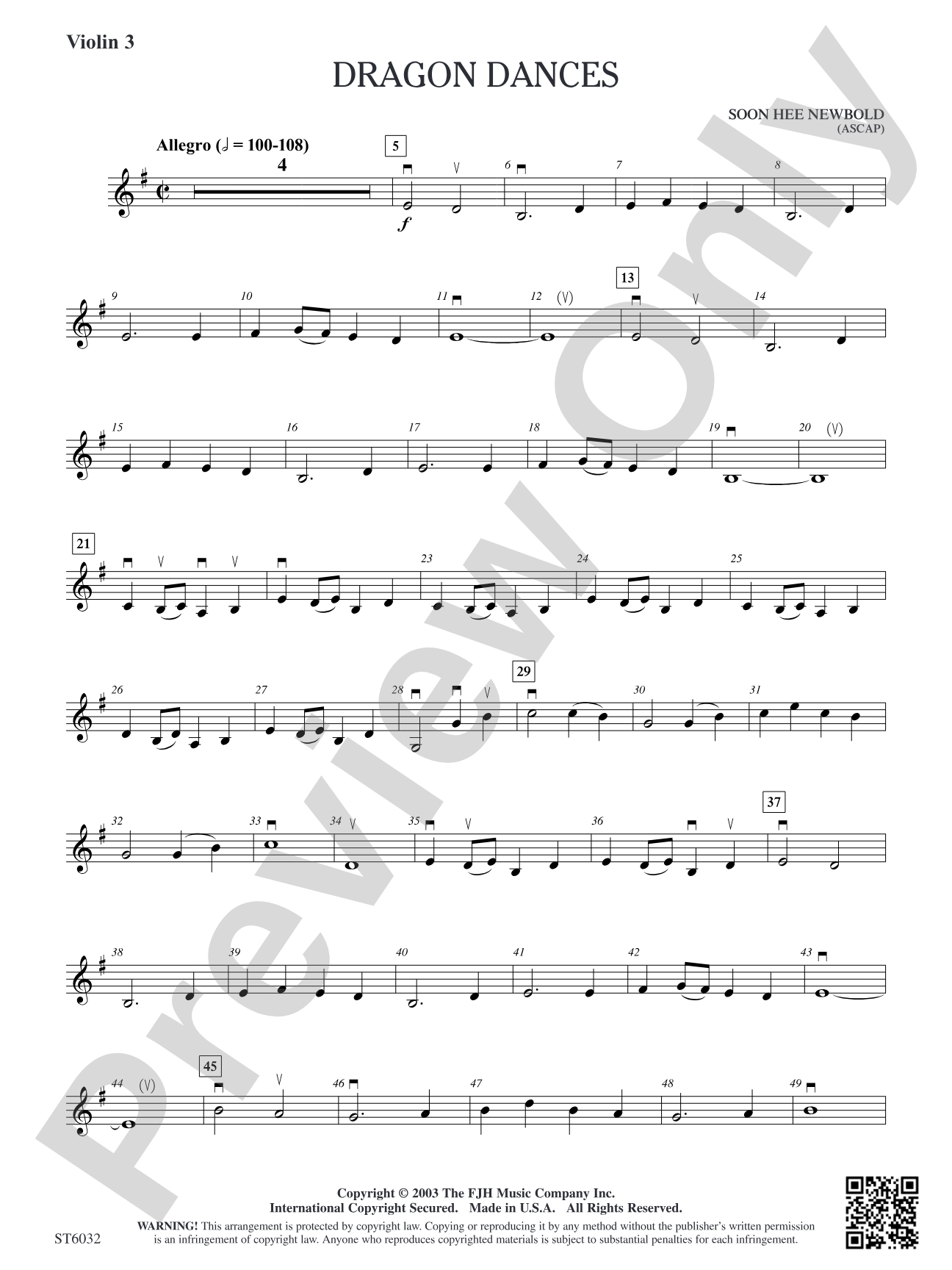

Dragon Dances: Optional Violin 3
By Soon Hee Newbold
Grade: 2
Item: 98-PC-DST6032_OVN3
$7.00
Pickup currently not available
Description
This Far-Eastern style work is sure to become a bestseller this year! An ostinato figure is presented in the violins before the lower voices introduce the melody. A pizzicato section gives the work a very unique and authentic sound. Strongly consider this work for your next performance. (2:00)


Don't just read it, hear it, play along with it, and watch your students grow with it. In MakeMusic Cloud, Dragon Dances: Optional Violin 3 comes alive with professional accompaniment, adjustable tempo, and built-in practice tools that turn solo practice into real progress.
Open in the Player
Jump straight in and assign it today.
Start Your Free Trial
Open this title and explore the full library in minutes.
Sample Audio
1
Audio File
--:--
0:00
0:00
Sample Video
No sample videos found.
Additional Details
Series:
FJH Developing Strings
Publisher:
The FJH Music Company, Inc.
SKU:
98-PC-DST6032_OVN3
More about this title
About the Composer: Soon Hee Newbold

Soon Hee Newbold built her compositional voice through a lifetime of cultural immersion and performance. A pianist from age five and violinist from seven, she performed as a concert artist across professional ensembles worldwide before establishing herself as a composer whose works span from elementary school orchestras to professional symphonies. Her music has graced major venues including Carnegie Hall, the Kennedy Center, Lincoln Center, and Disney Hall, as well as international stages in the Netherlands, Belgium, Australia, Indonesia, Singapore, and China.
Newbold's distinctive approach weaves cultural and ethnic traditions throughout her catalog, shaped by her extensive travels and collaborative experiences. Beyond the concert stage, she has worked as a filmmaker and composer in Hollywood, contributed to film and recording projects, and earned recognition as a guest clinician and keynote speaker at major music education conferences. Her work demonstrates how cultural specificity and strong compositional craft can serve ensembles at every level.
Why we love this
Newbold crafts an immediately engaging Far Eastern soundscape using economical means: the opening ostinato in violins captures attention from the first measure, the melodic entrance in lower voices creates natural layering, and the pizzicato textures feel authentically orchestrated rather than merely novel. At Grade 2, this piece respects developing string players while asking them to execute something genuinely sophisticated in both sound design and cultural authenticity.
What to expect
Delicate yet rhythmically propulsive, with an ornamental quality that recalls traditional Far Eastern instrumental music. The interplay of repeated figures and floating melody creates a sense of gentle momentum, while the pizzicato textures add color and textural variety that keeps the sound from feeling static across its two-minute span.
Who it's for
String orchestras in the early-intermediate range, particularly those seeking repertoire that broadens cultural perspectives without overwhelming developing players. Teachers and conductors who want a contest or festival piece that sounds more sophisticated than its difficulty level and engages students in non-Western musical idioms.
How to get the most out of it
- Establish the ostinato figure as the rhythmic and harmonic anchor of the piece. Have violins lock in the pattern at a steady tempo before adding other voices, ensuring precise ensemble alignment before layering complexity.
- Shape the melodic entrance in lower voices to emerge clearly from the ostinato texture. Balance dynamics so the melody reads as primary material without losing the rhythmic foundation underneath.
- Give the pizzicato section deliberate attack and evenness. Young string players often rush pizzicato passages or lose consistency in tone, so isolate this section in rehearsal to build technical confidence and articulation clarity.
- Attend to intonation in the unison or near-unison moments that Far Eastern styles often emphasize. Use these passages to refine listening skills and train the ensemble to blend by ear rather than relying on vibrato.
How to use it
This works beautifully as a festival or competition selection where cultural diversity in programming is a strength, or as a concert opener that signals to your audience that this ensemble explores beyond the standard European repertoire. Pair it with other Grade 2 works that contrast in style (perhaps a classical arrangement or Americana piece) to showcase your orchestra's range.
Skills your students will build
- Ensemble precision and lock-in of repeated ostinato patterns
- Melodic phrasing over a fixed rhythmic foundation
- Pizzicato execution with even tone and articulation
- Listening and intonation refinement in unison passages
- Cultural awareness and stylistic approach to non-Western music forms