
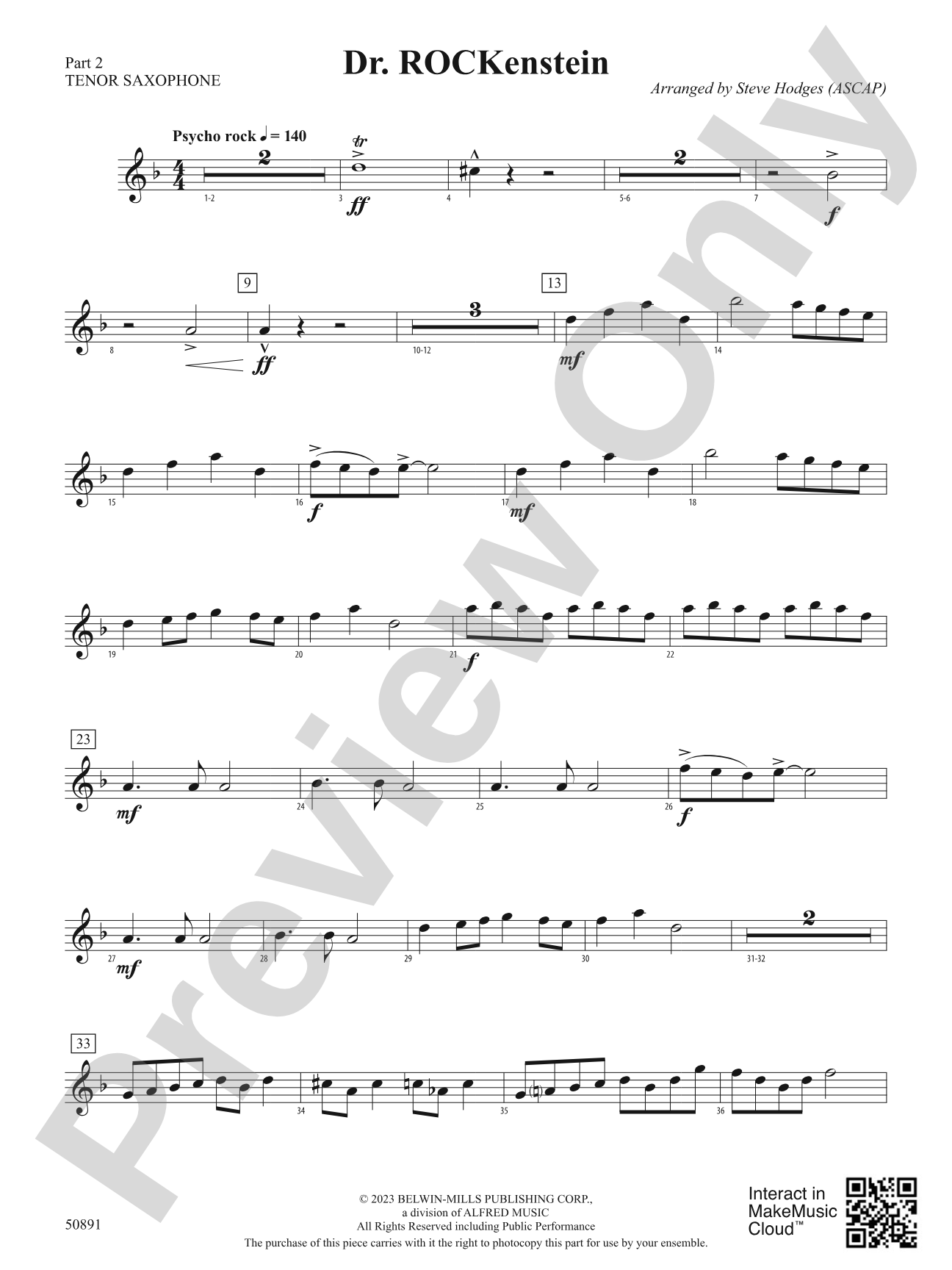

Dr. ROCKenstein: Part 2 - Tenor Saxophone
Arranged by Steve Hodges
Grade: 1.5
Item: 00-PC-0019112_PART2_TX
$3.00
Pickup currently not available
Description
Take some of the more memorable "scary" musical motives, set them to an exciting rock beat, and you have the perfect end-of-rehearsal piece! Challenging and engaging, this clever FLEX arrangement of Dr. ROCKenstein, by Steve Hodges, provides plenty of opportunities for each section of the band to shine. With active percussion and solid scoring, this piece will be a real hit with the band and audience alike! (2:05)
Percussion Accompaniment Track Downloads:
with click
without click


Percussion Accompaniment Track Downloads:
with click
without click
Don't just read it, hear it, play along with it, and watch your students grow with it. In MakeMusic Cloud, Dr. ROCKenstein: Part 2 - Tenor Saxophone comes alive with professional accompaniment, adjustable tempo, and built-in practice tools that turn solo practice into real progress.
Open in the Player
Jump straight in and assign it today.
Start Your Free Trial
Open this title and explore the full library in minutes.
Sample Audio
1
Audio File
--:--
0:00
0:00
Sample Video
Additional Details
Series:
Challenger Band Series
Publisher:
Alfred Music
SKU:
00-PC-0019112_PART2_TX
More about this title
About the Arranger: Steve Hodges

Steve Hodges built his compositional voice over four decades in the public school classroom, directing bands, choirs, and ensembles across multiple grade levels before retiring from full-time music education. He holds degrees from Western Oregon University (B.S.) and Central Washington University (M.A. in Music Education), credentials that shaped both his writing and his understanding of what works in rehearsal.
Since 1986, Hodges has published more than 120 concert band works through Alfred Music, along with choral arrangements through Staff Music and Shawnee Press. His pieces have traveled internationally, appearing at festivals and state conventions while also reaching national television audiences through TBS and ESPN. A member of ASCAP, Hodges continues to live in The Dalles, Oregon, where he remains active in community music and watches his grandchildren perform his own compositions in their school bands.
Why we love this
This arrangement transforms recognizable "scary" musical phrases into a rock-infused showcase that energizes rehearsal endings without sacrificing musical substance. The flexible instrumentation means you're not scrambling to fill instrumentation gaps, and the straightforward Grade 1.5 difficulty keeps the focus on groove and ensemble feel rather than technical wrestling. Hodges's four decades in the classroom shine through here: he knows exactly what engages students and what sounds good in a room.
What to expect
Picture a moment of theatrical mischief set to a driving rock pulse. The familiar horror-film motives feel fresh when wrapped in steady eighth-note grooves and crisp harmonic punctuation. There's playfulness here rather than actual menace, and the bright orchestration keeps the whole thing energetic and entertaining rather than dark.
Who it's for
This is ideal for middle school and early high school bands seeking a high-impact, low-stress finale that checks multiple boxes: it's accessible enough to learn quickly, engaging enough to hold student interest, and fun enough to land well with audiences. Directors working with flexible or mixed-instrumentation groups will appreciate the arrangement's written-in accommodation for varied band compositions.
How to get the most out of it
- Emphasize the rhythmic precision of the rock beat in your early rehearsals; lock the kick drum and bass line before layering melodic sections so the ensemble grasps the groove as a foundation.
- Let the percussion accompaniment tracks anchor your initial run-throughs, then gradually reduce reliance on them as confidence builds in the ensemble's internal pulse.
- Highlight the moments when different sections carry the "scary" motives by labeling them clearly in rehearsal; this builds awareness of musical storytelling and keeps engagement high.
- Balance the rock energy with clarity in harmonic transitions; the simplicity of the grade level means each chord change should land cleanly and intentionally.
How to use it
Program this as a closer to a casual concert or rehearsal showcase where the audience expects fun and spectacle rather than introspection. It's also an excellent reward piece mid-rehearsal season, arriving at a point where your ensemble has built enough technical confidence to nail the rhythm while enjoying the rock style's fresh sound. The short duration (2:05) makes it a natural palette cleanser between heavier works.
Skills your students will build
- Locked rock groove and steady pulse in an ensemble setting
- Reading and executing flexible instrumentation parts
- Balancing rhythmic precision with stylistic energy in a non-traditional genre
- Ensemble awareness across sections when motives rotate through different instruments
- Response to percussion accompaniment without losing musical independence