
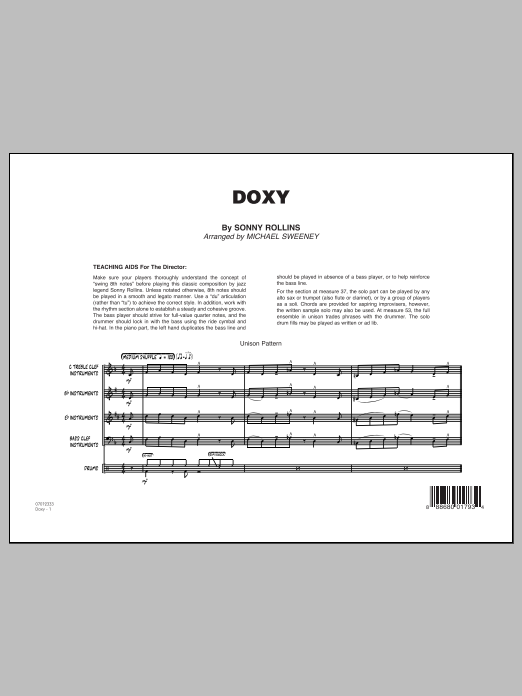

Doxy: Jazz Ensemble Conductor Score & Parts
As performed by Sonny Rollins / Arranged by Michael Sweeney
Grade: 1.5
Item: 35-PK00293724
$45.00
Pickup currently not available
Buy Extra Parts (Digital PDF Download)
| Product | Price | Quantity |
|---|---|---|
| Doxy - Conductor Score (Full Score) | $7.50 | |
| Doxy - Alto Sax 1 | $6.00 | |
| Doxy - Alto Sax 2 | $6.00 | |
| Doxy - Tenor Sax 1 | $6.00 | |
| Doxy - Tenor Sax 2 | $6.00 | |
| Doxy - Baritone Sax | $6.00 | |
| Doxy - Trumpet 1 | $6.00 | |
| Doxy - Trumpet 2 | $6.00 | |
| Doxy - Trumpet 3 | $6.00 | |
| Doxy - Trombone 1 | $6.00 | |
| Doxy - Trombone 2 | $6.00 | |
| Doxy - Trombone 3 | $6.00 | |
| Doxy - Guitar | $6.00 | |
| Doxy - Piano | $6.00 | |
| Doxy - Bass | $6.00 | |
| Doxy - Drums | $6.00 | |
| Doxy - Vibes | $6.00 | |
| Doxy - Flute | $6.00 | |
| Doxy - Bb Clarinet 1 | $6.00 | |
| Doxy - Bb Clarinet 2 | $6.00 | |
| Doxy - F Horn | $6.00 | |
| Doxy - Tuba | $6.00 |
Parts Added to Cart!
Description
Arranged in a medium swing/shuffle style, here is a very easy version of this jazz standard by Sonny Rollins that maintains the style and feel of the original. Featuring a mix of tutti playing and also call and response scoring, this is a great way to introduce a jazz legend to your young players. There is a written or ad lib solo for any trumpet or alto sax, and the shout chorus features a dialogue between the ensemble and drums.


Doxy: Jazz Ensemble Conductor Score & Parts isn't in MakeMusic Cloud just yet...but it could be. Let us know you'd like to see it, and you'll help shape what comes next. In the meantime, start a free trial and dive into thousands of interactive titles your students can play along with today.
Request This Title
Tell us you want it.
Start Your Free Trial
Explore everything that's ready to play right now.
Sample Audio
No sample audio found.
Sample Video
No sample videos found.
Additional Details
Publisher:
Hal Leonard
SKU:
35-PK00293724
More about this title
About the Artist: Sonny Rollins
Sonny Rollins stands as one of jazz's most inventive and fearless improvisers. Born in 1930 in New York, Rollins developed a tenor saxophone style marked by harmonic sophistication, motivic development, and an ability to play over changes with startling freedom. His compositions became standards in the jazz repertoire, performed across every style and setting.
For music educators, Rollins represents the jazz tradition at its most accessible yet uncompromising. His melodies are singable and memorable, his rhythmic ideas are clear enough for young players to grasp, yet his harmonic language rewards deeper study. Teaching his music gives students a direct line to the language of bebop and post-bebop jazz.
Why we love this
Michael Sweeney's arrangement preserves what makes Doxy instantly recognizable while stripping away the technical barriers. The call and response scoring keeps the ensemble engaged throughout, and the shout chorus with drum dialogue gives the section players a chance to feel the conversation that defines jazz playing. At this grade level, students encounter an actual jazz standard on their terms.
What to expect
Groovy and unpretentious. Doxy swings with ease and lets young players feel the forward momentum that makes jazz rewarding to play. The arrangement never condescends, and the space for improvisation reminds students that jazz is about conversation, not perfection.
Who it's for
Jazz ensembles at the beginning level who have basic section balance and can read simple swing notation. This works equally well for a dedicated jazz group or an ensemble built from your concert band players who want to add jazz to their experience.
How to get the most out of it
- Balance the melody in the opening statement so the groove sits underneath rather than above it. Young ensembles sometimes rush the swing feel out of eagerness.
- Encourage the soloist to listen to the rhythm section and build phrases in response to the accompaniment rather than play over it. This transforms the solo from a performance moment into a conversation.
- Mark the shout chorus dynamics clearly in rehearsal. The dialogue between ensemble and drums only lands if the hits are crisp and the ensemble understands when they're responding rather than stating.
- Let the ensemble hear how the medium shuffle differs from a straight eighth-note feel. A few measures of comparison work does wonders.
How to use it
Open a jazz concert or spring pops night with this piece. It announces the style immediately and gives the audience a genuine jazz standard rather than a simplified novelty. It also serves well as a winter repertoire choice when ensembles need engagement after holiday concerts.
Skills your students will build
- Reading swing eighth-note notation and shuffle rhythms
- Playing with intentional rhythmic space and pocket feel
- Call and response scoring and ensemble conversation
- Basic jazz soloing over a simple blues progression
- Listening to rhythm section accompaniment while maintaining the melodic line