
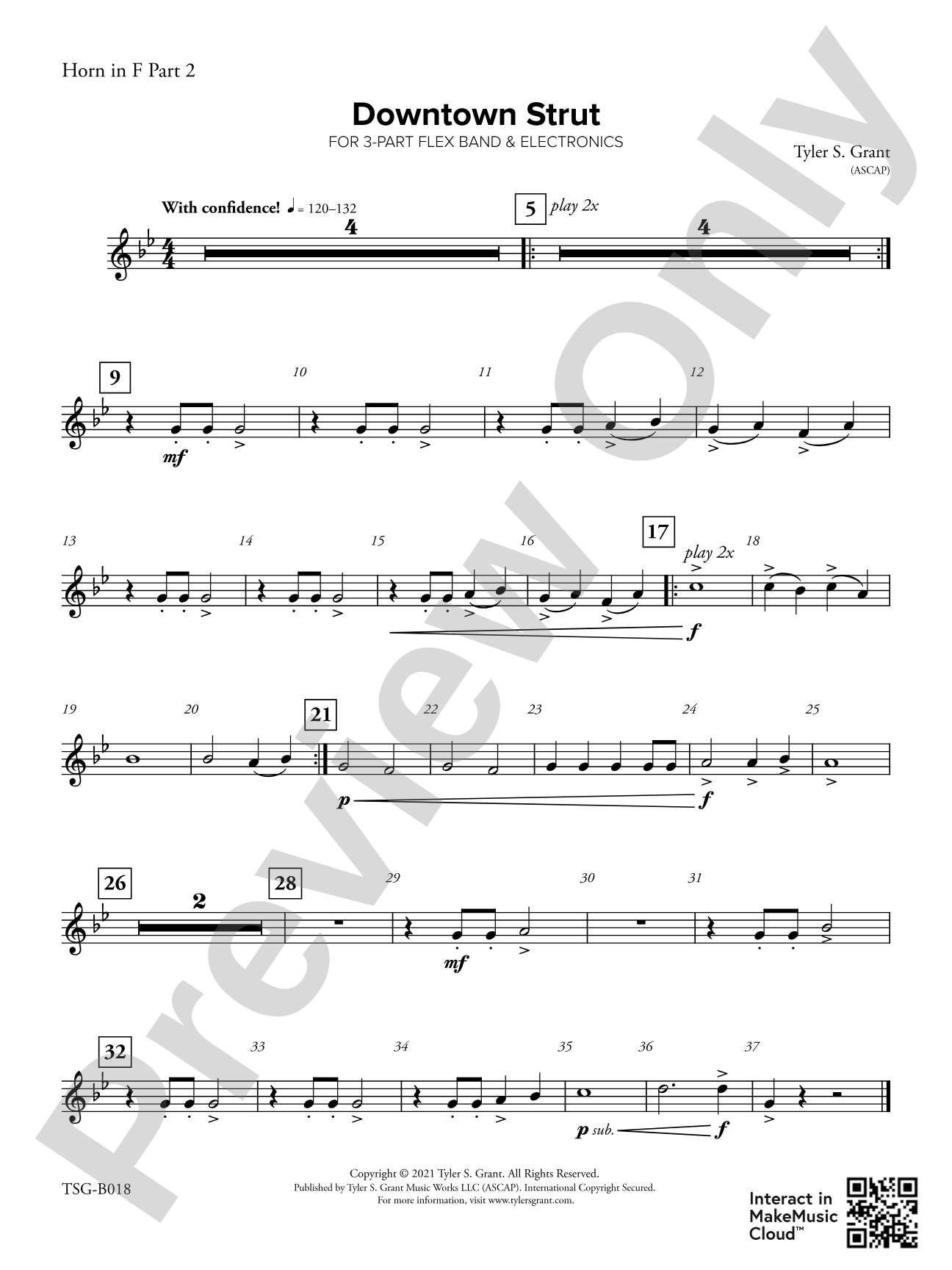

Downtown Strut: Part 2 - Horn in F
By Tyler S. Grant
Grade: 1
Item: 98-PC-TGB018_PART2_H1
$4.50
Pickup currently not available
Description
Electrifying and exciting! This flexible work is the perfect way to introduce your students to electro-acoustic music at a young level. Using only seven notes and modest rhythms, Downtown Strut by Tyler S. Grant will be a favorite for both students and audiences. (1:15)


Downtown Strut: Part 2 - Horn in F isn't in MakeMusic Cloud just yet...but it could be. Let us know you'd like to see it, and you'll help shape what comes next. In the meantime, start a free trial and dive into thousands of interactive titles your students can play along with today.
Request This Title
Tell us you want it.
Start Your Free Trial
Explore everything that's ready to play right now.
Sample Audio
1
Audio File
--:--
0:00
0:00
Sample Video
Additional Details
Series:
FLEX Editions
Publisher:
Tyler S. Grant Music Works, LLC.
SKU:
98-PC-TGB018_PART2_H1
More about this title
About the Composer: Tyler S. Grant

Tyler S. Grant has built a reputation as a composer and arranger whose works appear regularly on honor ensemble programs across the country. His compositions have won recognition through competitions like the Dallas Wind Symphony's 2014 "Call for Fanfares" Competition, and his music reaches audiences at major venues including Carnegie Hall, the Meyerson Symphony Center, and the Midwest Clinic.
Beyond the page, Grant maintains an active presence as a clinician and conductor, working with over 100 school programs across multiple states. He studied instrumental music education and conducting at the University of Alabama and has contributed educational resources to Alfred Music's Sound Innovations series. His mentorship from composer Brian Balmages shaped his approach to writing music that serves both student development and artistic performance.
Why we love this
Grant designed this piece specifically for young ensembles encountering electronic elements for the first time, removing technical barriers while preserving genuine excitement. The flexible instrumentation means you can perform it with exactly who shows up on concert day, making it practical for mixed-ability programs or changing roster situations. Elementary and middle school students will feel the energy of electro-acoustic music without wrestling with complex rhythms or extended ranges.
What to expect
Electro-acoustic textures meet youthful energy in a piece that sounds confident and current without losing sight of what makes young musicians excited to play. The rhythmic drive creates momentum; the electronic accompaniment adds color and sophistication that Grade 1 students rarely encounter in their standard repertoire.
Who it's for
Grade 1 band directors introducing contemporary sounds to young players. Ensembles with flexible instrumentation needs will appreciate the accessibility, and any program seeking a confident, engaging concert opener with modern appeal.
How to get the most out of it
- Balance the acoustic instruments with the electronic elements by starting rehearsals with the accompaniment at lower volume; gradually bring up the mix once the live players lock their parts.
- Establish a clear downbeat with your conducting; the straightforward rhythms benefit from confident, authoritative direction that helps students feel the groove.
- Assign someone to monitor the digital playback during rehearsals and performances so you can focus entirely on the ensemble's sound and ensemble balance.
- Let the seven-note constraint work for you as a teaching moment; discuss how composers use limitations creatively to build cohesive, memorable melodies.
How to use it
Position this as an opener on a concert where you want to signal that your program includes contemporary music and fresh arranging approaches. It works equally well as a standalone showpiece during a middle school assembly or alongside traditional Grade 1 fare to demonstrate musical range. At 1:15, it fits cleanly into any concert slot without eating up rehearsal time.
Skills your students will build
- Reading and performing with electronic accompaniment
- Rhythmic accuracy in ensemble contexts (steady quarter-note and eighth-note patterns)
- Listening and balance skills within mixed acoustic and digital textures
- Counting and maintaining ensemble unity with recorded backing tracks