
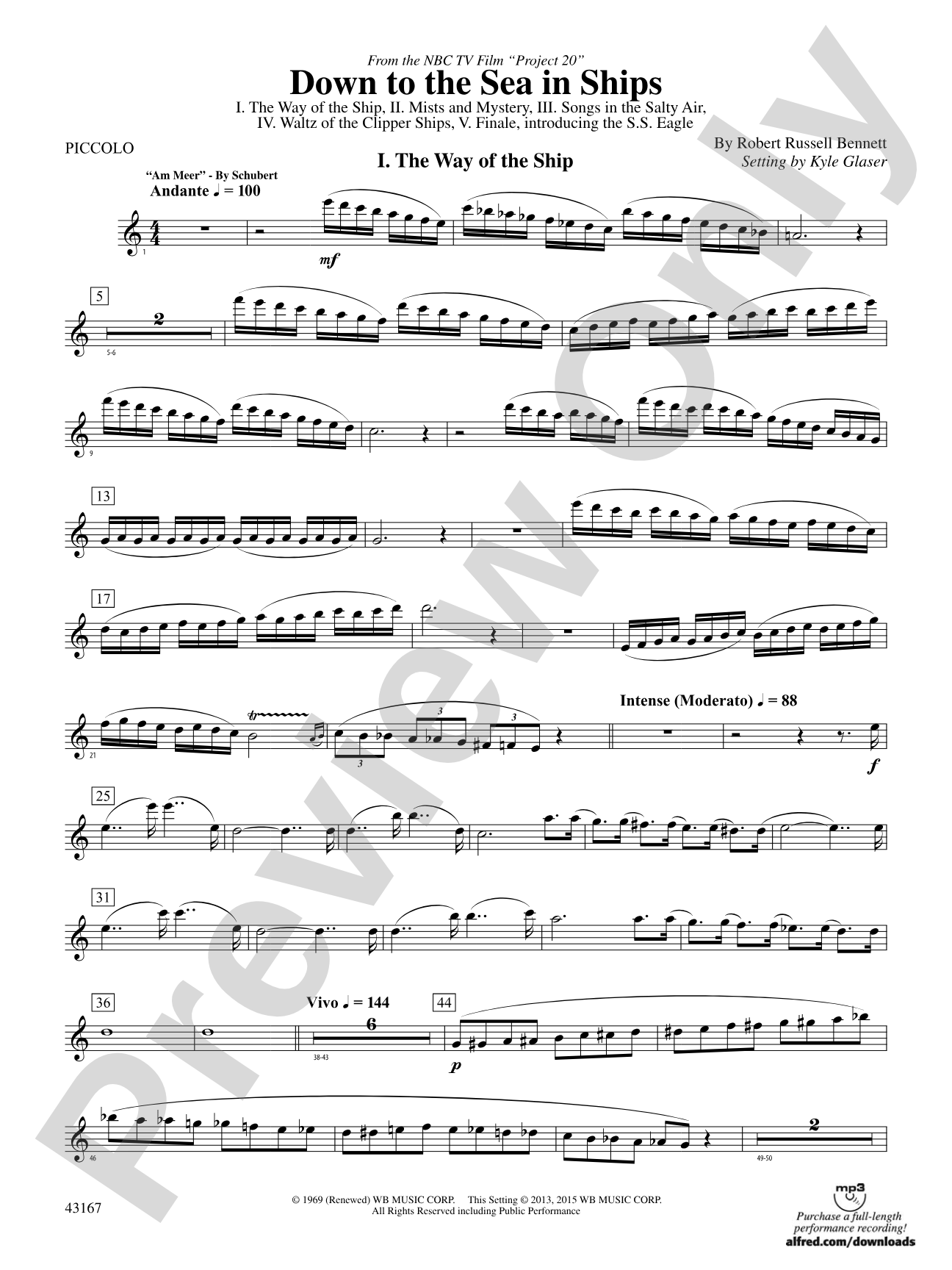
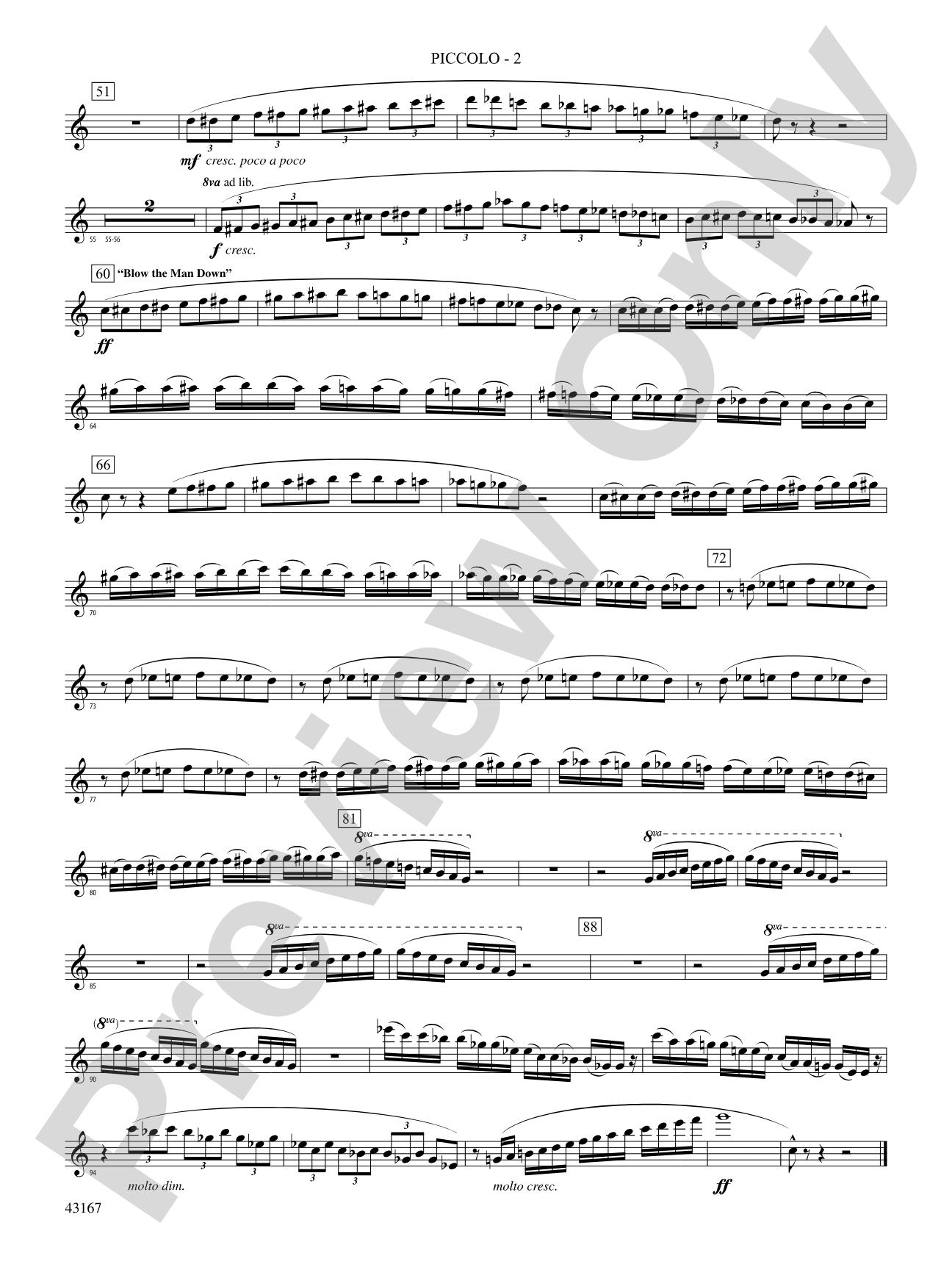

Down to the Sea in Ships (from the NBC TV Film Project 20): Piccolo
I. The Way of the Ship, II. Mists and Mystery, III. Songs in the Salty Air, IV. Waltz of the Clipper Ships, V. Finale, introducing the S.S. Eagle March
By Robert Russell Bennett / setting by Kyle Glaser
Grade: 5 (Difficult)
Item: 00-PC-0017528_P1
$3.00
Pickup currently not available
Description
An outgrowth of NBC's 1952 successful tele-documentary Victory at Sea, was Project 20 two years later: a 30-episode series that was scored completely by Robert Russell Bennett. The episode, called "Down to the Sea in Ships," utilized this score that initially aired in December of 1968. The magic of the sea, the beauty of ships, and fascination for the men who sail them, are fully explored in this five-movement epic work that relies heavily on sea shanties and folk material. In regarding the work in Bennett's own words, it "had a lot to tell us about our struggles, triumphs, and defeats on the mighty ocean." The movements are titled; "The Way of the Ship," "Mists and Mystery," "Songs of the Salty Air," "Waltz of the Clipper Ships," and "Finale, Introducing the S.S. Eagle March." This fresh, carefully edited concert band transcription has been extensively researched and will be a cherished addition to serious band literature for generations to come. (14:00)


Don't just read it, hear it, play along with it, and watch your students grow with it. In MakeMusic Cloud, Down to the Sea in Ships (from the NBC TV Film Project 20): Piccolo comes alive with professional accompaniment, adjustable tempo, and built-in practice tools that turn solo practice into real progress.
Open in the Player
Jump straight in and assign it today.
Start Your Free Trial
Open this title and explore the full library in minutes.
Sample Audio
1
Audio File
--:--
0:00
0:00
Sample Video
No sample videos found.
Additional Details
Series:
Belwin Classic Band
Publisher:
Alfred Music
Page Count:
540
SKU:
00-PC-0017528_P1
More about this title
About the Composer: Robert Russell Bennett
Robert Russell Bennett (1894-1981) was one of America's most prolific orchestrators and composers, with a career spanning nearly seven decades. His gift for musical storytelling made him the natural choice to score NBC's landmark television documentaries, including the celebrated Victory at Sea series and its successor Project 20, where he composed or arranged music for over 100 episodes. Bennett's mastery of large ensembles, combined with his ability to weave folk melodies and period styles into cohesive narratives, established him as a defining voice in twentieth-century American film and television music.
Beyond his screen work, Bennett composed extensively for concert band and orchestra, earning respect from both popular audiences and serious musicians. His orchestrations for Broadway shows (including works by Rodgers and Hammerstein) set the standard for the art form. For band directors, Bennett represents a bridge between accessibility and sophistication; his music engages students with recognizable material while demanding genuine musicianship and ensemble discipline.
Why we love this
Bennett's television scoring genius translates powerfully to the concert band medium in this five-movement epic. The work manages to feel both cinematic and genuinely substantial as concert literature; directors get a piece that captivates audiences with sea shanties and folk color while offering real musical and technical challenges that justify Grade 5 difficulty. The extended five-movement structure gives ensembles the chance to explore varied textures and moods, from misty atmosphere to rousing march, making this an unforgettable program highlight.
What to expect
Bennett captures the romance and danger of maritime life through sweeping melodic lines, atmospheric harmonic colors, and bracing rhythmic vitality. The work alternates between hushed moments of mist and mystery and grand, triumphant passages that celebrate human courage and adventure. Listeners experience the sea as both a place of beauty and struggle, grounded in the authenticity of working folk song and the grandeur of orchestral color.
Who it's for
This work suits mature concert bands with solid fundamental skills and comfort sustaining longer musical narratives. The Grade 5 difficulty assumes solid section leaders, confident intonation across the ensemble, and the stamina for extended rehearsal focus. Programming this piece engages both serious band students and audiences seeking substantial American concert music beyond typical overture and march fare.
How to get the most out of it
- Balance the folk melodies against supporting harmonies carefully in "Songs of the Salty Air." The sea shanties must project clearly, but the accompanying voices should maintain their own expressive weight rather than receding into accompaniment.
- Establish the rhythmic independence of your sections in the waltz movement before rehearsing full ensemble; this creates clarity and allows the characteristic lilt of the Clipper Ships section to breathe naturally.
- Shape the phrasing of the march finale with deliberate contrast between structural sections. The S.S. Eagle March builds on accented material; let ensemble unity at full volume serve the narrative rather than forcing intensity from the start.
- Use the extended duration (14 minutes) to your advantage in rehearsal by breaking movements into focused units. This prevents fatigue and allows students to engage with each distinct musical character as its own learning opportunity.
How to use it
Position this as a significant standalone work on a concert devoted to American music or classical television scoring. Its five-movement structure and 14-minute duration make it well-suited as a concert finale or centerpiece rather than a supporting piece. Consider pairing it with other Bennett arrangements or shorter works that share his gift for folk-inspired orchestration to create a cohesive thematic program.
Skills your students will build
- Sustaining long, lyrical melodic lines across multiple phrases
- Balancing folk-style melodies against harmonic accompaniment
- Reading and performing in varied meters and rhythmic textures across movements
- Coordinating extended ensemble passages with clear sectional independence
- Shaping extended musical narratives with contrasting tempi and dynamics
- Interpreting period idioms (sea shanty style, waltz character, march structure)