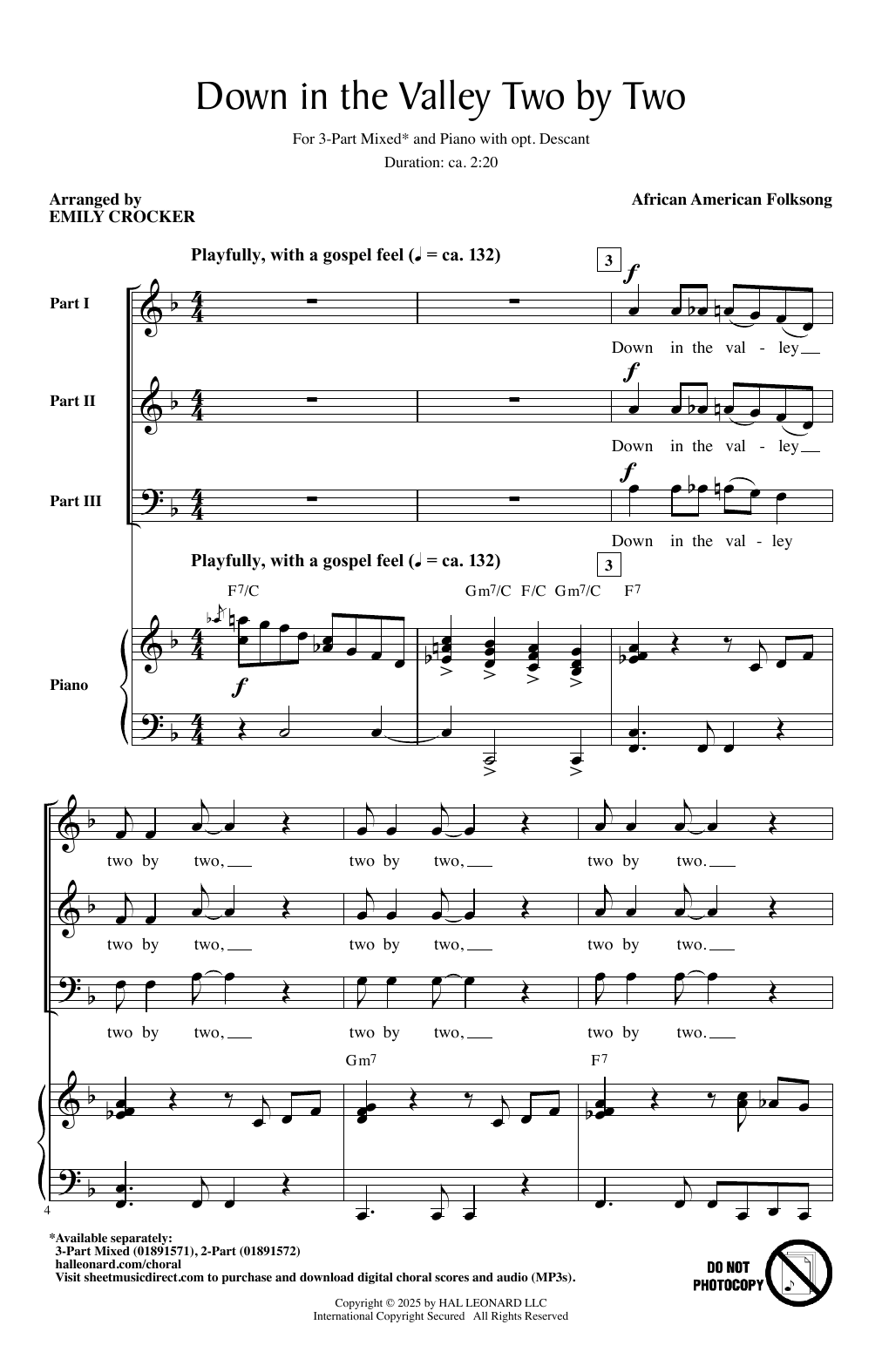
Emily Crocker spent 15 years teaching music in Texas public schools across all grade levels before moving into music publishing. She joined Hal Leonard in 1989 and shaped the company's choral catalog as VP of Choral Publications until her retirement in 2017 after nearly three decades with the firm.
Beyond publishing, Crocker founded and directed the Milwaukee Children's Choir from 1994 to 2009, establishing it as a significant training ground for young singers, and later created the Vocal Arts Academy of Milwaukee. Her own compositions have been performed globally, with particular recognition for her ability to craft accessible yet musically substantive choral instructional works. She now composes full time from Fort Worth, Texas.
Why we love this
Crocker brings a classroom teacher's sensibility to this arrangement, knowing exactly where three-part mixed ensembles need support and where they can stretch. The folk melody sits naturally in the voices while the harmonic setting feels fresh rather than predictable, making this a piece that sounds mature without demanding exhaustive rehearsal time.
What to expect
The arrangement opens up the familiar folk melody to a fuller harmonic landscape while preserving the song's warmth and simplicity. You get the intimate character of folk singing paired with the richness that comes from thoughtful three-part writing.
Who it's for
This arrangement works for developing mixed choirs that need repertoire with real musical substance but without extreme technical demands. It suits concert and festival programming where you want a piece that feels approachable to sing yet leaves an impression on the audience.
How to get the most out of it
Balance the melody between parts; the tune may migrate, so mark where each voice carries the primary line and drill those transitions separately.
Shape phrases by listening for the arch within each section rather than singing straight through, which helps the folk quality breathe.
Adjust tempos slightly based on your ensemble's comfort; folk arrangements reward a sense of ease rather than mechanical precision.
How to use it
Pair this with other American or folk-influenced repertoire to build a thematic concert half, or use it as a confidence builder early in the season when you're establishing basic blend and balance with a newer ensemble. Its accessibility and musical legitimacy make it equally at home at a festival or end-of-year concert.
Skills your students will build
Sustaining independent melodic lines in three-part texture
Singing folk melody with expression rather than rigidity
Listening for and adjusting to harmonic movement across parts
Balancing solo voice lines within ensemble context
You May Also Like
Scan to Complete Your Purchase
Use your phone's camera to scan the code below
You'll log in on your phone and the order will be added to your account