
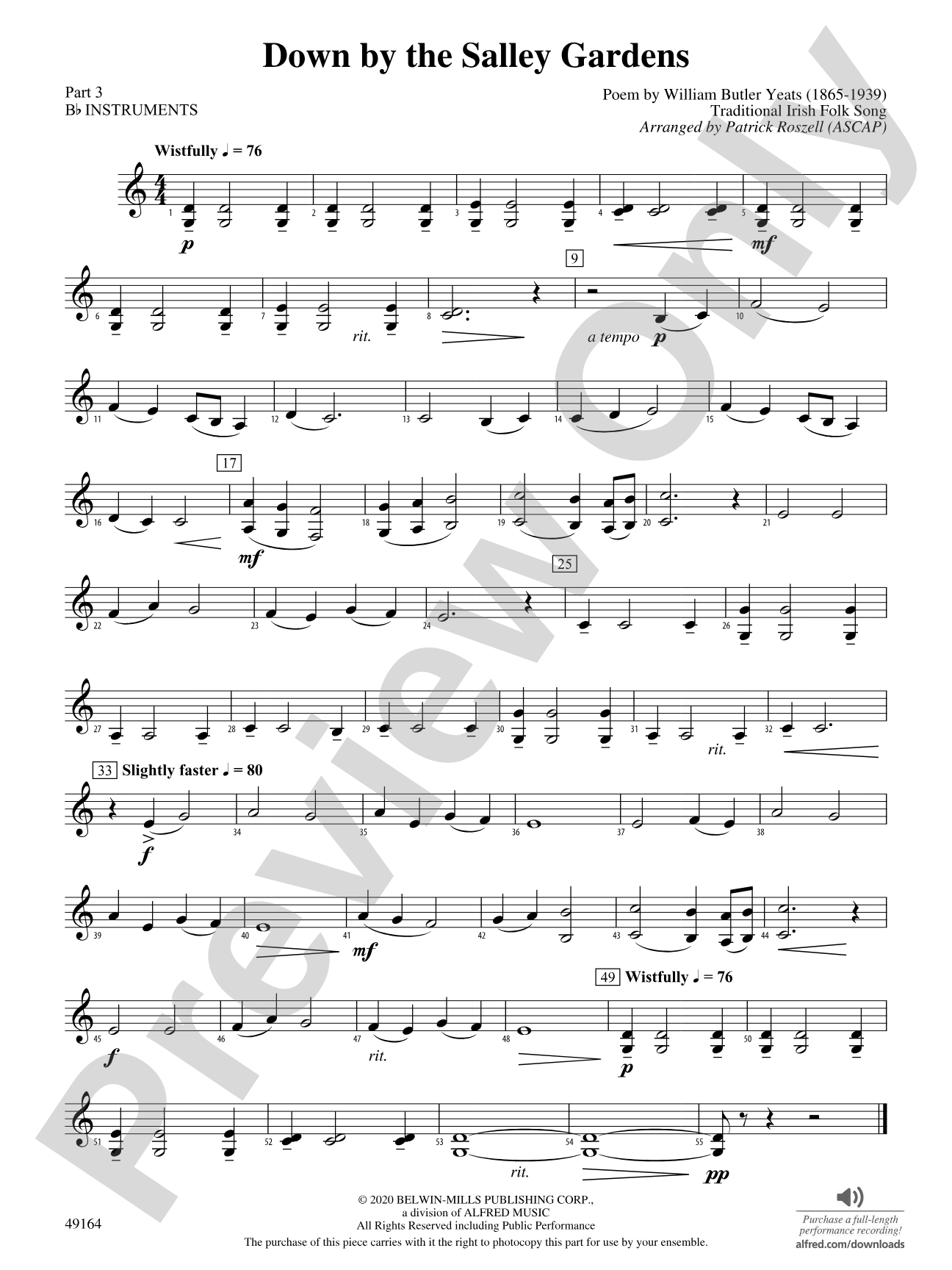

Down by the Salley Gardens: Part 3 - B-flat Instruments
Poem by William Butler Yeats (1865-1939) / Traditional Irish Folk Song / arr. Patrick Roszell
Grade: 1 (Very Easy)
Item: 00-PC-0018498_PART3_BFLAT
$3.00
Pickup currently not available
Description
This version of Down by the Salley Gardens arranged by Patrick Roszell is part of our Belwin FLEX offerings and is designed with maximum flexibility for use by any mix of instruments---wind, strings, and percussion, including like- or mixed-ensembles with as few as 4 players. The suggested instrumentation and a customizable Teacher Map will help you plan out how to best assign parts to suit your ensemble's needs. The 4-part instrumentation will support balanced instrumentation of the lower voices. It also comes with supplemental parts for maximum flexibility. With the purchase of this piece, permission is granted to photocopy the parts as needed for your ensemble. A percussion accompaniment track is also available as a free download. String parts have been carefully edited with extra fingerings and appropriate bowings to support students in mixed ensembles playing in less familiar keys.
The union of this glorious traditional Irish folk song with William Butler Yeats' compelling poem results in an expressive choice, arranged by Patrick Roszell. Lyrical in nature, there are musical teaching opportunities for slurring, sustaining phrases, intonation, and dynamic shading. Stunning! (3:00)
Percussion Accompaniment Track Downloads:
with click.
without click.
This title is available in MakeMusic Cloud.


The union of this glorious traditional Irish folk song with William Butler Yeats' compelling poem results in an expressive choice, arranged by Patrick Roszell. Lyrical in nature, there are musical teaching opportunities for slurring, sustaining phrases, intonation, and dynamic shading. Stunning! (3:00)
Percussion Accompaniment Track Downloads:
with click.
without click.
This title is available in MakeMusic Cloud.
Don't just read it, hear it, play along with it, and watch your students grow with it. In MakeMusic Cloud, Down by the Salley Gardens: Part 3 - B-flat Instruments comes alive with professional accompaniment, adjustable tempo, and built-in practice tools that turn solo practice into real progress.
Open in the Player
Jump straight in and assign it today.
Start Your Free Trial
Open this title and explore the full library in minutes.
Sample Audio
1
Audio File
--:--
0:00
0:00
Sample Video
No sample videos found.
Additional Details
Series:
Belwin Beginning Band
Publisher:
Alfred Music
Page Count:
73
SKU:
00-PC-0018498_PART3_BFLAT
More about this title
Why we love this
Roszell's arrangement respects the song's lyrical soul while making it genuinely playable for young ensembles across instrument families. The flexibility system is practical, not theoretical; you can actually build a balanced sound with whatever you have in the room, and the supplemental parts mean you're not locked into one instrumentation scheme. The string editing alone saves rehearsal time, with fingerings and bowings that account for keys and hand positions young players know.
What to expect
Serene and gentle, with the kind of melodic purity that comes from pairing a folk melody with Yeats' language. The arrangement invites singers without words; there's a sustained, almost pastoral quality that asks players to sustain and shape rather than rush, creating space and quietness in a young ensemble's sound.
Who it's for
Directors of beginning concert bands, mixed ensembles, and string groups who need a single piece that works with unpredictable or mixed instrumentation. It's equally at home in a full band setting, a quartet, or anything in between, making it ideal for schools with small programs or rehearsal spaces that combine different instruments.
How to get the most out of it
- Shape long tones with slight dynamic swell at the phrase midpoint, letting the line breathe rather than sit flat across the four bars.
- Listen across sections for blend on sustained passages; intonation sharpens naturally when players hear the neighboring parts clearly, especially in open vowel sounds and harmonic support.
- Use the percussion accompaniment track with click as a practice aid first, then pull it back in performance to let the ensemble ownership emerge.
- Balance the lower voices deliberately during sectionals so they anchor the melody without drowning it; Grade 1 ensembles often hide bass and baritone parts when they should sit warm underneath.
How to use it
Open a concert with this piece to set a reflective tone, or use it as an encore to close a program with something memorable and moving. It works well early in the school year as a sight-reading and phrasing study without demanding technical fireworks, giving students success while building listening skills.
Skills your students will build
- Sustaining long phrases without breaking tone
- Blending dynamics across changing instrumentation
- Reading mixed keys and transpositions in flexible scoring
- Intonation adjustment in changing harmonic contexts
- Shaping slurred passages with direction and shape