
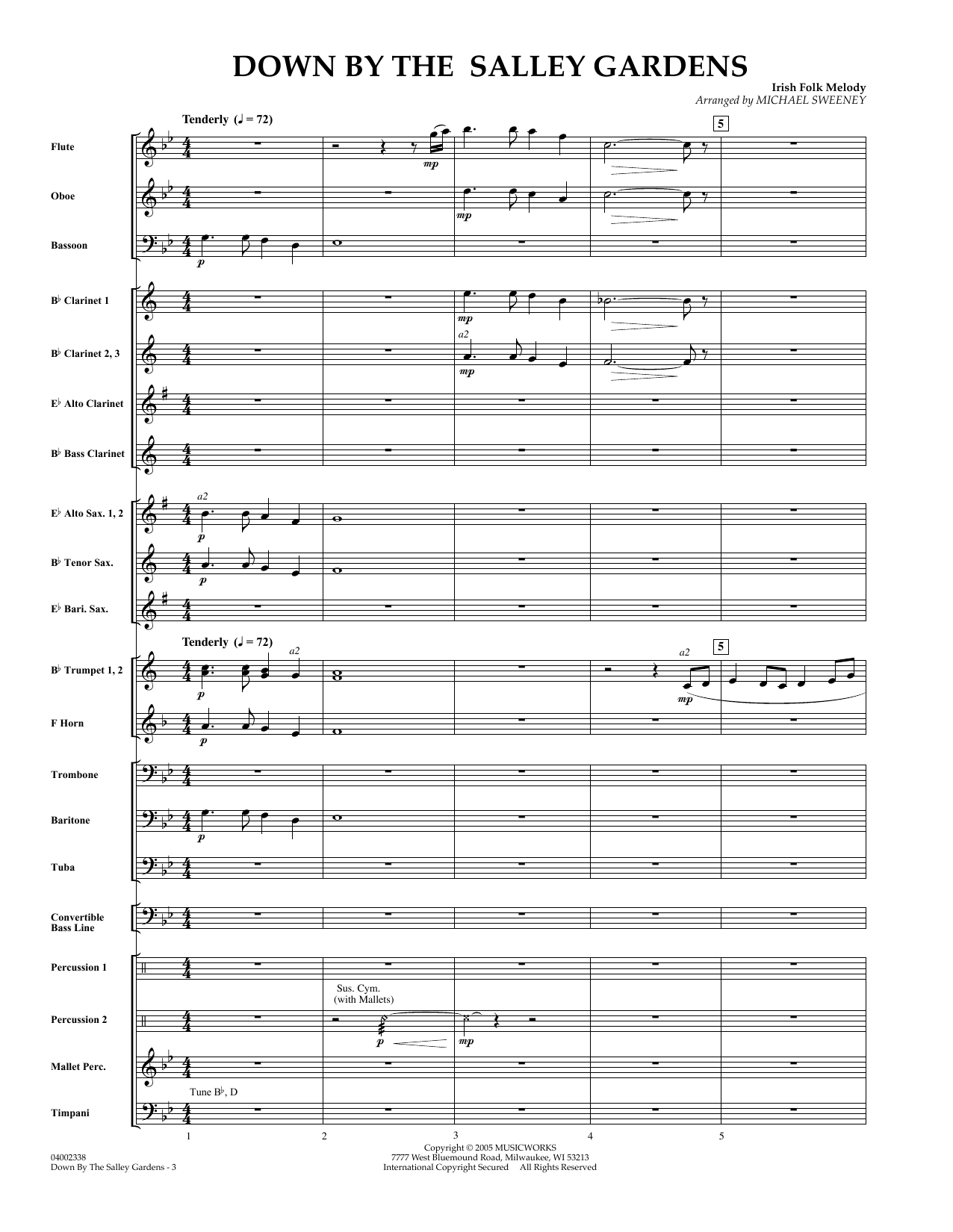

Down by the Salley Gardens: Concert Band Conductor Score & Parts
As performed by William Butler Yeats / Arranged by Michael Sweeney
Grade: 2
Item: 35-PK00315360
$65.00
Pickup currently not available
Buy Extra Parts (Digital PDF Download)
Parts Added to Cart!
Description
The haunting melody of this traditional Irish folk song is treated here in a lush and moving setting by Michael Sweeney. Even at this easy level, the instrumentation is varied and a wealth of musical elements are provided through creative harmonizations and carefully placed key changes. This is scored in a way that will make even small bands sound terrific. Dur: 3:05


Down by the Salley Gardens: Concert Band Conductor Score & Parts isn't in MakeMusic Cloud just yet...but it could be. Let us know you'd like to see it, and you'll help shape what comes next. In the meantime, start a free trial and dive into thousands of interactive titles your students can play along with today.
Request This Title
Tell us you want it.
Start Your Free Trial
Explore everything that's ready to play right now.
Sample Audio
No sample audio found.
Sample Video
No sample videos found.
Additional Details
Publisher:
Hal Leonard
SKU:
35-PK00315360
More about this title
About the Artist: William Butler Yeats
William Butler Yeats (1865-1939) was an Irish poet and playwright whose work became foundational to the Irish Literary Revival. His poetry drew deeply from Irish folklore, mythology, and the emotional landscape of his homeland. "Down by the Salley Gardens" originated as a poem in Yeats's 1889 collection "The Wanderings of Oisin and Other Poems," where it captured the melancholy beauty of lost love through vivid natural imagery.
For music educators, Yeats matters because his words have inspired countless musical settings across genres and styles. His gift for lyrical simplicity paired with emotional depth makes his poetry ideal for choral and instrumental arrangements. This particular text has become one of the most recorded traditional Irish songs, introducing generations of students to the intersection of literature and music.
Why we love this
Michael Sweeney's arrangement proves that Grade 2 doesn't mean simplistic. The varied instrumentation and harmonic sophistication here elevate a beloved melody without overwhelming developing musicians, making this an ideal choice when you want your band to sound polished and expressive at a manageable technical level. The key changes create genuine musical drama while remaining accessible, and scoring this lean gives every section meaningful material rather than filler.
What to expect
There's a wistful quality here, the kind of beauty that comes from restraint rather than effort. The lush harmonies create warmth around a melody that feels both timeless and intimate, evoking an Irish garden at dusk where memory and landscape merge. Even at this accessible level, the arrangement manages to be genuinely moving.
Who it's for
This works for developing bands that need something graceful and expressive without technical complexity. It fits well in programs where you're building artistic maturity alongside fundamental skills, and it's particularly valuable for bands learning to balance ensemble blend with clear melodic projection.
How to get the most out of it
- Shape the opening melody with a gentle arch rather than playing it straight; the tune invites subtle rubato that brings out its lyrical character without breaking the steady accompaniment underneath.
- Balance harmony voices carefully during the key changes so that the shift feels like a revelation rather than a jolt; support your melody line during these moments so the new harmonic color registers clearly.
- Let the three-minute duration work for you by maintaining steady focus throughout; this is a piece that breathes rather than rushes, and young musicians benefit from the discipline of sustaining a gentle, singing quality from start to finish.
- Encourage the rhythm section to listen for the harmonic movement beneath the folk melody; woodwinds will lock in more securely when brass and reeds understand how the supporting voices move together.
How to use it
Program this early in the year when working on tone quality and blend; the gentle dynamics and singing style build good habits without demanding technical facility. It also pairs beautifully in a concert exploring folk traditions across cultures, or as a thoughtful contrast to more energetic contemporary works. The three-minute length makes it ideal for thematic programming around Irish heritage or poetry-inspired music.
Skills your students will build
- Sustaining pure ensemble tone across a full three minutes
- Tracking harmonic movement and voice independence
- Responding to subtle dynamic shaping in lyrical music
- Executing key changes with smooth voice leading
- Blending melody and accompaniment voices transparently