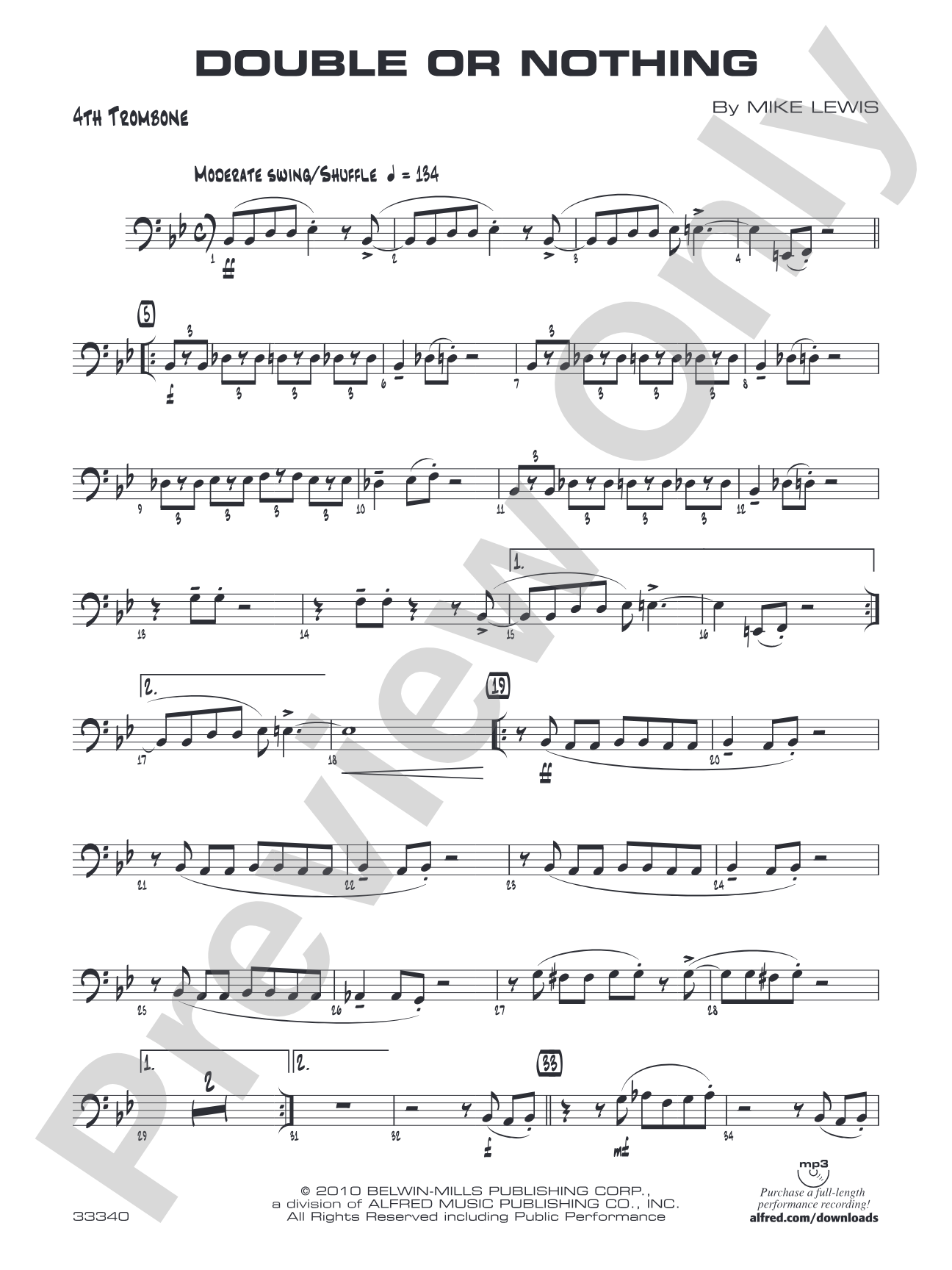
Double or Nothing: 4th Trombone Sheet Music Preview

Double or Nothing: 4th Trombone

By Mike Lewis

Grade: 2 (Medium Easy)

Item: 00-PC-0017168_TN4

Digital Download
$3.00
Description
This title is available in MakeMusic Cloud.

Don't just read it, hear it, play along with it, and watch your students grow with it. In MakeMusic Cloud, Double or Nothing: 4th Trombone comes alive with professional accompaniment, adjustable tempo, and built-in practice tools that turn solo practice into real progress.

Sample Audio
0:00
0:00
Sample Video
Additional Details
Series: Young Jazz Ensemble
Publisher: Alfred Music
Page Count: 90
SKU: 00-PC-0017168_TN4

More about this title

Why we love this

Mike Lewis writes for young jazz ensembles with genuine swing feel and accessible voicings that don't sacrifice musicality. Grade 2 charts from the Young Jazz Ensemble series give students real jazz vocabulary without overwhelming inexperienced sections, which means you're not simplifying the idiom—you're teaching it at the right pace.

What to expect

Genuine swing and playfulness without gimmicks. The writing has space for individual voices to emerge while keeping the ensemble grounded in straightforward harmonic movement and clear form.

Who it's for

Jazz ensemble directors teaching Grade 2 students who are beginning to understand jazz comping, swing feel, and ensemble listening. This works equally well for mixed-experience groups where you need material that serves developing musicians without patronizing them.

How to get the most out of it

  • Lock the comping rhythm in the piano and guitar parts before full section rehearsals; a solid harmonic foundation makes the horn lines and solos sit naturally.
  • Give soloists space to breathe between phrases, even in uptempo passages; the chart's structure supports individual voices, not wall-of-sound textures.
  • Balance the bass line as a melodic voice, not just timekeeping. Young bassists benefit from hearing how the walking line serves the harmony and supports comping players.
  • Use the conductor score to mark cues for soloists and section entries. At this level, clear visual reference points help students track form changes and keep ensemble confidence high.

How to use it

Program this in a jazz showcase or spring concert where you want to demonstrate that young ensembles can perform authentic jazz repertoire. It also pairs well as a centerpiece for a unit on jazz style and history, giving students a complete, singable example of swing comping and soloing in action.

Skills your students will build

  • Swing feel and rhythmic placement (straight eighth notes versus swing interpretation)
  • Jazz comping and harmonic awareness in rhythm section players
  • Reading and executing basic jazz notation (slash chords, rhythm slashes, swing indications)
  • Listening and responding to other soloists and section players in real time
  • Form navigation and ensemble cueing in a multi-chorus structure

You May Also Like