Dorian Variations: 2nd Violin Sheet Music Preview

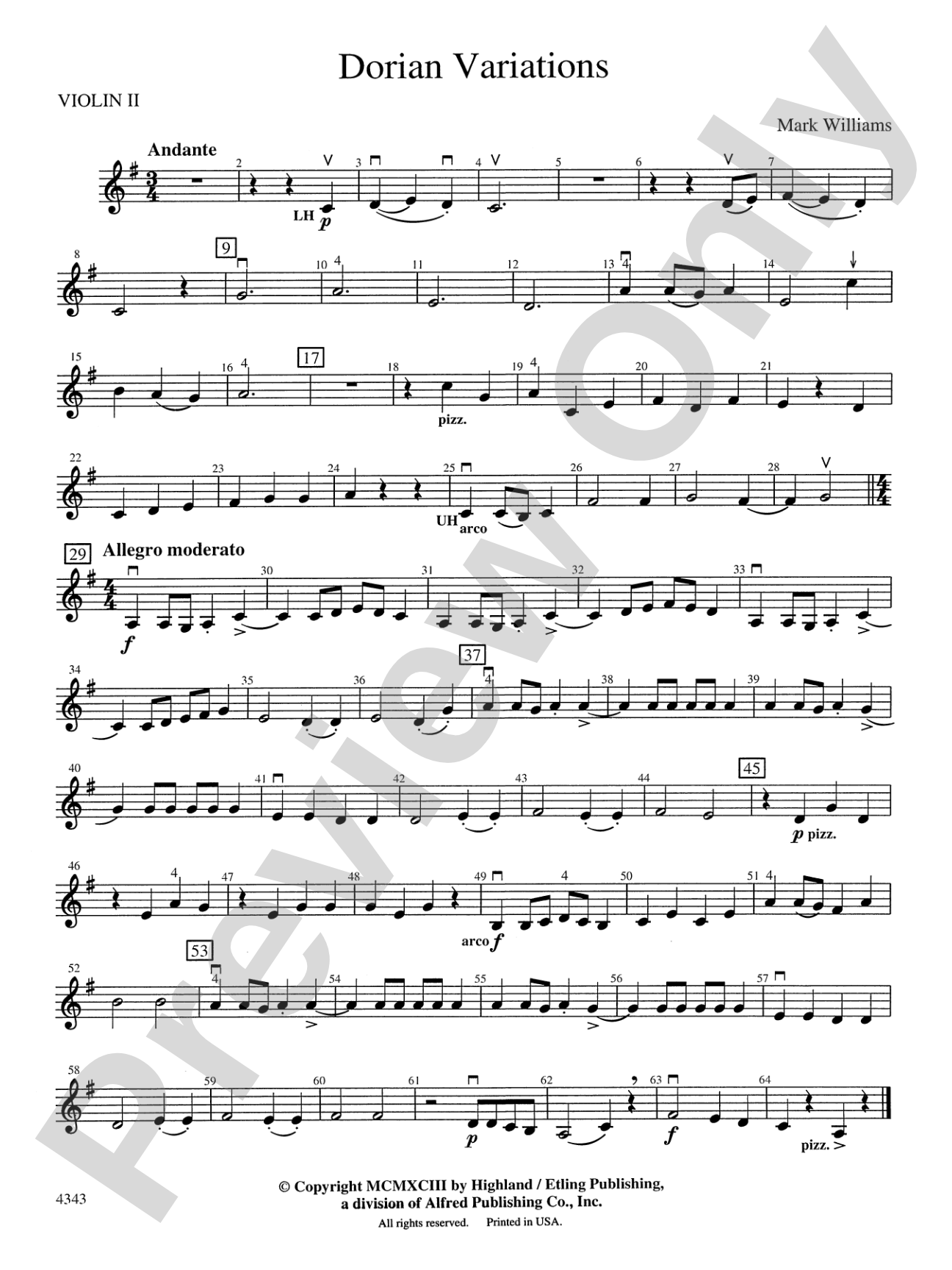
Dorian Variations: 2nd Violin

By Mark Williams

Grade: 1

Item: 00-PC-0001856_VN2

Digital Download
$5.99
Description
Mark Williams creates a vivid "Old English" flavor in his modal variations. The nocturne-like 3/4 Andante is nicely complemented by a strongly rhythmic 4/4 Allegro Moderato. Students will love the style and character of this colorful piece as they master the C-natural finger patterns and energetic eighth-note passages. (2:32) This title is available in MakeMusic Cloud.

Don't just read it, hear it, play along with it, and watch your students grow with it. In MakeMusic Cloud, Dorian Variations: 2nd Violin comes alive with professional accompaniment, adjustable tempo, and built-in practice tools that turn solo practice into real progress.

Sample Audio
0:00
0:00
Sample Video
Additional Details
Series: Highland/Etling Strictly Strings
Publisher: Alfred Music
Page Count: 72
SKU: 00-PC-0001856_VN2

More about this title

About the Composer: Mark Williams

Mark Williams

Mark Williams composed over 200 works for school ensembles and became known throughout North America for his distinctive voice in band and orchestra literature. His career took him across 34 states, five Canadian provinces, and Australia as a clinician and guest conductor, while he maintained a teaching position in Washington state focused on elementary band instruction.

Beyond composition, Williams was an accomplished bassoon performer and served as conductor and artistic director for the Spokane British Brass Band. His dual degrees from Eastern Washington University and his service as a woodwind arranger for the 560th Air Force Band shaped his deep understanding of instrumental writing. His contributions to music education earned him recognition through the Western International Band Clinic's Gralia Competition and multiple ASCAP Special Awards.

Why we love this

Williams captures something genuinely charming here without sacrificing musical substance. The modal writing creates an accessible entry point into tonal color while the contrasting tempos and meters keep the piece engaging for young players who might otherwise find variations predictable.

What to expect

The opening Andante evokes an intimate, reflective mood through its steady 3/4 pulse and modal color. When the Allegro Moderato enters with its energetic eighth-note motion, the piece shifts into something more dance-like and spirited, creating a satisfying arc from stillness to movement.

Who it's for

Grade 1 string orchestras ready to explore modal writing and contrasting forms without sacrificing musicality. Players at this level will find the C-natural patterns manageable enough to focus on ensemble listening and stylistic interpretation rather than survival through the piece.

How to get the most out of it

  • Emphasize the contrast between the lyrical Andante and the driving Allegro Moderato by adjusting both tone and articulation; the shift from 3/4 to 4/4 should feel like a distinct character change, not just a tempo increase.
  • Build security in the C-natural finger patterns during sectional rehearsals before combining parts; isolating these passages allows players to develop muscle memory without the cognitive load of managing texture and balance simultaneously.
  • Shape the eighth-note figures in the Allegro Moderato with attention to phrase contour rather than mechanical precision; students often play these passages as isolated technical challenges when the composer intended them as rhythmic momentum through longer lines.

How to use it

Program this as a standalone concert piece or as part of a set exploring modal music across different eras. Its colorful "Old English" character pairs well with other folk-influenced or modal works, and the concise length makes it ideal for festival performances or a supplementary piece in an all-strings concert.

Skills your students will build

  • Reading and playing in C Dorian mode
  • Shifting between 3/4 and 4/4 meters
  • Executing running eighth-note passages with rhythmic precision
  • Sustaining lyrical phrasing in slow tempo
  • Responding to contrasting articulation and character within a single piece

You May Also Like