Donna: Piano/Vocal/Chords Digital Sheet Music

Donna: Piano/Vocal/Chords Digital Sheet Music

Ritchie Valens

Item: 00-PS-0009126

Digital Download
$3.99
Description

Donna: Piano/Vocal/Chords Digital Sheet Music isn't in MakeMusic Cloud just yet...but it could be. Let us know you'd like to see it, and you'll help shape what comes next. In the meantime, start a free trial and dive into thousands of interactive titles your students can play along with today.

Sample Audio
No sample audio found.
Sample Video
Additional Details
SKU: 00-PS-0009126

More about this title

About the Artist: Ritchie Valens

Ritchie Valens (1941-1959) was a pioneering rock and roll musician who broke through racial barriers in the early rock era. At just 15 years old, he became the first Latino artist to achieve mainstream rock success, recording "Come On, Let's Go" and "Donna" while still in high school in California.

Valens' brief but influential career demonstrated that rock and roll could authentically blend multiple musical traditions. His use of the guitar, combined with his songwriting instinct for infectious melodies and driving rhythms, made him a crucial figure in rock's first generation. Though his life ended tragically at 17 in the 1959 plane crash that also claimed Buddy Holly and The Big Bopper, his recordings remain essential listening in any survey of early rock music.

Why we love this

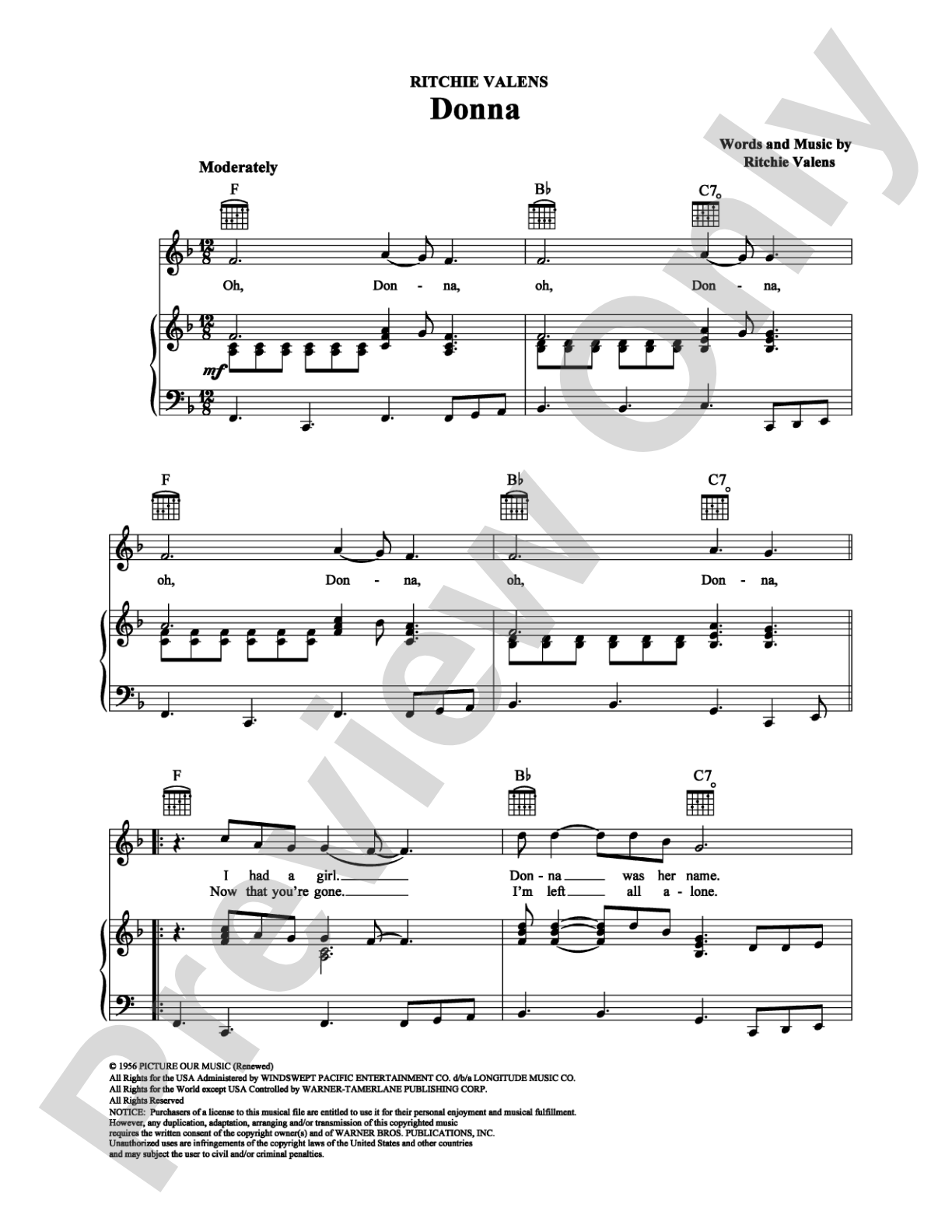
This arrangement captures one of the most charming rock and roll singles of 1958, with a melody that sits naturally for singers and clean piano voicing that doesn't demand virtuosity. The song's modest technical demands make it accessible for singers still building confidence with popular music, while its cultural significance opens doors for conversations about representation in early rock history.

What to expect

"Donna" carries the sincerity of mid-1950s rock ballads, earnest and unironic, with a melody that lodges immediately in the ear. The song radiates straightforward emotional directness without sentimentality, powered by a harmonic language that feels both familiar and slightly nostalgic.

Who it's for

Young singers (middle school through early college) exploring popular music repertoire and pianists seeking engaging accompaniments for recitals or studio partnerships. Teachers can also use this with ensemble singers preparing for pops concerts or music history units on early rock and roll.

How to get the most out of it

  • Keep the tempo steady and energetic; this song thrives on rhythmic lift, not rubato. The accompaniment pattern should feel like it's propelling the melody forward.
  • Balance the vocal line over the piano chords without drowning out the harmonic movement. The simplicity of the arrangement relies on clarity.
  • Lean into the warmth of the lyrics. The earnestness of a teenage rock and roller writing about a girl is part of the song's charm; avoid oversinging or becoming overly sentimental.

How to use it

Program this alongside other early rock standards in a pops or "Rock Through the Decades" concert to give students and audiences a sense of the genre's historical roots. It pairs well with other 1950s hits and works particularly effectively as a solo feature that doesn't require elaborate orchestration.

Skills your students will build

  • Singing over steady harmonic accompaniment in a pop context
  • Interpreting rhythm section patterns and maintaining ensemble cohesion with piano
  • Balancing vocal projection and interpretive choices with simplicity of arrangement
  • Reading chord symbols and understanding basic rock and roll harmonic structure

You May Also Like