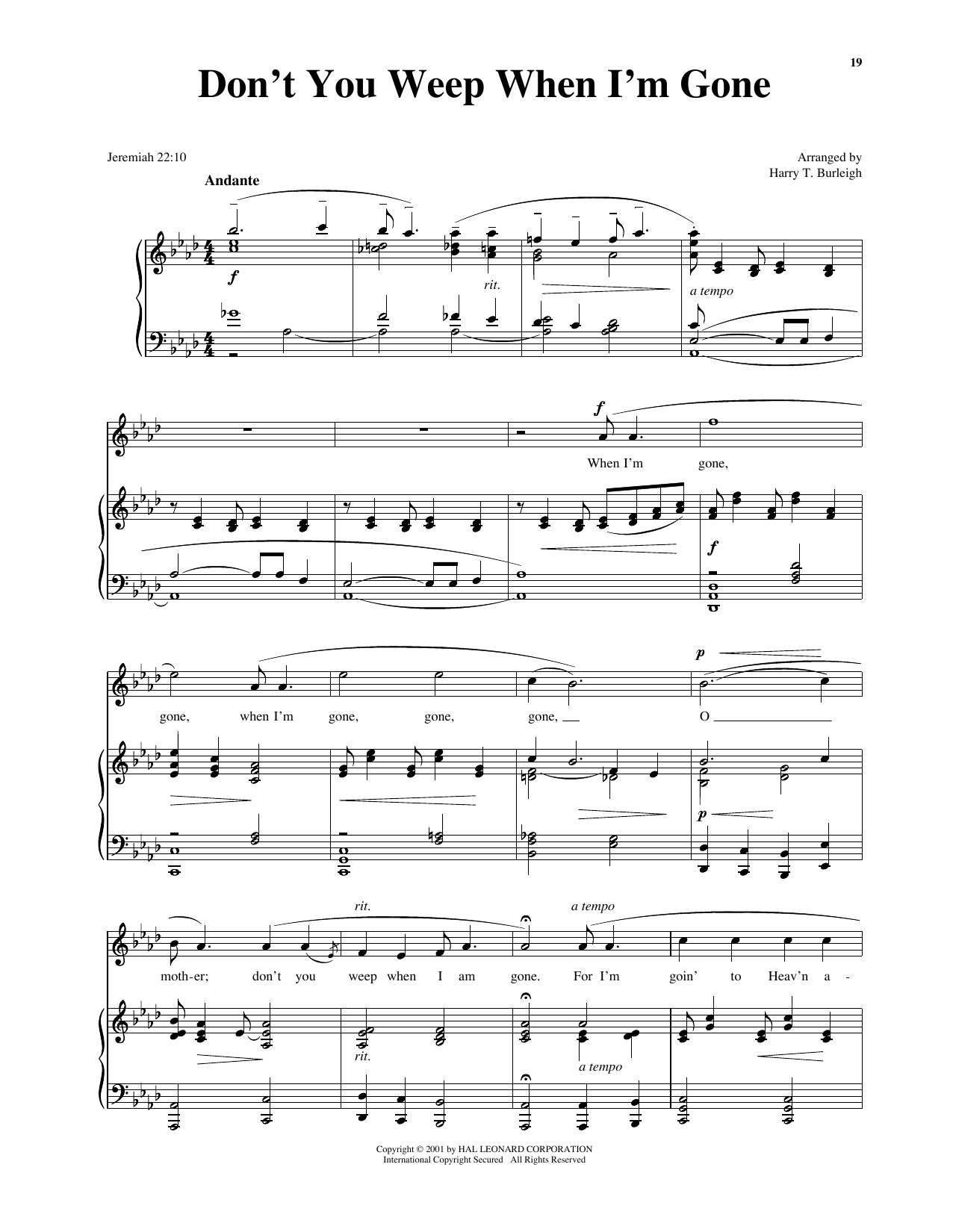
Don't You Weep When I'm Gone Sheet Music Preview

Don't You Weep When I'm Gone: Piano Vocal

Arranged by Richard Walters / Arranged by Harry T. Burleigh

Item: 35-DS01536993

Digital Download
$5.99
Description

Don't You Weep When I'm Gone: Piano Vocal isn't in MakeMusic Cloud just yet...but it could be. Let us know you'd like to see it, and you'll help shape what comes next. In the meantime, start a free trial and dive into thousands of interactive titles your students can play along with today.

Sample Audio
No sample audio found.
Sample Video
Additional Details
Publisher: Hal Leonard
Page Count: 3
SKU: 35-DS01536993

More about this title

About the Arranger: Richard Walters

Richard Walters is a composer, arranger, and musicologist whose work centers on American vocal music and art song. His arrangements prioritize vocal clarity and accessibility while maintaining artistic integrity, making classical and traditional repertoire available to singers across experience levels.

Why we love this

Walters' arrangement respects the spiritual's emotional core while offering a piano part that's genuinely musical rather than merely accompanying. High voice singers get a setting that sits comfortably in the passaggio and allows for genuine interpretive depth.

What to expect

There's a quiet dignity in this spiritual, something between grief and acceptance. The harmonic language is warm and grounded, and the piano writing creates an intimate space where the voice can speak plainly about loss.

Who it's for

High voice soloists preparing recital repertoire, aria students exploring art song alternatives, and singers building a foundation in American vocal traditions. This arrangement also works for voice lessons where teachers want to deepen students' understanding of spiritual tradition without overwhelming technical demands.

How to get the most out of it

  • Shape the phrase arc across longer lines rather than stopping at bar breaks; spirituals live in their legit, sustained phrasing.
  • Let the piano establish the mood in the introduction; the accompaniment sets the emotional temperature before the voice enters.
  • Explore dynamic subtlety within the spiritual's restraint; this isn't about big gestures but about honest, quiet conviction.
  • Balance vibrato carefully in the highest passages to maintain the intimacy of the text and tune.

How to use it

Pair this with other American spirituals or art songs for a recital exploring themes of resilience and faith. It also fits naturally into a concert program examining vocal traditions from different cultures, offering a moment of reflective simplicity.

Skills your students will build

  • Phrasing across longer melodic lines without relying on rests
  • Interpreting text with restraint and emotional authenticity
  • Balancing vibrato in sustained high passages
  • Understanding the harmonic language of African American spirituals
  • Collaborating with a piano partner on rubato and emotional pacing

You May Also Like