Don't Worry 'Bout Me Sheet Music Preview

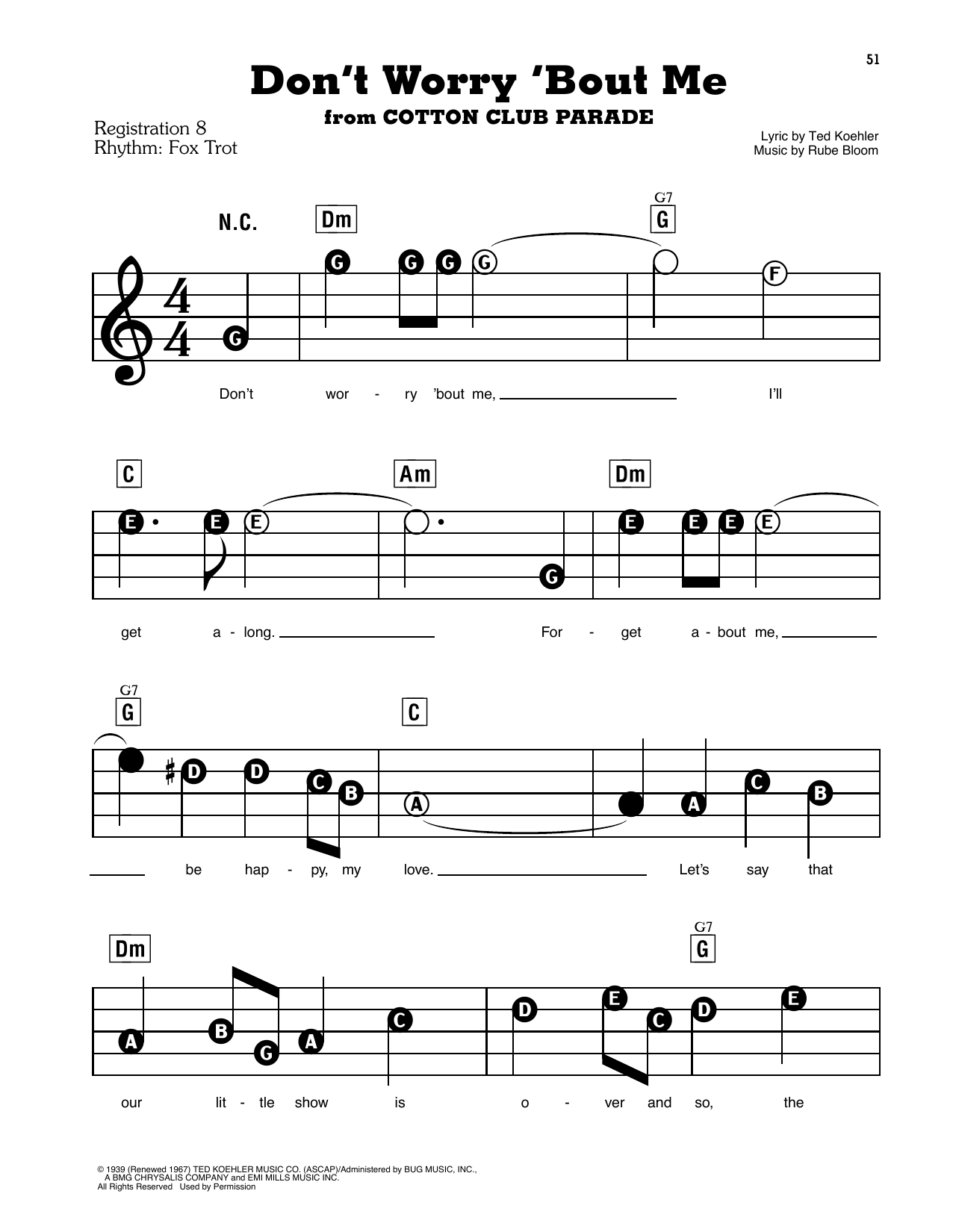
Don't Worry 'Bout Me: E-Z Play Today

As performed by Frank Sinatra

Item: 35-DS00447833

Digital Download
$4.99
Description

Don't Worry 'Bout Me: E-Z Play Today isn't in MakeMusic Cloud just yet...but it could be. Let us know you'd like to see it, and you'll help shape what comes next. In the meantime, start a free trial and dive into thousands of interactive titles your students can play along with today.

Sample Audio
No sample audio found.
Sample Video
Additional Details
Publisher: Hal Leonard
Page Count: 3
SKU: 35-DS00447833

More about this title

About the Artist: Frank Sinatra

Frank Sinatra (1915-1998) shaped American popular music across seven decades, moving fluidly between jazz standards, swing, and introspective ballads. His phrasing and interpretive approach to melody became the blueprint for how singers approach the Great American Songbook, making his recordings essential references for understanding vocal jazz and popular song interpretation.

Why we love this

Sinatra's arrangement of this standard hits the sweet spot between accessibility and sophistication. The three-page layout keeps it manageable for intermediate pianists while the jazz voicings and harmonic movement offer real interpretive depth, making it rewarding to revisit across different semesters.

What to expect

Warm, assured, and tinged with subtle melancholy. The standard's title promises reassurance, but Sinatra's treatment finds the wistfulness underneath, creating space for introspection even as the harmonic language swings.

Who it's for

Intermediate to advanced jazz pianists and students exploring the standards repertoire will find this arrangement straightforward without being simplistic. Teachers building a curriculum around American songbook material will appreciate having an authentic Sinatra arrangement at hand.

How to get the most out of it

  • Listen closely to the vocal inflections in Sinatra's original recording; his phrasing often sits ahead of or behind the beat in ways that deepen the emotional content, and mirroring that sensibility in the accompaniment elevates the whole performance.
  • Shape the melody line with rubato in the opening section. Sinatra never plays these songs mechanically, so give yourself permission to breathe with the phrase rather than lock strictly to the pulse.
  • Pay attention to chord voicings in the bridge. Jazz standards often hide their harmonic complexity there, and letting those extensions ring clearly transforms how the section feels.

How to use it

Pair this with other standards in a jazz or popular music set, or use it as a bridge between classical repertoire and jazz in a semester program focused on American musical traditions. The compact length makes it ideal for solo recital openings or as an intermission piece that lets audiences settle into a more intimate mood.

Skills your students will build

  • Interpreting jazz chord voicings and upper extensions
  • Rubato and flexible phrasing in accompaniment
  • Responding to a vocal melody without over-accompanying
  • Understanding harmonic language in the American songbook
  • Balancing technical accuracy with stylistic sensitivity

You May Also Like