
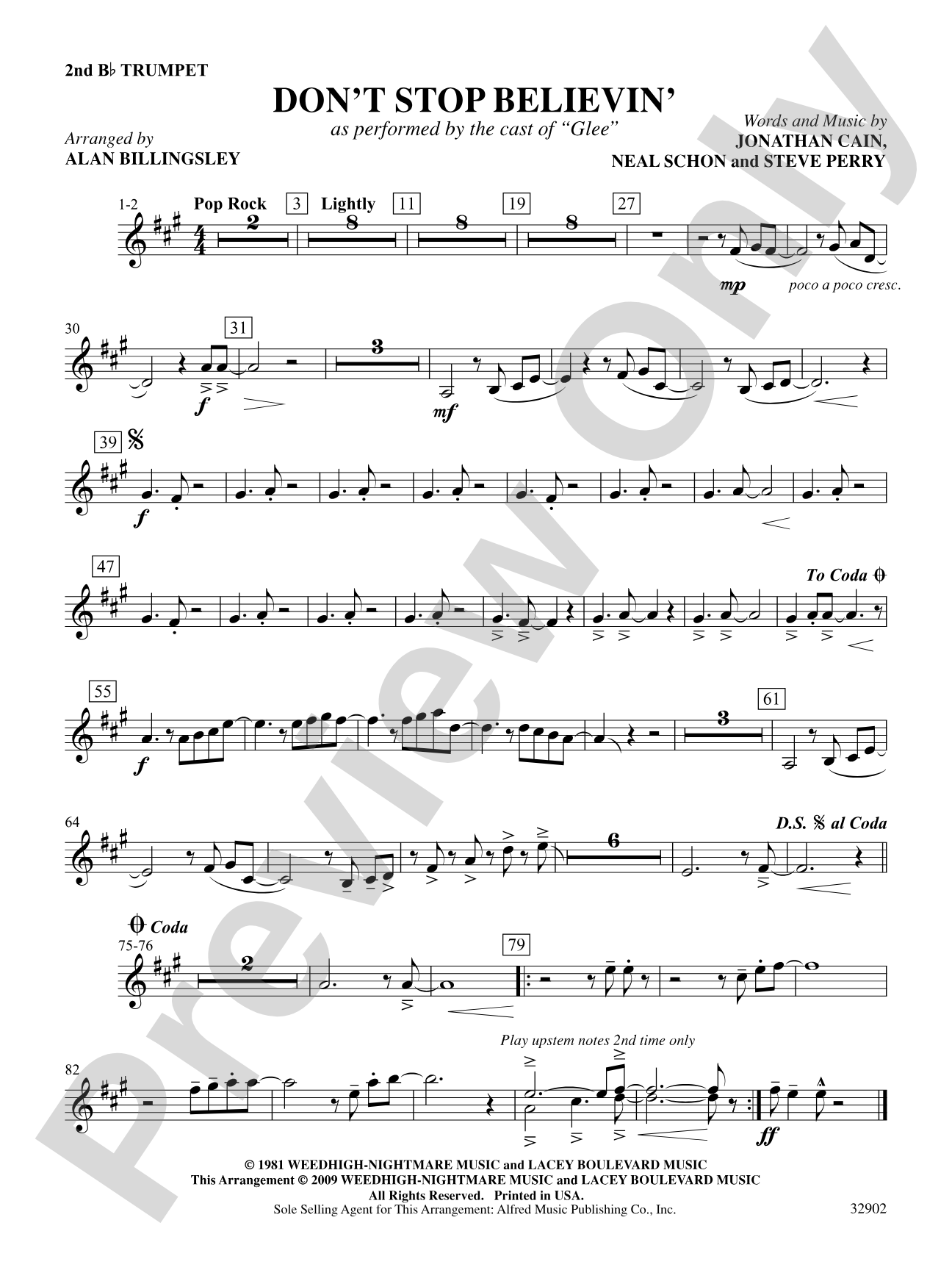

Don't Stop Believin': 2nd B-flat Trumpet: Choral SoundPax
As Performed by the cast of Glee / Words and music by Jonathan Cain, Neal Schon, and Steve Perry [Journey] / arr. Alan Billingsley
Item: 00-PC-0014419_T2
$3.00
Pickup currently not available
Description
Your students will thank you! This monster power ballad, as heard on the pilot episode of the hit TV show Glee, is from Journey's 1981 album Escape. It's also featured in the current Broadway musical Rock of Ages. This is a song for the ages!


Don't just read it, hear it, play along with it, and watch your students grow with it. In MakeMusic Cloud, Don't Stop Believin': 2nd B-flat Trumpet: Choral SoundPax comes alive with professional accompaniment, adjustable tempo, and built-in practice tools that turn solo practice into real progress.
Open in the Player
Jump straight in and assign it today.
Start Your Free Trial
Open this title and explore the full library in minutes.
Sample Audio
1
Audio File
--:--
0:00
0:00
Sample Video
No sample videos found.
Additional Details
Series:
Alfred Pop Choral Series
Publisher:
Alfred Music
Page Count:
26
SKU:
00-PC-0014419_T2
Instrumentation:
SoundPax
More about this title
About the Composer: Jonathan Cain
Jonathan Cain joined Journey in 1980 as keyboardist and became one of the band's primary songwriters. He co-wrote "Don't Stop Believin'" with Neal Schon and Steve Perry, a track that defined the band's sound and has since become one of the most recognizable rock anthems in popular music. His work spans decades of hit songwriting for one of rock's most enduring acts.
Cain's compositions blend accessible melodies with sophisticated harmonic language, qualities that make his songs particularly rewarding for choral arrangements. His influence on popular music extends well beyond Journey, with his songs covered and reinterpreted across genres and media.
Why we love this
Alan Billingsley's arrangement captures the soaring, anthemic quality that makes this song so singable while remaining true to the original's emotional arc. The SoundPax format gives you flexibility in how you present it—whether as a full choral feature or with instrumental support—making it equally effective in concert, assembly, or musical theater contexts. Students connect instantly to music they already know, and this particular song carries enough musical substance to reward genuine artistic interpretation.
What to expect
A declaration of resilience wrapped in soaring melodies and rich harmonies. The song builds from intimate vulnerability to anthemic triumph, with that unforgettable keyboard hook translated into the fabric of the vocal writing itself. Singers feel the weight of commitment when they nail those sustained notes in the chorus.
Who it's for
High school and mature middle school choirs looking to program contemporary rock repertoire with genuine artistic substance. This works equally well for auditioned ensembles and mixed-ability choirs, since the arrangement accommodates a range of vocal sophistication while keeping the song's essential power intact.
How to get the most out of it
- Balance the opening with restraint; let the verses breathe before the full sound emerges at the chorus. This dynamic shape mirrors the original and builds listener investment in the payoff.
- Pay attention to vowel consistency across your sections during the soaring chorus lines. The height and brightness of the sustained notes depends on unified vowel shapes.
- Use the recorded accompaniment strategically during rehearsals to establish harmonic accuracy, then gradually move toward singing without it so students own the parts independently.
- Shape the final chorus and outro with a slight broadening in tempo to honor the song's cinematic quality without losing forward momentum.
How to use it
This is a natural fit for pop or contemporary music concerts, but it also works beautifully as an opener or closer on more traditional programs—it signals to your audience that they're about to experience singers who can handle both classical technique and contemporary style. Consider pairing it with other rock-era pieces to build a thematic program, or use it as a standalone feature that showcases your ensemble's range.
Skills your students will build
- Sustaining long, legit phrases over full chords without fading in intensity
- Balancing individual part independence against vertical harmonic alignment
- Interpreting contemporary popular music with the same artistic intentionality as classical repertoire
- Navigating rhythmic precision in a contemporary idiom
- Building ensemble blend across a large, four-part texture