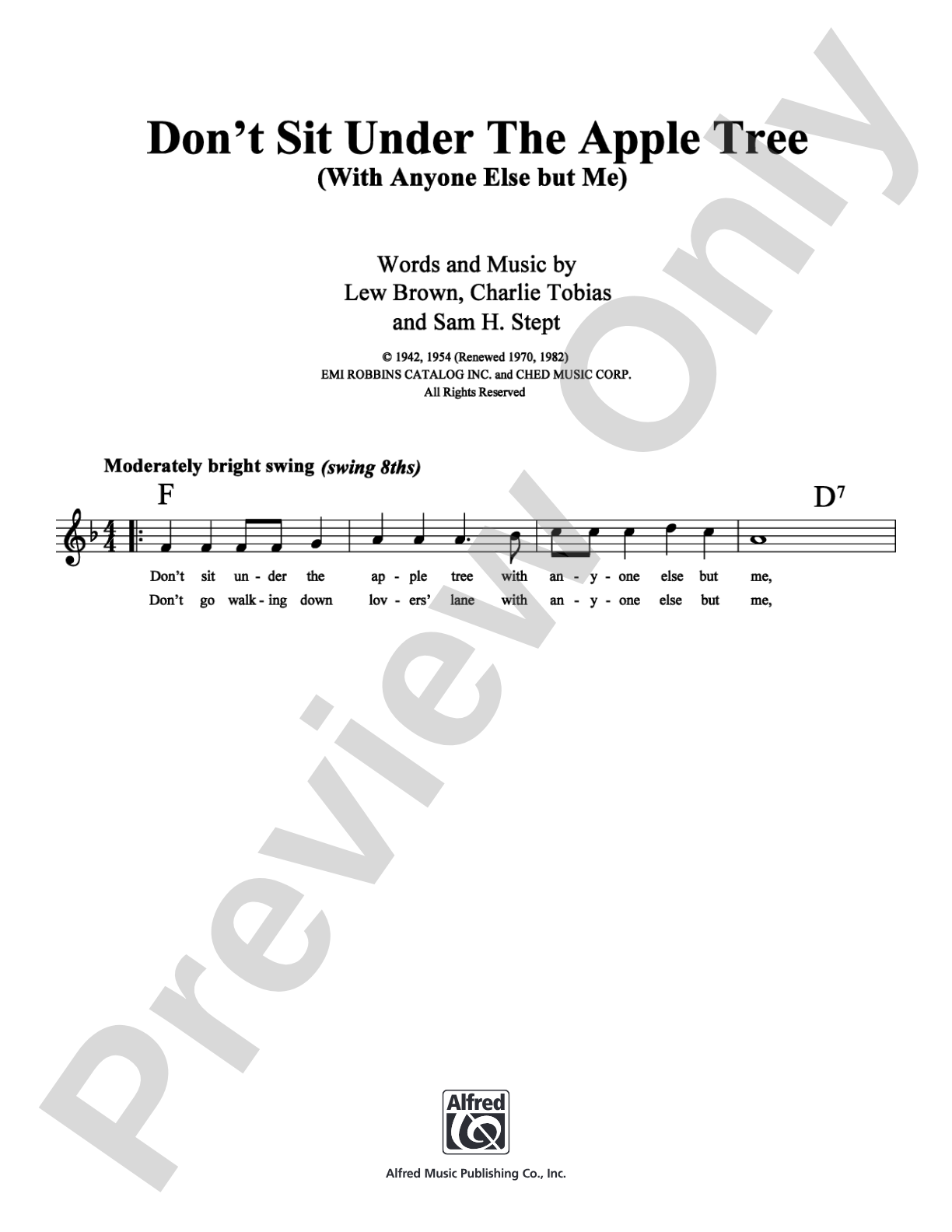
Don't Sit Under The Apple Tree (With Anyone Else But Me): Lead Sheet Digital Sheet Music

Don't Sit Under The Apple Tree (With Anyone Else But Me): Lead Sheet Digital Sheet Music

Charlie Tobias, Lew Brown, Glenn Miller, Sam H. Stept, The Andrews Sisters

Item: 00-PS-0009459

Digital Download
$1.99
Description

Don't Sit Under The Apple Tree (With Anyone Else But Me): Lead Sheet Digital Sheet Music isn't in MakeMusic Cloud just yet...but it could be. Let us know you'd like to see it, and you'll help shape what comes next. In the meantime, start a free trial and dive into thousands of interactive titles your students can play along with today.

Sample Audio
No sample audio found.
Sample Video
Additional Details
SKU: 00-PS-0009459

More about this title

About the Artist: Glenn Miller

Glenn Miller led one of the most commercially successful big bands of the 1940s, bringing a refined, organized sound to swing that appealed to mainstream audiences. His arrangements emphasized clear voicing and precision; the "Miller Sound" became synonymous with the era's most polished orchestral jazz. Though his life was cut short when his plane disappeared over the English Channel in 1944, his recordings remain cultural touchstones of the American Swing Age.

Why we love this

This lead sheet captures one of the most recognizable melodies from the Swing Era, a tune that still resonates across generations. It's an ideal vehicle for exploring the harmonic language and rhythmic swing of 1940s popular music without the complexity of a full big band chart.

What to expect

Buoyant and nostalgic, with an infectious melodic hook that bounces along on offbeats and swung rhythms. There's warmth in the melody and a gentle humor in the lyric conceit that makes this feel like eavesdropping on a moment of romantic certainty from another era.

Who it's for

This lead sheet works well for jazz students, pianists exploring Swing Era repertoire, and singers preparing for standards-focused recitals or jam sessions. It's equally valuable for anyone studying the harmonic vocabulary and song structure typical of 1940s popular song.

How to get the most out of it

  • Establish a clear swing feel from the top; the melody sits best when the eighth notes breathe with a relaxed triplet subdivision rather than straight rhythm.
  • Pay attention to the lyrical phrasing between the questions posed in the first section and the confident answers that follow; this call-and-response shape should guide your interpretation.
  • Consider the context of the original recording: this was written as a light, humorous novelty song, so lean into the charm and playfulness rather than treating it sentimentally.

How to use it

Pair this with other Swing Era standards in a nostalgia-themed concert or jazz recital. It works equally well as a solo vehicle for a vocalist or pianist, or as a foundation for small jazz ensemble arrangements. The simple, clear notation makes it accessible for study sessions or informal performance settings.

Skills your students will build

  • Reading lead sheet notation and interpreting chord symbols
  • Recognizing and executing swing eighth-note rhythms
  • Understanding AABA song form in popular song
  • Comping changes over a familiar harmonic progression

You May Also Like