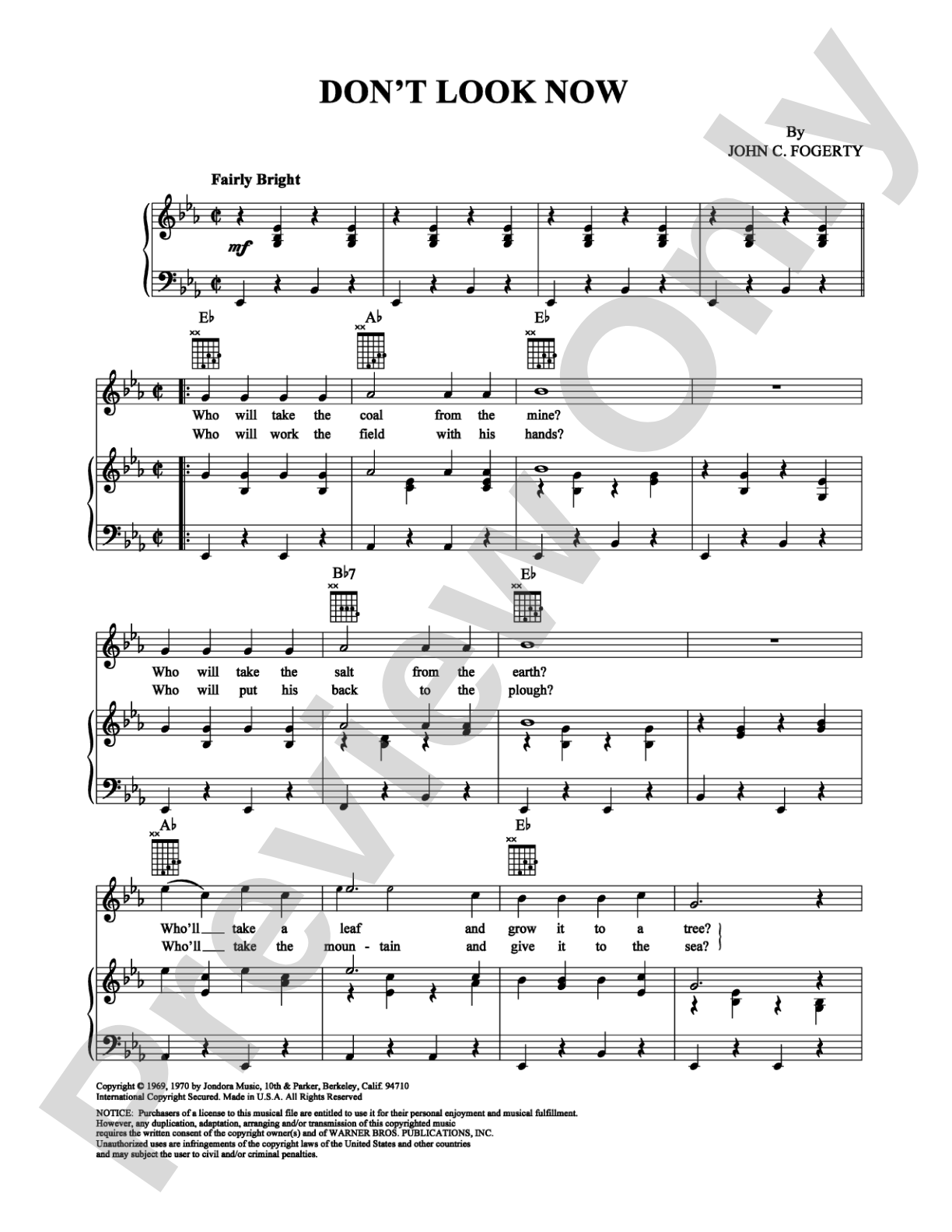
Don't Look Now: Piano/Vocal/Chords Digital Sheet Music

Don't Look Now: Piano/Vocal/Chords Digital Sheet Music

Creedence Clearwater Revival, John Fogerty

Item: 00-PS-0007611

Digital Download
$2.95
Description

Don't Look Now: Piano/Vocal/Chords Digital Sheet Music isn't in MakeMusic Cloud just yet...but it could be. Let us know you'd like to see it, and you'll help shape what comes next. In the meantime, start a free trial and dive into thousands of interactive titles your students can play along with today.

Sample Audio
No sample audio found.
Sample Video
Additional Details
SKU: 00-PS-0007611

More about this title

About the Artist: Creedence Clearwater Revival

Creedence Clearwater Revival emerged from El Sobrante, California, in 1967 and became one of the most commercially successful rock bands of their era. Led by John Fogerty's distinctive vocals and songwriting, the band combined swamp rock, blues, and country influences into a sound that dominated radio play and defined late 1960s and early 1970s rock music. Their catalog of hits includes "Proud Mary," "Bad Moon Rising," "Fortunate Son," and "Have You Ever Seen the Rain," songs that remain staples of popular music education and cover repertoire.

Why we love this

"Don't Look Now" showcases the band's gift for accessible rock songwriting paired with singable melodies that work equally well in vocal studio settings and contemporary pop ensembles. The piano/vocal/chords format gives singers and pianists a direct entry point to period rock repertoire that students recognize and want to perform. Choosing material that bridges the gap between popular music and formal musical training makes rehearsal time feel relevant.

What to expect

The song carries a reflective, mid-tempo rock sensibility with conversational vocal melody and understated harmonic movement. It unfolds with the confidence of a band that knew how to build a hit without resorting to spectacle, letting the song itself carry the weight.

Who it's for

Vocalists preparing contemporary pop repertoire for recitals, auditions, or ensemble performance will find this arrangement accessible and musically satisfying. Pianists accompanying singers benefit from straightforward chord notation paired with a melody line that requires sensitive listening and dynamic restraint. This material works for high school through adult singers with some performance experience.

How to get the most out of it

  • Anchor the groove in a steady, understated piano part; resist the urge to overplay comping chords, which will muddy the vocal line and disrupt the song's forward momentum.
  • Shape the vocal phrasing around natural speech rhythms and the song's lyrical storytelling rather than mechanical metric precision; this brings authenticity to the delivery.
  • Balance the lead vocal clearly above the piano; the chords support without dominating, so your accompanist should listen actively to the singer's phrasing and dynamics.

How to use it

Pair this with other 1960s-70s rock standards in a popular music recital or studio showcase to acknowledge repertoire that shaped modern musical taste. It also serves well as a bridge piece in a program that moves between classical work and contemporary material, demonstrating how rock songwriting employs similar musical principles.

Skills your students will build

  • Reading and interpreting chord symbols in a pop rock context
  • Balancing vocal phrasing with piano accompaniment
  • Understanding how melody relates to harmonic progression in popular song forms
  • Sustaining vocal tone and clarity over longer phrases in a conversational style

You May Also Like