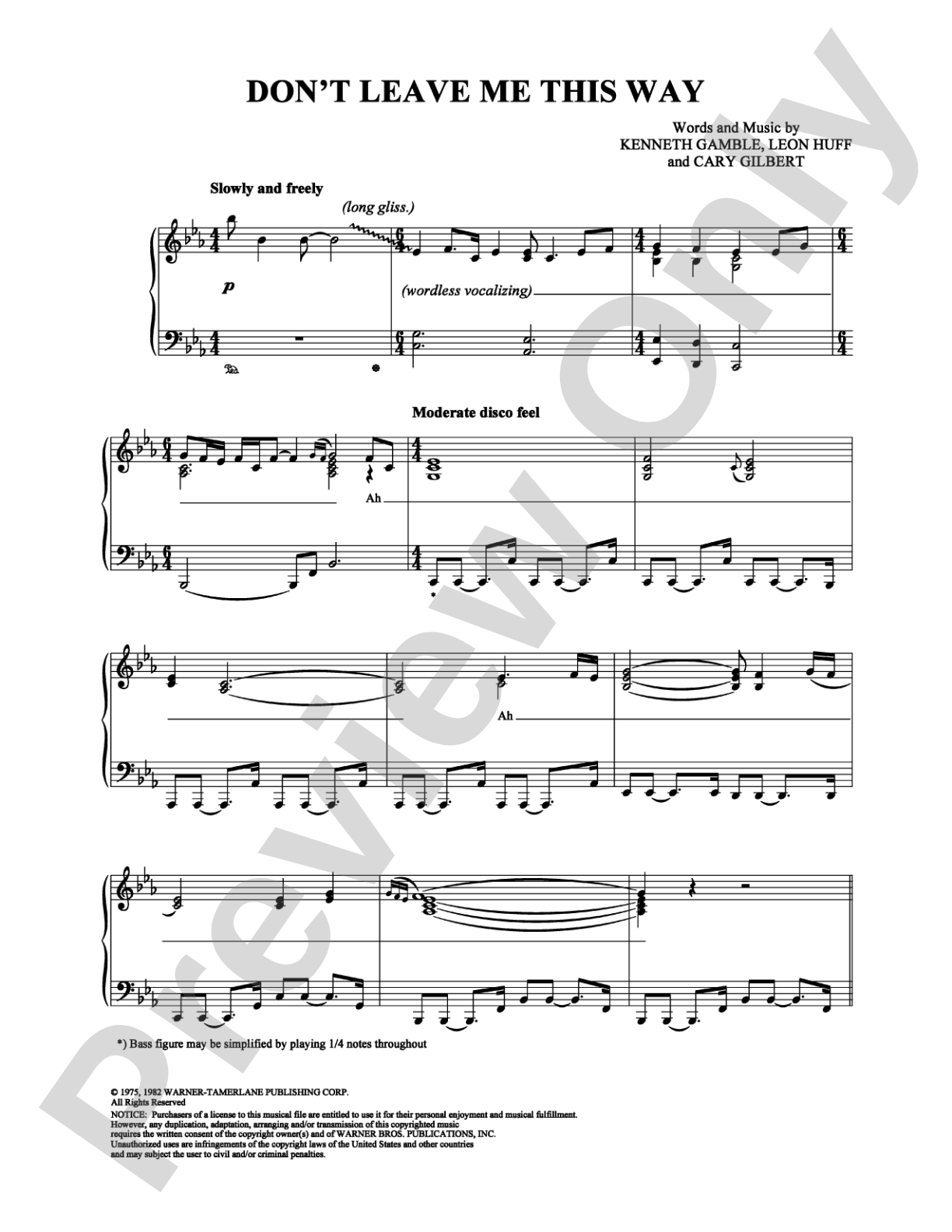
Don't Leave Me This Way: Piano/Vocal/Chords Digital Sheet Music

Don't Leave Me This Way: Piano/Vocal/Chords Digital Sheet Music

Kenneth Gamble, Leon Huff, Thelma Houston, Cary Gilbert

Item: 00-PS-0004596

Digital Download
$3.99
Description

Don't Leave Me This Way: Piano/Vocal/Chords Digital Sheet Music isn't in MakeMusic Cloud just yet...but it could be. Let us know you'd like to see it, and you'll help shape what comes next. In the meantime, start a free trial and dive into thousands of interactive titles your students can play along with today.

Sample Audio
No sample audio found.
Sample Video
Additional Details
SKU: 00-PS-0004596

More about this title

About the Artist: Thelma Houston

Thelma Houston is an R&B and pop vocalist whose powerful, commanding presence defined 1970s soul and disco. Her recording of "Don't Leave Me This Way" became a signature anthem, showcasing her ability to deliver emotional depth within an infectious groove. Houston's influence on contemporary vocalists extends far beyond her chart success; her fearless interpretation of material and technical control over dynamics and phrasing continue to inspire singers across multiple genres.

For music educators, Houston's work offers a masterclass in how to inhabit a song. Her interpretations demonstrate the importance of emotional authenticity, rhythmic flexibility, and understanding the relationship between lyrical content and melodic shape. These qualities make her recordings valuable references for singers learning how to move beyond technical accuracy into genuine communication.

Why we love this

This recording sits perfectly at the intersection of accessibility and vocal challenge. Singers get to explore soul phrasing and rhythmic control within a groove that feels contemporary enough to engage modern students, while the harmonic language offers pianists real collaboration opportunities. It's the kind of song that reminds everyone why pop music belongs in serious music education.

What to expect

Confident and soulful, with an undercurrent of both strength and longing. The groove propels everything forward, but beneath it sits genuine emotion; there's vulnerability in asking someone not to leave, even as the delivery remains assured and grounded.

Who it's for

Singers working on contemporary pop interpretation and jazz phrasing who want to understand how to handle groove-based material with emotional authority. Pianists preparing to accompany singers in pop, R&B, or musical theatre contexts will find practical chord voicing challenges and the chance to develop sensitivity to a vocalist's timing and shaping.

How to get the most out of it

  • Find the pocket between straight rhythm and swing feel. The groove sits slightly behind the beat; reference the original recording to locate where Houston lays back rhythmically.
  • Treat the chord symbols as starting points, not restrictions. Listen to how the original uses extensions, alterations, and reharmonization to create movement and color beneath the vocal line.
  • Shape phrases around the lyrics rather than strict 4-bar phrases. Houston's phrasing often extends or compresses to serve the emotional arc of the words.
  • Balance vocal power with vulnerability in slower sections. This song requires dynamic range beyond volume; the quieter moments matter as much as the belt.

How to use it

Program this as part of a contemporary vocal recital, alongside other pop standards and soul classics. It works equally well as a showcase for a singer with strong pop chops or as a stepping stone for jazz singers beginning to explore soul and R&B vocabularies. The song also pairs well with other 1970s material in concert programming that celebrates that era's vocal innovation.

Skills your students will build

  • Phrasing within a groove context
  • Rhythmic flexibility and swing feel
  • Dynamic control and emotional shaping
  • Understanding chord symbols beyond basic changes
  • Collaborative listening between vocalist and accompanist

You May Also Like