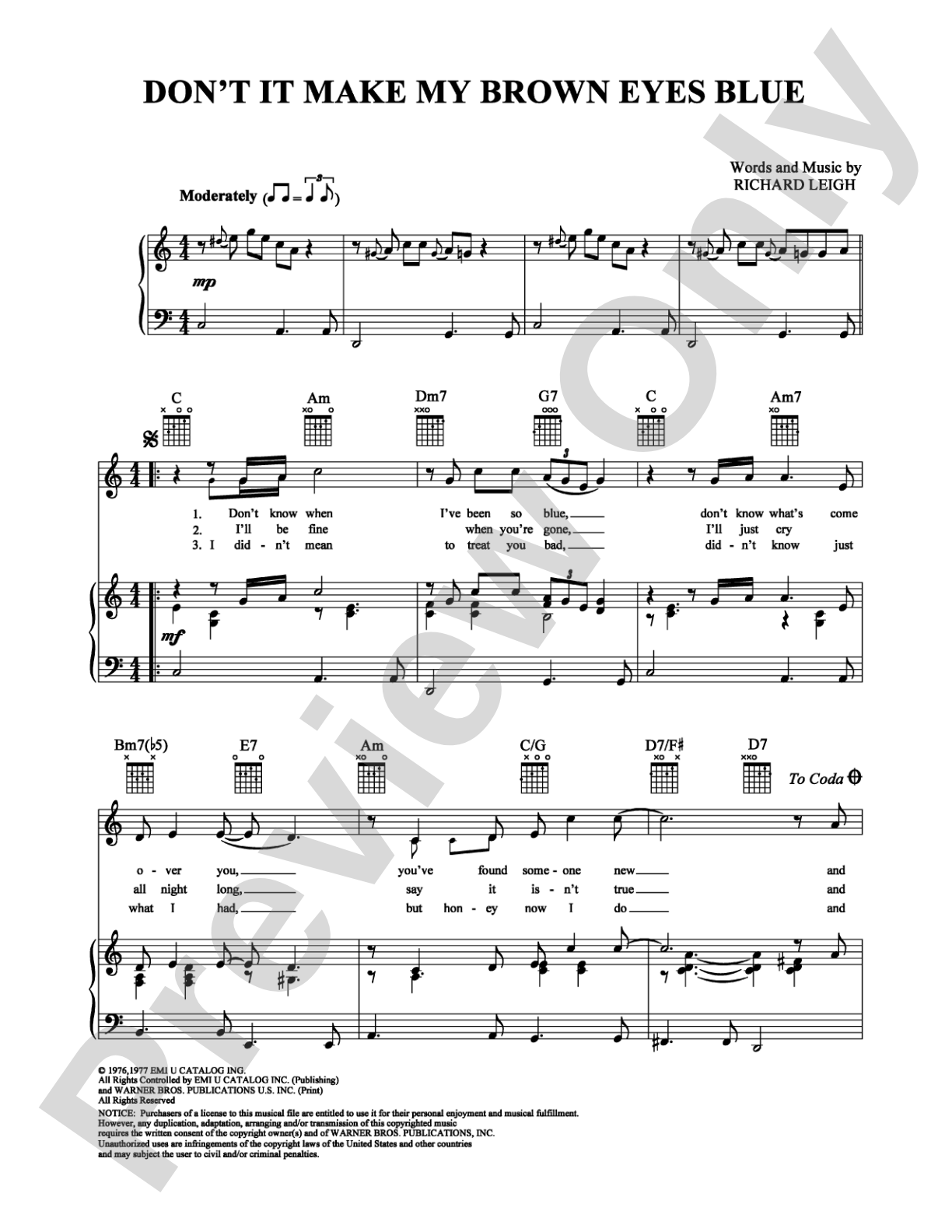
Don't It Make My Brown Eyes Blue: Piano/Vocal/Chords Digital Sheet Music

Don't It Make My Brown Eyes Blue: Piano/Vocal/Chords Digital Sheet Music

Crystal Gayle, Richard Leigh

Item: 00-PS-0007317

Digital Download
$3.99
Description

Don't It Make My Brown Eyes Blue: Piano/Vocal/Chords Digital Sheet Music isn't in MakeMusic Cloud just yet...but it could be. Let us know you'd like to see it, and you'll help shape what comes next. In the meantime, start a free trial and dive into thousands of interactive titles your students can play along with today.

Sample Audio
No sample audio found.
Sample Video
Additional Details
SKU: 00-PS-0007317

More about this title

About the Artist: Crystal Gayle

Crystal Gayle became the first female country artist to achieve a number one pop hit with "Don't It Make My Brown Eyes Blue" in 1977. Her distinctive vocal tone and sophisticated phrasing brought crossover appeal to country music during a pivotal moment in the genre's mainstream expansion. A classically trained vocalist with deep roots in bluegrass and country traditions, she shaped how country artists approached pop audiences without abandoning their musical identity.

Why we love this

This arrangement captures the intimacy and restraint that made the original recording so powerful. The piano/vocal/chords format lets singers and pianists focus on the emotional clarity of the melody and lyric rather than competing with a full arrangement, making it ideal for recitals, studio teaching, or intimate concert settings where storytelling takes priority.

What to expect

The song breathes with quiet longing and the certainty of specific memory. Its melody moves without urgency, resting in the middle of the voice's range where vulnerability feels most genuine. The harmonic movement is gentle but deliberate, supporting a lyric that confesses affection through observation rather than declaration.

Who it's for

This edition suits voice students and pianists who work in pop, country, and adult contemporary styles, as well as music theater students developing contemporary ballad skills. It's equally valuable for teachers seeking crossover repertoire that bridges country and popular music traditions with genuine musical substance.

How to get the most out of it

  • Shape the vocal line around the lyric's emotional arc rather than strict phrasing convention; the song's power lives in its vulnerability and conversational tone.
  • Support the vocalist with rhythmic clarity in the piano part while keeping dynamics restrained; this isn't a song that benefits from dramatic accompaniment.
  • Pay attention to the chord changes in moments of harmonic shift, as they often underpin the emotional weight of specific lyric moments.
  • Allow space between phrases; the original recording thrives on the silence and stillness between ideas, not on filling every moment with sound.

How to use it

Include this in a program exploring country and pop crossover repertoire, or pair it with other ballads that emphasize vocal storytelling and economy of arrangement. It works particularly well in contexts where students perform with acoustic piano only, highlighting the power of lyric and vocal tone over orchestration.

Skills your students will build

  • Phrasing and breath placement in contemporary ballads
  • Legit vocal production in middle-range singing
  • Harmonic listening and chord awareness for pianists
  • Lyric interpretation and emotional narrative in first-person songs
  • Accompanying skills that balance support with restraint

You May Also Like