
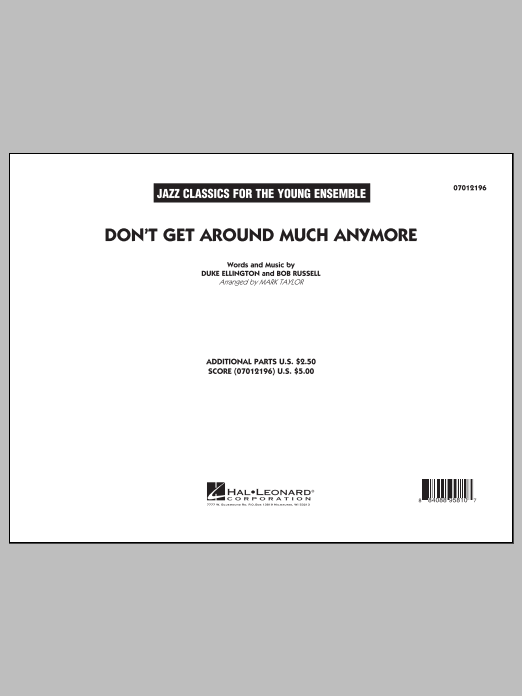

Don't Get Around Much Anymore: Jazz Ensemble Conductor Score & Parts
As performed by Duke Ellington / Arranged by Mark Taylor
Grade: 3
Item: 35-PK00290549
$50.00
Pickup currently not available
Buy Extra Parts (Digital PDF Download)
Parts Added to Cart!
Description
One of the trademark tunes from the Duke Ellington library, this familiar jazz classic is solidly scored for young players in this terrific arrangement by Mark Taylor. When it comes to playable charts in a medium swing style, this one can't be beat!


Don't Get Around Much Anymore: Jazz Ensemble Conductor Score & Parts isn't in MakeMusic Cloud just yet...but it could be. Let us know you'd like to see it, and you'll help shape what comes next. In the meantime, start a free trial and dive into thousands of interactive titles your students can play along with today.
Request This Title
Tell us you want it.
Start Your Free Trial
Explore everything that's ready to play right now.
Sample Audio
No sample audio found.
Sample Video
No sample videos found.
Additional Details
Publisher:
Hal Leonard
SKU:
35-PK00290549
More about this title
About the Artist: Duke Ellington
Duke Ellington stands as one of the most prolific composers in American music history, with a catalog spanning five decades and touching nearly every jazz style that emerged during his lifetime. His gift for melody and harmonic sophistication set a standard that still shapes how we teach jazz composition and arranging today. In the classroom, his works serve as blueprints for understanding how jazz can be both intellectually rigorous and irresistibly swinging.
Ellington's influence on music education runs deeper than repertoire alone. His insistence on writing specifically for the strengths of individual players, his fearless harmonic experimentation, and his ability to craft pieces that work equally well in formal concerts and casual jam sessions offer directors a masterclass in what great jazz writing accomplishes.
Why we love this
Mark Taylor's arrangement captures the essence of this Ellington standard without overcomplicating it for developing players. The medium swing groove sits right in the pocket for Grade 3 ensembles, giving students real jazz feel without the rhythmic or harmonic density that derails younger groups. It's the kind of chart that builds genuine confidence while sounding completely authentic.
What to expect
Relaxed sophistication. The tune has the ease of something you've known forever, wrapped in just enough harmonic flavor to feel genuinely jazz. There's room for interpretation and personality without demanding virtuosity.
Who it's for
Young jazz ensembles ready to move beyond funk grooves into authentic swing territory. Directors seeking repertoire that teaches jazz idiom through a recognized masterpiece rather than a teaching composition. Players who benefit from seeing how great melodies work in a jazz context.
How to get the most out of it
- Establish the shuffle feel early in sectional rehearsals. Have the rhythm section lock the triplet-based eighth notes before adding melody voices; this foundation makes the whole ensemble swing together.
- Balance the solo sections generously. This tune lives in its exposed melodies, so resist the urge to layer too much underneath the featured lines.
- Keep the tempo conversational. A medium swing around 120 bpm lets the jazz phrasing breathe and gives younger players room to phrase naturally without rushing.
- Shape the call-and-response moments between sections with clear dynamics. The arrangement likely trades phrases between reeds and brass, so mark those conversations in your score to highlight the dialogue.
How to use it
Pair this with other Ellington works for a thematic concert, or use it as an anchor piece in a jazz standards unit that also includes standards from other eras. It works beautifully as a closer to a lighter set, sending the audience out with a smile and a groove. Consider featuring it as a first solo vehicle for young soloists who need a forgiving, recognizable melody to build their improvisation vocabulary.
Skills your students will build
- Playing swing eighth notes with triplet feel and proper articulation
- Responding to jazz phrasing and call-and-response textures
- Maintaining consistent groove while navigating section dynamics
- Listening to other ensemble voices to shape balanced jazz voicings
- Understanding how a simple, memorable melody works in a jazz arrangement