
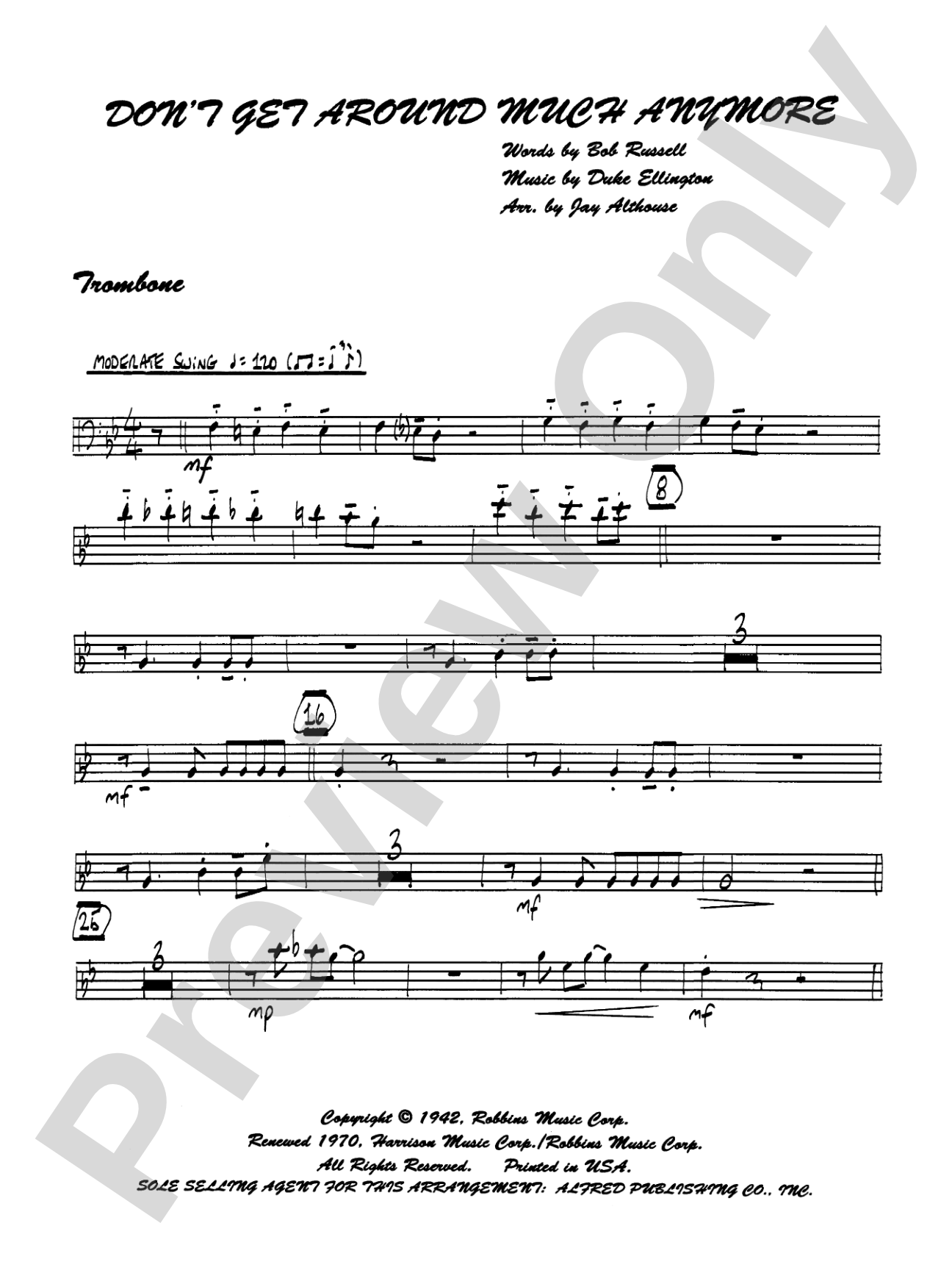

Don't Get Around Much Anymore: 1st Trombone: Choral SoundPax
Arr. Jay Althouse
Item: 00-PC-0015267_TN1
$3.00
Pickup currently not available
Description
A light, swinging, Jay Althouse arrangement of a Duke Ellington "standard." Features accessible voice leading and some simple scat syllables...but no vocal improvisation. Accessible voice leading. Add the SoundPax parts (horns and rhythm section) for an authentic, small combo sound. InstruPax includes: director's score, trumpet, trombone, 2 alto saxes, rhythm.


Don't just read it, hear it, play along with it, and watch your students grow with it. In MakeMusic Cloud, Don't Get Around Much Anymore: 1st Trombone: Choral SoundPax comes alive with professional accompaniment, adjustable tempo, and built-in practice tools that turn solo practice into real progress.
Open in the Player
Jump straight in and assign it today.
Start Your Free Trial
Open this title and explore the full library in minutes.
Sample Audio
1
Audio File
--:--
0:00
0:00
Sample Video
No sample videos found.
Additional Details
Series:
Alfred Choral Designs
Publisher:
Alfred Music
Page Count:
32
SKU:
00-PC-0015267_TN1
Instrumentation:
trumpet, trombone, 2 alto saxes, rhythm, score
More about this title
About the Arranger: Jay Althouse

Jay Althouse holds degrees in Music Education and Music from Indiana University of Pennsylvania, where he was later recognized with the Distinguished Alumni award. Early in his career, he spent eight years in rights and licensing administration at a major educational music publisher, where he also served on the Executive Board of the Music Publishers Association of America.
As a composer, Althouse has created more than 800 choral works performed throughout the English-speaking world. He holds membership in ASCAP and is a frequent recipient of the ASCAP Special Award. Beyond composition, he has co-written children's musicals with Sally K. Albrecht, compiled vocal solo collections, authored pedagogical resources including The Complete Choral Warm-up Book and Accent on Composers, and contributed educational reproducibles for music classrooms. His choral composition I Hear America Singing, co-written with Albrecht, was performed by the San Francisco Girls and Boys Choirs at President Obama's 2009 Inauguration. Althouse resides in North Carolina and serves on the National Advisory Board of the Folk Art Society of America.
Why we love this
Althouse's gift for accessible writing shines here: the voice leading never feels simplified, and singers stay engaged with real harmonic movement rather than padding their parts. The scat syllables add character without demanding jazz interpretation skills your singers don't yet have, making this feel authentic without being intimidating.
What to expect
Sophisticated and suave, with a small-group intimacy that swings. The arrangement captures the relaxed sophistication of a 1940s jazz combo while keeping the vocal writing accessible enough that singers can focus on phrasing and feel rather than struggling with technical demands.
Who it's for
Choirs at the intermediate level and up who want to explore jazz repertoire without requiring advanced improvisation skills or complicated arranging. Works equally well for a show choir looking to add a swinging standard or a concert choir eager to expand beyond classical and sacred music.
How to get the most out of it
- Shape the swing feel through the rhythm section parts; even modest commitment to the groove in piano and bass makes the whole arrangement breathe.
- Balance the horns carefully so they enhance rather than overpower the choir; these combo voicings work best when the sax and brass blend as a unified color.
- Keep the scat phrases light and syllabic; they're meant to sit comfortably alongside the choir, not showcase individual jazz credibility.
- Use the recorded accompaniment to lock the choir's rhythmic pocket, then gradually reduce reliance on it so singers internalize the swing.
How to use it
Pair this with other standards or jazz arrangements to create a full jazz-influenced concert set, or anchor it within a pop and contemporary program where it reads as an elegant genre shift. The modest instrumentation and under-32-page length make it ideal for spring pops concerts or versatile enough to slip into holiday programs with a jazz angle.
Skills your students will build
- Singing jazz phrasing and swing articulation
- Reading and performing scat syllables in ensemble
- Blending with small instrumental combo
- Understanding chord movement and harmony in jazz voicing
- Responding to rhythm section groove rather than conducting beat