Don't Blame Me: Piano Digital Sheet Music

Don't Blame Me: Piano Digital Sheet Music

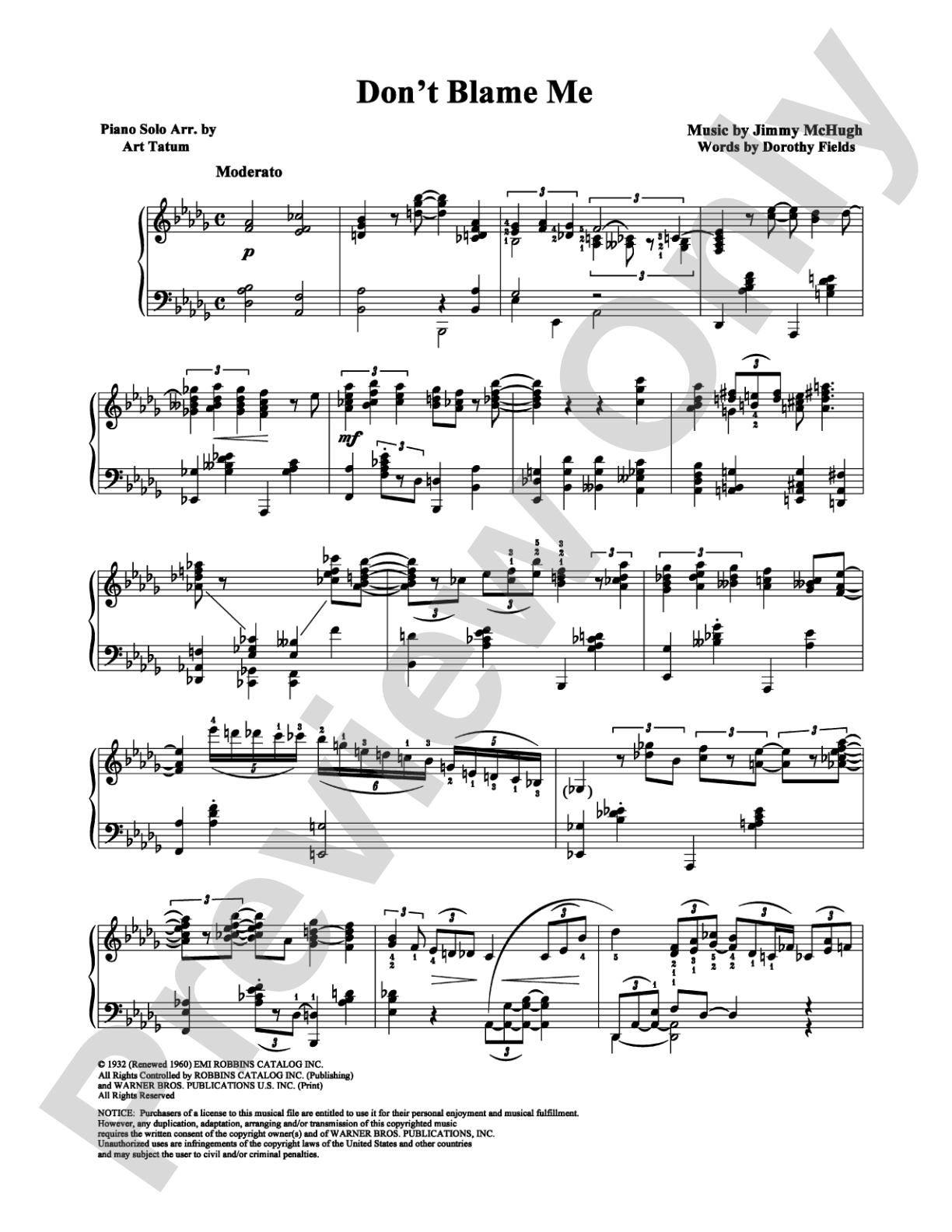
Jimmy McHugh, Art Tatum

Item: 00-PS-0007290

Digital Download
$3.99
Description

Don't Blame Me: Piano Digital Sheet Music isn't in MakeMusic Cloud just yet...but it could be. Let us know you'd like to see it, and you'll help shape what comes next. In the meantime, start a free trial and dive into thousands of interactive titles your students can play along with today.

Sample Audio
No sample audio found.
Sample Video
Additional Details
SKU: 00-PS-0007290

More about this title

About the Artist: Art Tatum

Art Tatum (1909-1956) stands as one of the most technically formidable pianists in jazz history. His lightning-fast runs, sophisticated harmonic substitutions, and ability to reimagine standards established him as a towering influence on generations of jazz pianists who followed.

Tatum's approach to repertoire was distinctive: he took popular songs and Broadway standards and transformed them through virtuosic improvisation and chromatic reharmonization. His interpretations became the template for how jazz pianists could balance respect for a tune's melody with radical harmonic and rhythmic freedom. His recordings remain essential listening for any pianist serious about understanding jazz language.

Why we love this

This is a masterclass in improvisation and reharmonization captured in notation. Tatum's treatment of this standard reveals how a jazz pianist can disassemble and rebuild a melody through chromatic voice leading and unexpected harmonic turns, making it invaluable for students learning to hear and think beyond the changes.

What to expect

Elegant and introspective, yet dazzling in execution. Tatum inhabits the vulnerability of the ballad while demonstrating complete command of the keyboard, creating moments of intimate lyrical beauty alongside passages of almost orchestral density.

Who it's for

Intermediate to advanced jazz pianists ready to tackle sophisticated harmonic language and technical demands. Students learning from recordings or method books studying jazz piano will find this transcription both inspiring and instructive as a model of how to reimagine standard tunes.

How to get the most out of it

  • Study the harmonic substitutions bar by bar. Tatum rewrites the chords underneath familiar melodies; understanding his logic opens doors to your own reharmonization ideas.
  • Don't rush the decorative passages. Those rapid runs serve the phrase architecture, not the other way around. They should feel inevitable, not tacked on.
  • Balance transparency with complexity. Even in his densest moments, Tatum kept the original tune audible. Let listeners hear the song inside the virtuosity.
  • Work through this slowly first without worrying about tempo. Lock in the harmonic movements and voice leading before adding speed and swing feel.

How to use it

Program this in a jazz recital as a solo piano feature or alongside other standard-based improvisations to showcase your development as a jazz musician. It works equally well as a private study piece, offering endless material for understanding how to voice chords, construct melodic lines, and shape a solo.

Skills your students will build

  • Reading and executing jazz chord substitutions and reharmonization
  • Balancing fast scalar passages with harmonic clarity
  • Understanding voice leading across the keyboard in a jazz context
  • Interpreting swing feel and rhythmic placement in notated jazz transcriptions
  • Developing left-hand independence and comping techniques

You May Also Like