Don't Be That Way: Lead Sheet Digital Sheet Music

Don't Be That Way: Lead Sheet Digital Sheet Music

Benny Goodman, Edgar Sampson

Item: 00-PS-0007284

Digital Download
$1.99
Description

Don't Be That Way: Lead Sheet Digital Sheet Music isn't in MakeMusic Cloud just yet...but it could be. Let us know you'd like to see it, and you'll help shape what comes next. In the meantime, start a free trial and dive into thousands of interactive titles your students can play along with today.

Sample Audio
No sample audio found.
Sample Video
Additional Details
SKU: 00-PS-0007284

More about this title

About the Artist: Benny Goodman

Benny Goodman (1909-1986) was a clarinetist and bandleader who became one of the most influential figures in American jazz. Known as the "King of Swing," Goodman broke racial barriers in the 1930s and 1940s by integrating his orchestras and small ensembles at a time when such collaboration was rare. His bands and combos recorded some of the era's most enduring standards, establishing a template for big band arranging and small group improvisation that remains central to jazz pedagogy.

Goodman's legacy extends far beyond the bandstand. His virtuosity on clarinet and his ear for arranging and personnel shaped how successive generations learned jazz repertoire and ensemble playing. Educators value his recordings and compositions as essential listening for understanding swing phrasing, section balance, and the interplay between composed melody and improvised solos.

Why we love this

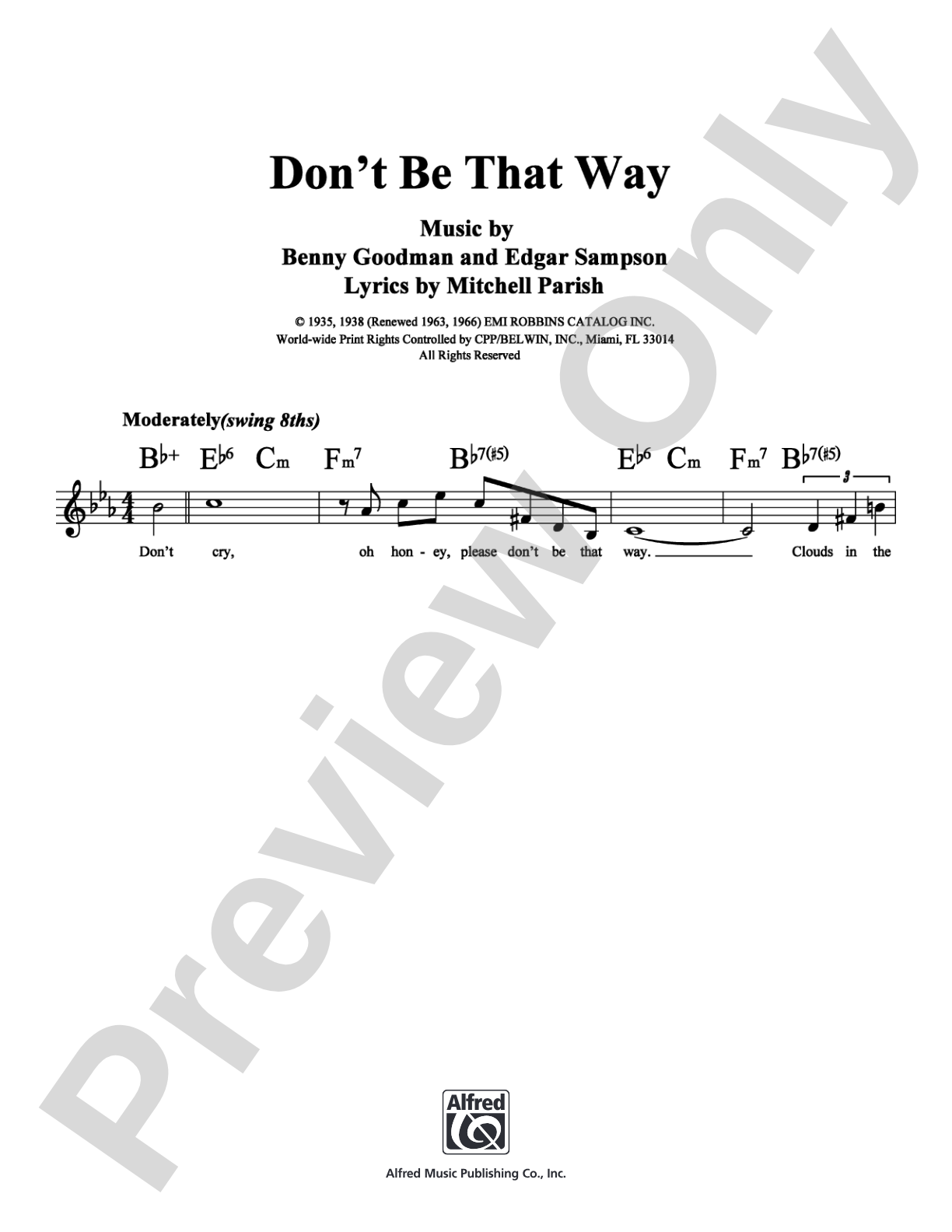
This standard distills everything that makes swing-era composition work: a memorable melody, natural harmonic movement, and room for genuine soloing without requiring elaborate reharmonization. Pianists and small ensemble leaders gravitate to this piece because the lead sheet format demands real listening skills and encourages musicians to listen to the classic Goodman recordings as part of their preparation.

What to expect

The tune moves with an easy, rolling confidence characteristic of early swing. There's lift in the melody without artifice, and the harmonic changes sit comfortably under the fingers, inviting you to play through them rather than around them.

Who it's for

Jazz pianists building their standards repertoire, small combo players learning the classic swing vocabulary, and music students who need a working lead sheet to transcribe solos or explore reharmonization. This format works equally well for classroom ear training and practice room preparation.

How to get the most out of it

  • Study at least one complete recording of the tune before writing in any changes; your first instinct for phrasing will be stronger if you know where the melody naturally breathes.
  • Pay attention to the upbeat figures and syncopation characteristic of swing phrasing; this lead sheet will read more authentically if you resist the temptation to straighten rhythms.
  • If you're comping behind a soloist, anchor your voicings to the root position chords first, then layer in extensions once you've solidified the basic harmonic rhythm.

How to use it

Use this as a study piece for jazz ensemble rehearsals focused on melody and basic changes, or program it in a jazz recital where the simplicity of the lead sheet allows soloists to shine without demanding sight-reading of complex notation. It also serves well as a bridge repertoire for students transitioning from classical to jazz contexts.

Skills your students will build

  • Reading and interpreting lead sheet notation
  • Swing phrasing and articulation specific to the jazz vernacular
  • Harmonic function and voice leading over ii-V-I progressions
  • Listening comprehension through comparison with recorded performances
  • Spontaneous reharmonization and melodic variation

You May Also Like