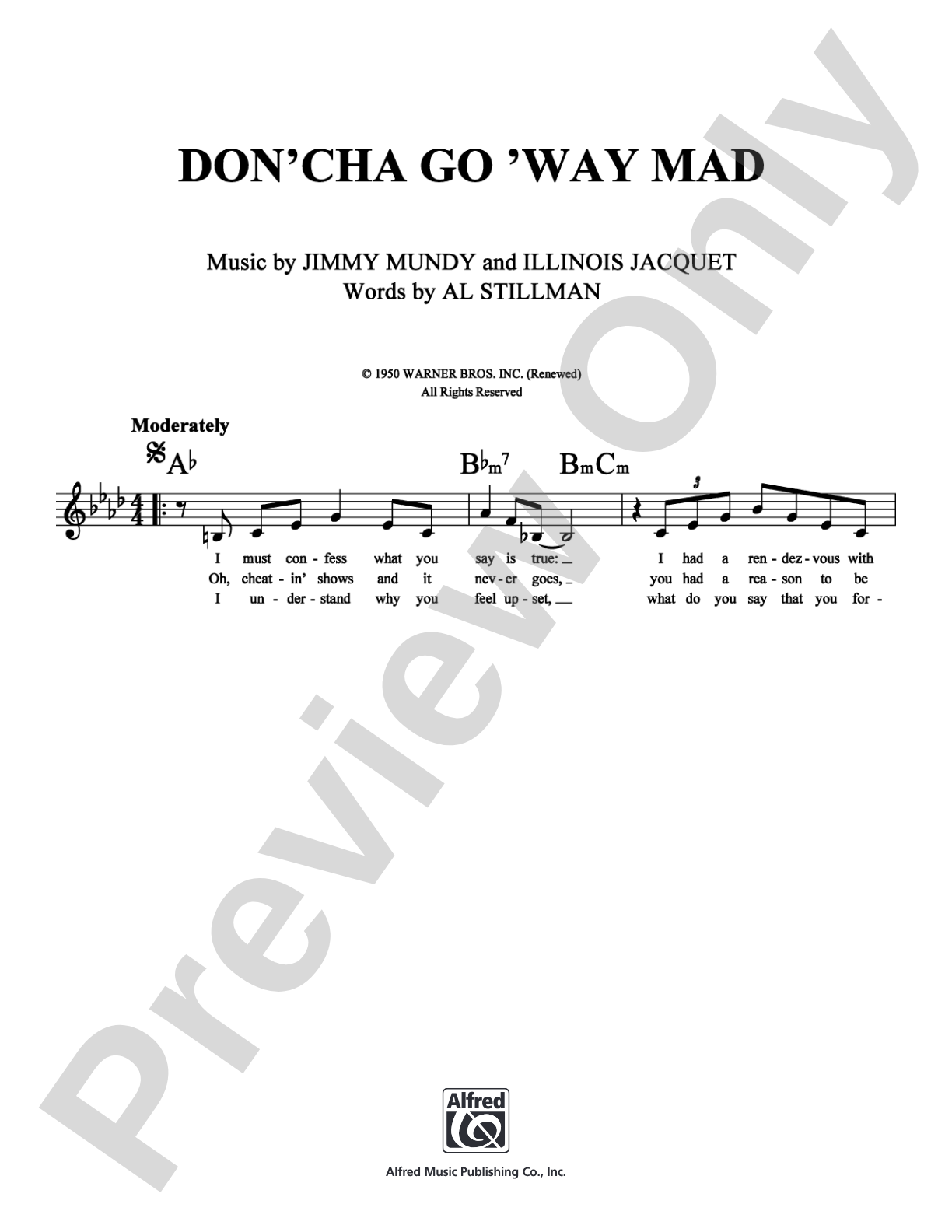
Don'cha Go 'Way Mad: Lead Sheet Digital Sheet Music

Don'cha Go 'Way Mad: Lead Sheet Digital Sheet Music

Jimmy Mundy, Illinois Jacquet

Item: 00-PS-0008742

Digital Download
$1.99
Description

Don'cha Go 'Way Mad: Lead Sheet Digital Sheet Music isn't in MakeMusic Cloud just yet...but it could be. Let us know you'd like to see it, and you'll help shape what comes next. In the meantime, start a free trial and dive into thousands of interactive titles your students can play along with today.

Sample Audio
No sample audio found.
Sample Video
Additional Details
SKU: 00-PS-0008742

More about this title

About the Artist: Illinois Jacquet

Illinois Jacquet (1922, 1994) was a tenor saxophonist who became one of the defining voices of jump blues and early rhythm and blues. His honking, full-bodied tone and rhythmic vitality made him instantly recognizable and influential across multiple genres. Jacquet's work bridged swing jazz, bebop, and the emerging R&B sound of the 1940s and 1950s, earning him respect from both mainstream jazz musicians and popular audiences.

Why we love this

This tune showcases the joyful irreverence and melodic wit that made Jacquet a bandstand favorite. The lead sheet captures a composition with genuine personality, built on accessible changes but with enough character to reward players who dig into the phrasing and feel. It's the kind of piece that reminds students why jazz matters: the music swings, it makes people smile, and it's built for real conversation between players.

What to expect

Buoyant and sly, with a melody that bounces between swagger and simplicity. The tune has an easy-going confidence that invites both tight ensemble playing and wide-open solo space.

Who it's for

Jazz students learning to navigate 12-bar blues structures, tenor saxophonists building a standard repertoire, and ensembles wanting an accessible, historically grounded tune for small group or big band settings. This lead sheet works equally well for study and performance.

How to get the most out of it

  • Lean into the swagger of the melody. This isn't a polite tune; let it have attitude and groove.
  • Approach the blues changes with confidence rather than caution. Use the lead sheet as a springboard for trading solos and working on your vocabulary over a 12-bar blues.
  • Lock in with the rhythm section early in rehearsal. The pocket is everything here, so settle the tempo and feel before diving into improvisation.

How to use it

Feature this in a jazz combo or small ensemble concert where you want to highlight the blues tradition and give soloists room to shine. It also serves as a conversation starter in history or repertoire classes about the roots of rock and roll.

Skills your students will build

  • 12-bar blues form and harmonic progression
  • Improvisation over a basic blues changes
  • Tenor saxophone melody and phrasing in the jump blues style
  • Comping and rhythm section dialogue
  • Reading and interpreting lead sheet notation

You May Also Like