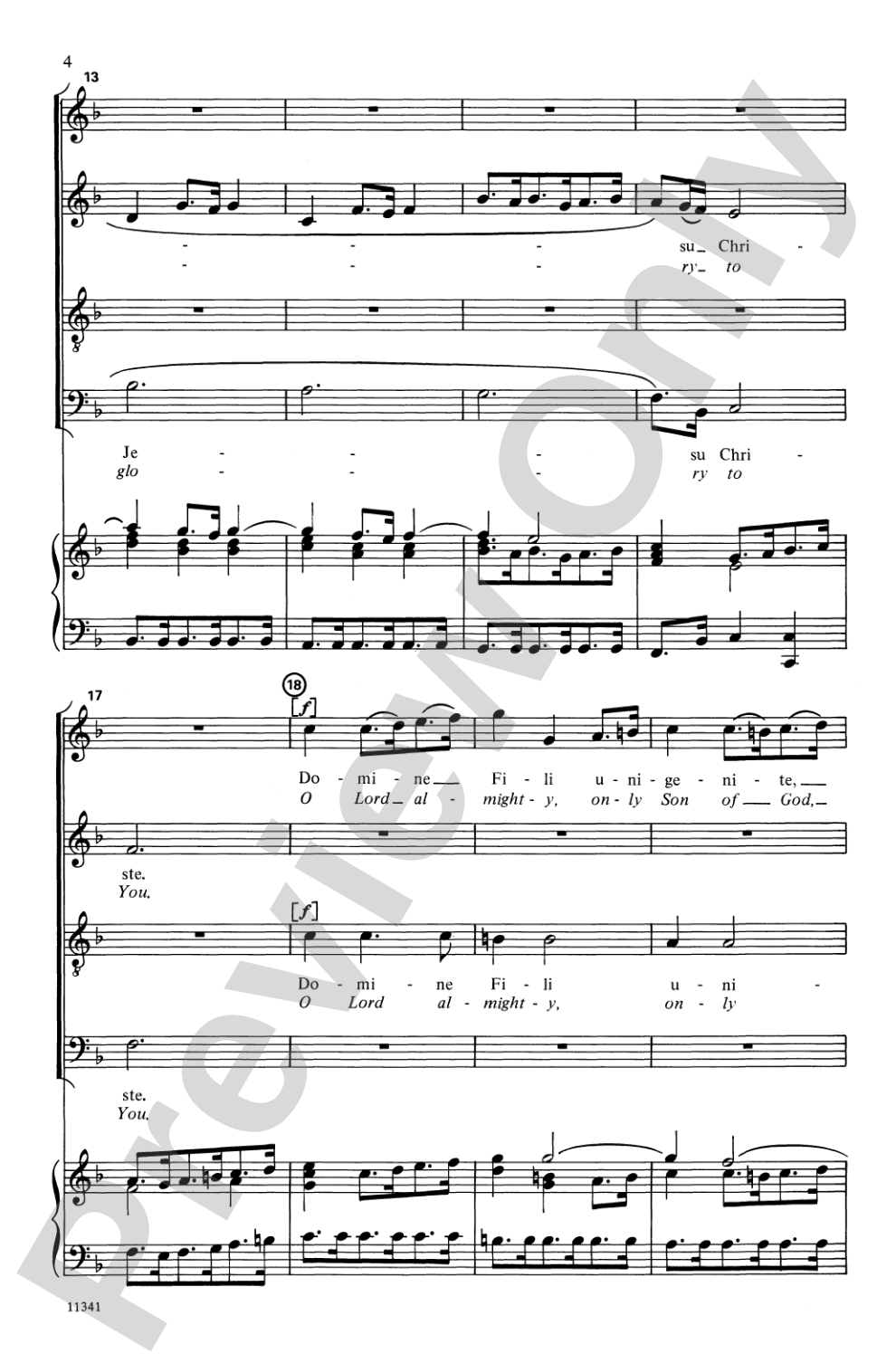
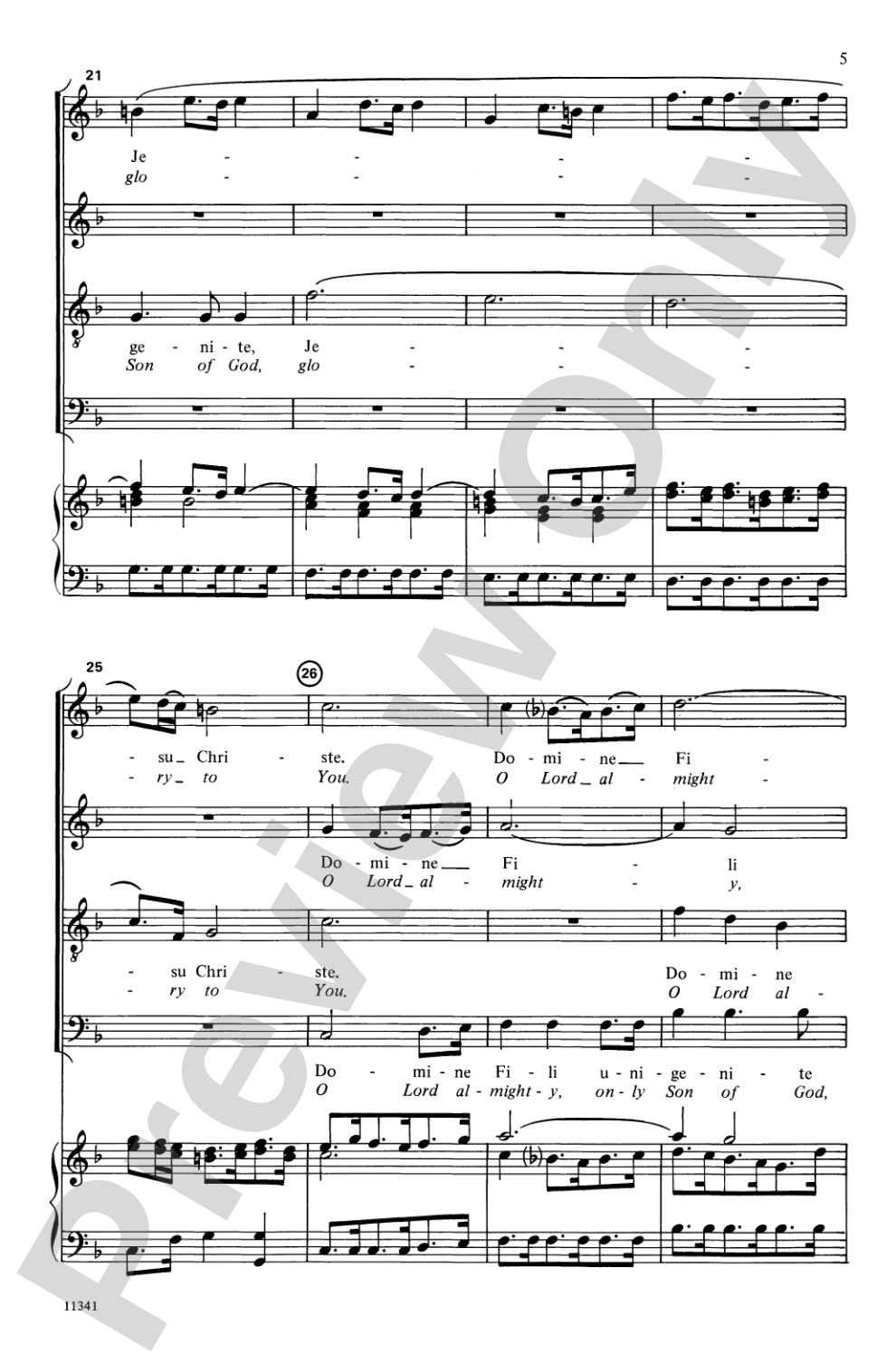
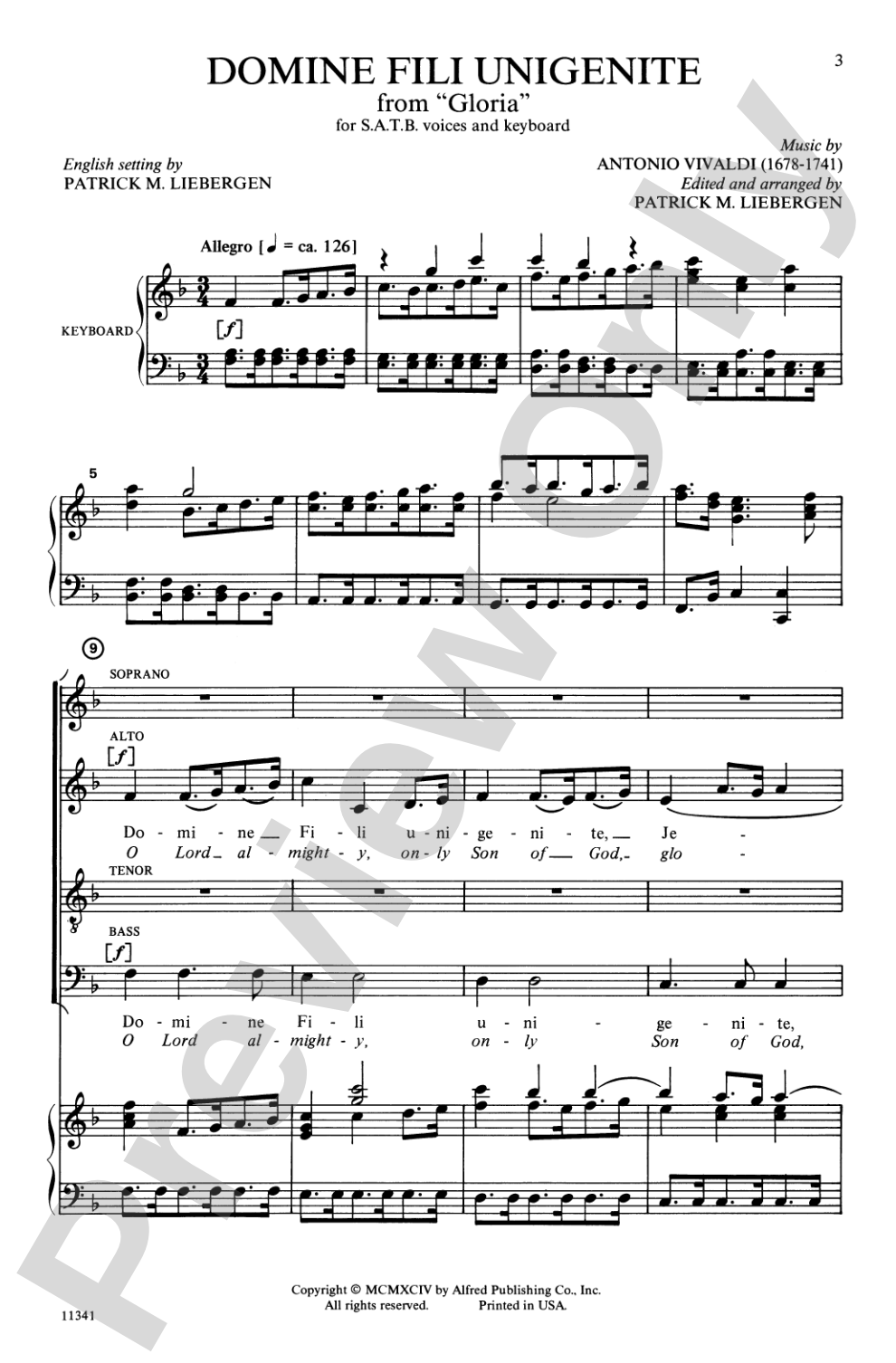
Domine Fili Unigenite (from <i>Gloria</i>) Sheet Music Preview

Domine Fili Unigenite (from Gloria): SATB Choral Octavo

Music by Antonio Vivaldi / arr. Patrick M. Liebergen

Item: 00-PO-0003795

Digital Download
$2.95

Minimum order quantity: 20 copies

Description
Domine Fili unigenite is found in Vivaldi's GLORIA, his most famous choral work. GLORIA is set for eight choruses, arias for a soprano and alto and a duet for two sopranos. It also includes instrumental parts for oboe, trumpet, strings and continuo. The very energetic seventh movement of the work is set to the words Domine Fili unigenite, Jesu Christe (Lord, only begotten Son, Jesus Christ).

Domine Fili Unigenite (from Gloria): SATB Choral Octavo isn't in MakeMusic Cloud just yet...but it could be. Let us know you'd like to see it, and you'll help shape what comes next. In the meantime, start a free trial and dive into thousands of interactive titles your students can play along with today.

Sample Audio
No sample audio found.
Sample Video
Additional Details
Series: Alfred Archive Edition: Alfred Choral Designs
Publisher: Alfred Music
Page Count: 16
SKU: 00-PO-0003795

More about this title

About the Composer: Antonio Vivaldi

Antonio Vivaldi (1678-1741) stands as one of the Baroque era's most prolific and influential composers. A master of instrumental concertos, he brought comparable energy and structural innovation to his sacred vocal works, particularly the Gloria, which showcases his gift for theatrical pacing and memorable melodic invention. Vivaldi's music education legacy spans centuries; his works remain central to understanding how Baroque composers balanced formal liturgical demands with dramatic, audience-engaging composition.

Why we love this

Liebergen's arrangement preserves the kinetic brilliance of Vivaldi's original while making this iconic movement accessible to SATB choirs without sacrificing the harmonic sophistication that makes the Gloria endure. The piece delivers immediate impact on a concert program, opening doors to Baroque repertoire for singers who might otherwise encounter only Renaissance polyphony or later choral masterworks.

What to expect

Radiant and propulsive, with the confidence of Baroque ceremonial music at its most exuberant. Vivaldi's melodic gift and harmonic momentum sweep the text forward, creating moments of jubilation punctuated by clear harmonic arrivals that feel both inevitable and fresh.

Who it's for

Intermediate to advanced choirs seeking substantial Baroque repertoire that performs well in concert or festival settings. This arrangement opens the Gloria to ensembles without large instrumental forces, making it ideal for school, community, and church choirs ready to engage with canonical sacred music.

How to get the most out of it

  • Anchor the repeated rhythmic figures in the accompaniment to establish the movement's forward momentum; these patterns drive the energy that defines the seventh movement's character.
  • Shape the phrase 'Jesu Christe' with clear articulation and a slight diminuendo to avoid a heavy, static landing after the vigorous opening.
  • Balance the SATB texture so that overlapping phrases in different voice parts remain distinct; Vivaldi's original orchestration benefits from transparent voice leading rather than blended, homogeneous chords.
  • Vary dynamics across repeated sections to sustain listener engagement over the piece's length and to echo the dramatic pacing Vivaldi intended.

How to use it

This movement shines as a standalone concert piece or as part of a larger sacred music program pairing it with other Baroque settings of the Ordinary or supplementary liturgical texts. Consider programming it after a slower Renaissance motet or chant to showcase the stylistic leap and renewed energy Vivaldi brought to the Baroque sacred tradition.

Skills your students will build

  • Baroque performance practice: articulation, phrasing, and rhythmic drive appropriate to period style
  • Multi-voice independence while maintaining harmonic cohesion in fast-moving passages
  • Handling repeated rhythmic and melodic figures without losing musical expression
  • Ensemble balance in texturally complex sections where voice parts enter at staggered points

You May Also Like