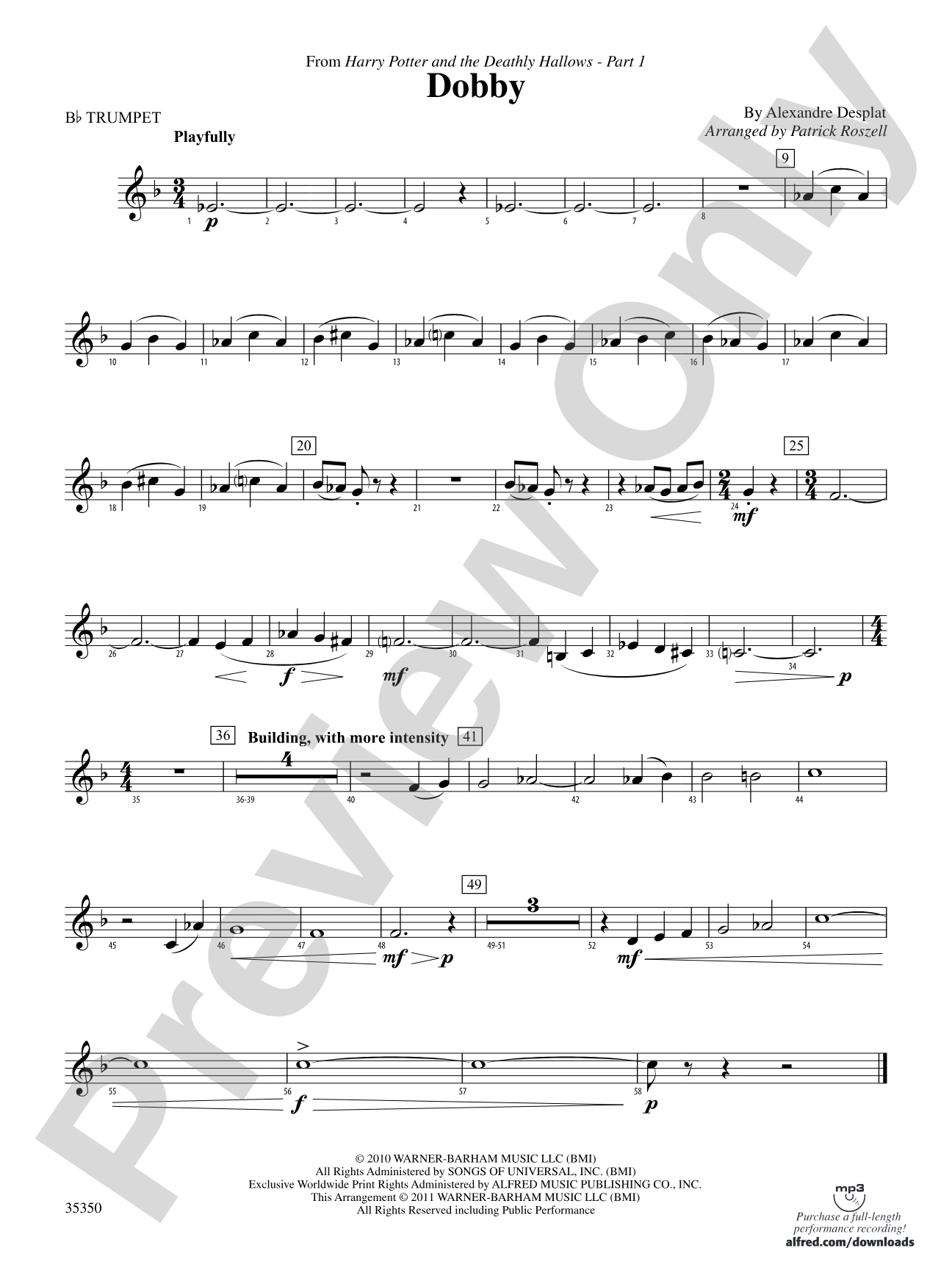
Dobby (from Harry Potter and the Deathly Hallows, Part 1): 1st B-flat Trumpet Sheet Music Preview

Dobby (from Harry Potter and the Deathly Hallows, Part 1): 1st B-flat Trumpet

By Alexandre Desplat / arr. Patrick Roszell

Grade: 1.5 (Very Easy to Easy)

Item: 00-PC-0014905_T1

Digital Download
$3.00
Description
Portraying three characters from the Harry Potter universe, composer Alexandre Desplat musically illustrates the mysterious Kreacher, the noble Dobby, and the nefarious thief Mundungus. A simple, yet amusing melody from the blockbuster film that can be used to introduce dissonance and reinforce accidentals and courtesy accidentals with your students. (1:31)

Don't just read it, hear it, play along with it, and watch your students grow with it. In MakeMusic Cloud, Dobby (from Harry Potter and the Deathly Hallows, Part 1): 1st B-flat Trumpet comes alive with professional accompaniment, adjustable tempo, and built-in practice tools that turn solo practice into real progress.

Sample Audio
0:00
0:00
Sample Video
Additional Details
Series: Pop Beginning Band
Publisher: Alfred Music
Page Count: 132
SKU: 00-PC-0014905_T1

More about this title

About the Composer: Alexandre Desplat

Alexandre Desplat has composed the scores for eight Harry Potter films, becoming synonymous with the musical voice of the wizarding world. His work across the franchise demonstrates mastery of character leitmotifs, orchestral color, and the ability to write music that functions equally well in dramatic film moments and classroom settings.

Beyond Potter, Desplat has earned Academy Award nominations for his film scores and continues to compose for major motion pictures. His gift for writing accessible yet sophisticated melodies makes his music particularly valuable for music educators introducing students to film scoring and thematic development.

Why we love this

This arrangement captures three distinct personalities in a single, manageable piece that Grade 1.5 bands can execute convincingly. The educational payoff extends beyond the fun factor: you get a genuine teaching tool for accidentals and dissonance that doesn't feel like a drill because the musical context is genuinely entertaining.

What to expect

A musical journey through three distinct magical personalities: mysterious and shadowy, then noble and earnest, then mischievously playful. The orchestration shifts in tone as neatly as a costume change, giving bands a chance to explore how melody, harmony, and orchestral color work together to tell a story.

Who it's for

Very easy to easy concert bands looking for repertoire that builds foundational skills while keeping students engaged. Teachers seeking film music that serves a clear pedagogical purpose beyond novelty will find this particularly useful.

How to get the most out of it

  • Balance the melody line so listeners clearly hear the character it represents at any moment; the contrast between Dobby's noble theme and Mundungus's thievish gestures should feel obvious even from a distance.
  • Watch the accidentals carefully in rehearsal. This piece uses them purposefully to color each character, so students need to understand which notes are chromatic inflections rather than sight-reading mistakes.
  • Maintain clarity in the accompanying voices so the feature melody sings through without drowning out the harmonic context that makes Desplat's orchestration work.
  • The 1:31 runtime means pacing and ensemble cohesion matter immediately; lock tempo and entrances early in the rehearsal process.

How to use it

Program this alongside other film music or fantasy-themed repertoire for a concert that speaks to younger audiences without sacrificing musical substance. It also works as an excellent warm-up or interlude piece that keeps energy high without requiring extended rehearsal time once basic parts are secure.

Skills your students will build

  • Reading and performing accidentals and courtesy accidentals in context
  • Identifying and performing dissonant harmonic color
  • Balancing melody against accompaniment
  • Understanding character-driven orchestration and leitmotif
  • Ensemble accuracy at a brisk tempo

You May Also Like