Do You Know What I Mean Sheet Music Preview

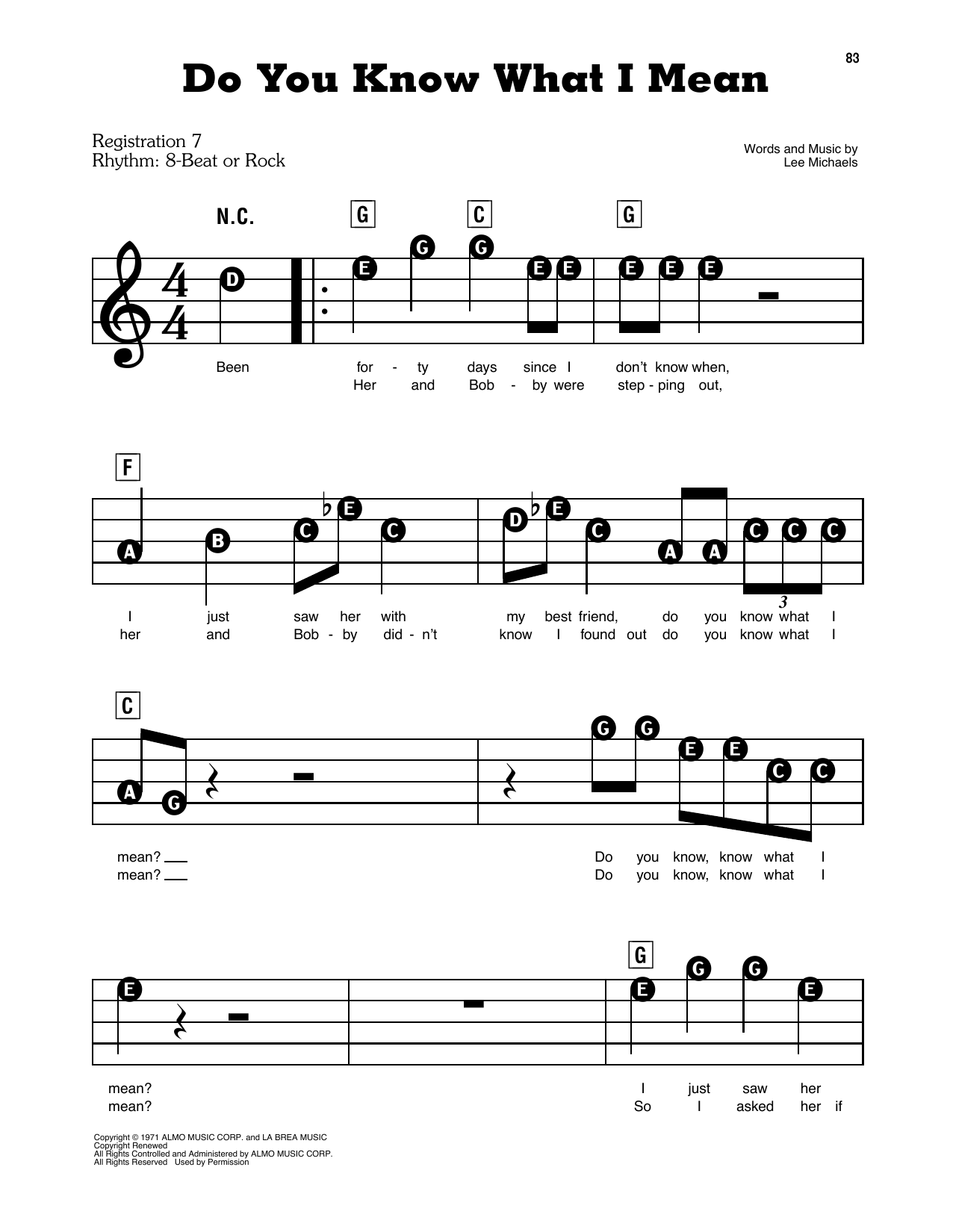
Do You Know What I Mean: E-Z Play Today

As performed by Lee Michaels

Item: 35-DS00733911

Digital Download
$4.99
Description

Do You Know What I Mean: E-Z Play Today isn't in MakeMusic Cloud just yet...but it could be. Let us know you'd like to see it, and you'll help shape what comes next. In the meantime, start a free trial and dive into thousands of interactive titles your students can play along with today.

Sample Audio
No sample audio found.
Sample Video
Additional Details
Publisher: Hal Leonard
Page Count: 5
SKU: 35-DS00733911

More about this title

About the Artist: Lee Michaels

Lee Michaels emerged as a distinctive voice in 1960s rock and soul, known for his energetic organ playing and soulful vocal delivery. His work bridged the gap between rock sensibility and R&B groove, establishing him as a significant figure in the era's keyboard-driven sound.

Why we love this

This track captures a moment when rock and soul collided on the keyboard, giving pianists a chance to explore that soulful, driving groove without oversized technical demands. The five-page arrangement honors the original's character while remaining accessible for intermediate players who want to sound confident and expressive.

What to expect

Warm and deliberate, with a swagger that comes from strong rhythmic conviction rather than speed. The piece invites you into a conversation between the keyboard and the song itself, where phrasing matters as much as precision.

Who it's for

Pianists working to develop their comfort with soul and rock grooves will find this arrangement both rewarding and fair. It suits students ready to move beyond classical phrasing into style-specific interpretation.

How to get the most out of it

  • Commit to the rhythmic pocket. The groove sits on the syncopation rather than landing on obvious beats, so internalize the pulse before worrying about note accuracy.
  • Layer your dynamics across the progression. The piece builds energy through repeating sections, so vary your touch and voicing to create movement without adding extra notes.
  • Balance the vocal melody with accompaniment figuration. When the main tune enters, let it breathe while keeping the underlying rhythmic motion alive beneath it.

How to use it

Pair this with other soul and rock standards to create a program segment that showcases keyboard versatility beyond classical and jazz. It also works well as a solo feature for a pianist showing range in a variety recital.

Skills your students will build

  • Soul and rock keyboard phrasing
  • Syncopated rhythm reading and execution
  • Dynamic control across repeated harmonic sections
  • Translating vocal performance sensibility to the keyboard

You May Also Like