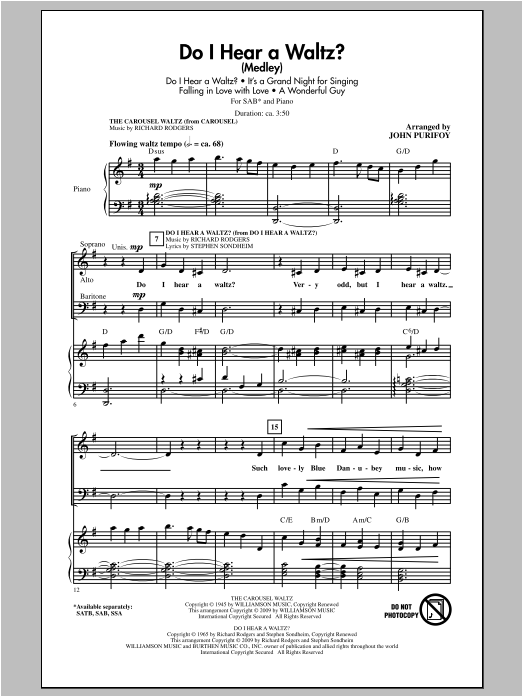
Do I Hear A Waltz? Sheet Music Preview

Do I Hear A Waltz?: SAB Choral Octavo

Arranged by John Purifoy

Item: 35-DS00263086

Digital Download
$2.99
Description

Do I Hear A Waltz?: SAB Choral Octavo isn't in MakeMusic Cloud just yet...but it could be. Let us know you'd like to see it, and you'll help shape what comes next. In the meantime, start a free trial and dive into thousands of interactive titles your students can play along with today.

Sample Audio
No sample audio found.
Sample Video
Additional Details
Publisher: Hal Leonard
Page Count: 15
SKU: 35-DS00263086

More about this title

About the Arranger: John Purifoy

John Purifoy has built a reputation as a thoughtful arranger whose choral work balances accessibility with musical substance. His arrangements appear regularly in school and community choral programs, where they serve directors seeking pieces that engage singers without sacrificing artistry.

Why we love this

Purifoy's arrangement captures the charm of waltz time while keeping the part writing lean and manageable for developing singers. The piece slots perfectly into a lighter concert set without feeling trivial, and the straightforward SAB voicing means you won't spend rehearsal time untangling dense counterpoint.

What to expect

There's a buoyant, gently nostalgic quality to this piece that invites audiences in without pretense. The waltz meter creates forward motion and natural phrasing, giving singers the satisfaction of riding a clear musical line.

Who it's for

This arrangement works for treble or mixed ensembles at the high school or community choir level. Directors seeking accessible yet musically coherent material for younger singers or those newer to ensemble singing will find it a practical addition to their repertoire.

How to get the most out of it

  • Shape the accompaniment with a gentle lilt; let the piano part breathe the waltz feel rather than forcing it with overly exaggerated rubato.
  • Balance the tune so it floats above the supporting voices without requiring sopranos to oversing. The melody should feel inevitable, not strained.
  • Attend to the text underlay carefully during sectional rehearsals. Waltz time can compress diction if singers aren't conscientious about clarity on upbeats.
  • Consider a light vibrato ensemble approach in the unison passages to maintain vocal ease and blend across the group.

How to use it

Fit this into a spring or informal concert as a palate cleanser between heavier repertoire, or pair it with other lyrical pieces in a lighter set. Its 15 pages suggest it can anchor a shorter program or complement a longer mixed concert without dominating the overall arc.

Skills your students will build

  • Singing in waltz meter (3/4) with proper metric emphasis
  • Blending three independent parts in a lean voicing texture
  • Maintaining steady pulse across longer phrases without dragging
  • Executing clear articulation in a moderate tempo without rushed diction

You May Also Like