
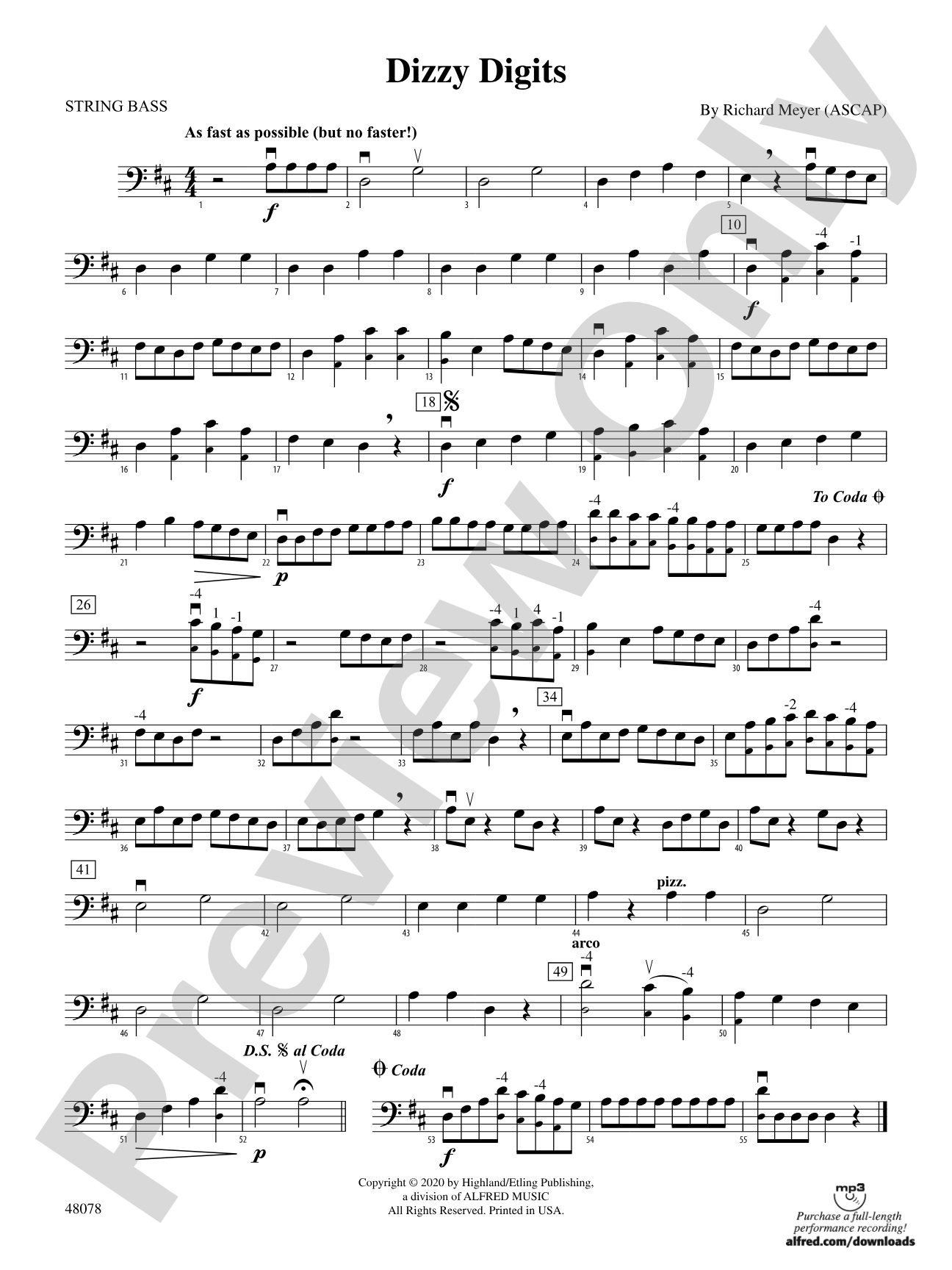

Dizzy Digits: String Bass
By Richard Meyer
Grade: 1
Item: 00-PC-0018514_SB
$3.00
Pickup currently not available
Description
This title features Alfred Music's String Orchestra FLEX options. That means that every part in this set is now transposed into every other part, so you can play this title with any combination of like- or mixed-string ensemble. After purchasing this set, decide what additional parts you need to meet the unique needs of your ensemble, then download and print them for free at alfred.com/supplemental---free of charge.
Using the notes of the D major scale, Dizzy Digits by Richard Meyer was written to improve early readers' finger dexterity and note-reading skills. Your students are sure to rise to the challenge of this fun, perpetual-motion style selection that is great for concert or contest. Start slow and increase the tempo a bit each day and watch those digits start flying! A great motivator for year one and two string students! Correlated to String Explorer, Book 1, Unit 8. (2:00) This title is available in MakeMusic Cloud.


Using the notes of the D major scale, Dizzy Digits by Richard Meyer was written to improve early readers' finger dexterity and note-reading skills. Your students are sure to rise to the challenge of this fun, perpetual-motion style selection that is great for concert or contest. Start slow and increase the tempo a bit each day and watch those digits start flying! A great motivator for year one and two string students! Correlated to String Explorer, Book 1, Unit 8. (2:00) This title is available in MakeMusic Cloud.
Don't just read it, hear it, play along with it, and watch your students grow with it. In MakeMusic Cloud, Dizzy Digits: String Bass comes alive with professional accompaniment, adjustable tempo, and built-in practice tools that turn solo practice into real progress.
Open in the Player
Jump straight in and assign it today.
Start Your Free Trial
Open this title and explore the full library in minutes.
Sample Audio
1
Audio File
--:--
0:00
0:00
Sample Video
Additional Details
Series:
Highland/Etling String Explorer
Publisher:
Alfred Music
Page Count:
72
SKU:
00-PC-0018514_SB
More about this title
About the Composer: Richard Meyer

Richard Meyer spent 35 years teaching strings across elementary, middle, and high school levels in California public schools. At Oak Avenue Intermediate School in Temple City, he directed orchestras for 22 years, expanding the program from 29 students to 200, while simultaneously overseeing the city's elementary string curriculum. He led the Pasadena Youth Symphony Orchestra for 16 years, taking them on performance tours to New York, Washington D.C., Vienna, Australia, and Canada.
Beyond the classroom and podium, Meyer has established himself as a prolific composer and arranger with over 190 works in print, and served as string editor for Alfred Publishing for 16 years. He co-authored the String Explorer method series and Sight-read It for Strings, making his fingerprints visible across string education nationwide. In 2009, he created the "Giving Bach" program at his school, an initiative that has gained national recognition for using interactive concerts to serve special needs and underserved student populations throughout Southern California. Meyer is a frequent clinician at major conferences including the A.S.T.A. National Conference and has guest-conducted All-State and Honor Orchestras across multiple states.
Why we love this
The FLEX instrumentation model eliminates the logistics headache of managing multiple printed part sets; every part is transposed into every other part, so you can substitute freely and download only what you need. Meyer's perpetual-motion writing style keeps early readers engaged while genuinely improving their finger dexterity and note-reading accuracy, making this a selection that teaches without feeling like a drill.
What to expect
Dizzy Digits captures the playful energy of rapid fingerwork without overwhelming young players; the D major scale keeps harmonic choices simple, but the relentless motion creates genuine excitement. There's a lightness to the writing that feels more like a musical game than an exercise, rewarding students who dig in with focus.
Who it's for
This piece sits squarely in the first-year string orchestra level, making it ideal for students in their first or second year of study. It works equally well for mixed string ensembles of any configuration, thanks to the FLEX parts system, so it accommodates everything from a small private school orchestra to a large suburban program.
How to get the most out of it
- Start at a comfortable tempo where students can articulate cleanly, then add 5 to 10 BPM each rehearsal until you reach the desired speed; the cumulative effect builds confidence and creates a measurable progress marker for your ensemble.
- Lock in the rhythm section (cello and bass parts) first so the upper voices have a steady anchor for their faster passages; this prevents the perpetual motion from becoming muddy.
- Use the two-minute runtime to your advantage in rehearsal by running the piece multiple times in succession, allowing students to internalize the momentum and smooth out any rough seams.
How to use it
Program this in a winter or spring concert to showcase how far your first-year students have come since September; the short runtime and high energy level make it an excellent opener or a crowd-pleasing encore. It also pairs well with festival or competition settings, where the technical challenge and musical appeal appeal to adjudicators and audiences alike.
Skills your students will build
- Reading D major scale passages fluently
- Building finger dexterity and left-hand facility through rapid note passages
- Maintaining steady pulse in a perpetual-motion texture
- Executing clean articulation at increasing tempos
- Balancing individual line work with ensemble cohesion