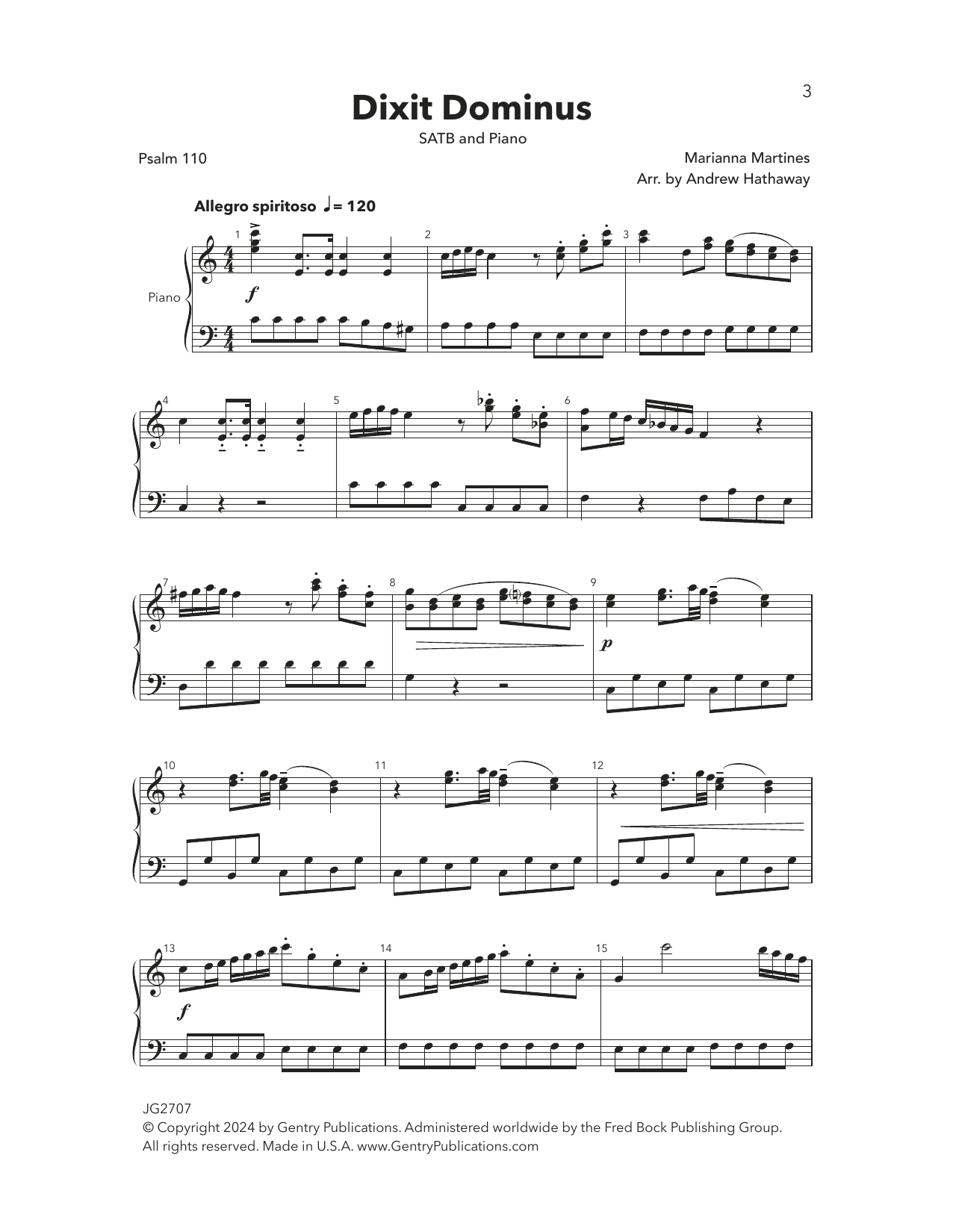
Dixit Dominus (arr. Andrew Hathaway) Sheet Music Preview

Dixit Dominus (arr. Andrew Hathaway): SATB Choral Octavo

By Marianna Martines / Arranged by Andrew Hathaway

Item: 35-DS01442685

Digital Download
$4.45
Description

Dixit Dominus (arr. Andrew Hathaway): SATB Choral Octavo isn't in MakeMusic Cloud just yet...but it could be. Let us know you'd like to see it, and you'll help shape what comes next. In the meantime, start a free trial and dive into thousands of interactive titles your students can play along with today.

Sample Audio
No sample audio found.
Sample Video
Additional Details
Publisher: Hal Leonard
Page Count: 19
SKU: 35-DS01442685

More about this title

About the Composer: Marianna Martines

Marianna Martines (1726-1812) was one of the most accomplished composers of the 18th century and among the few women whose works achieved regular performance and publication during her lifetime. Born in Venice to a prominent musical family, she studied composition with Padre Giovanni Martini and became known for her command of counterpoint, her gift for memorable melody, and her fluency across multiple genres including sacred vocal works, instrumental sonatas, and concertos.

Martines composed Dixit Dominus as part of a rich tradition of Italian psalm settings. Her approach to this liturgical text reflects both her contrapuntal training and her ear for the harmonic language emerging in the late 18th century. Her music rewards careful study; the part writing remains elegant without becoming cumbersome, and the emotional arc sustains across substantial forms.

Why we love this

Andrew Hathaway's arrangement makes this 18th-century masterwork accessible to modern SATB ensembles without sacrificing the architecture that gives it power. The piece sits at that sweet spot where singers feel musically substantial but aren't wrestling with extreme ranges or Renaissance polyphonic density.

What to expect

Dixit Dominus has an intimate grandeur. The texture alternates between moments of crystalline four-part writing and more densely woven passages where the voices interlock in counterpoint. There's an underlying formality to the language without coldness; instead, the piece radiates the kind of quiet assurance that comes from masterful craftsmanship.

Who it's for

This arrangement works for advanced high school choirs, college choirs, and community ensembles with solid musicianship and some experience with Baroque and Classical sacred music. The piece demands secure part singing and attention to harmonic blend, but rewards that investment with a genuinely satisfying performance.

How to get the most out of it

  • Shape the phrase contours with long lines rather than stopping at bar breaks; Martines' harmonic rhythm often carries across what looks like natural pause points on the page.
  • Balance the soloistic moments (especially if parts separate into duets or smaller groupings) so they float clearly above the tutti sections without losing textural cohesion.
  • Allow the text painting to emerge naturally from the vocal writing rather than imposing artificial drama; Martines tends toward structural elegance over rhetorical gesture.

How to use it

Include this on a concert exploring women composers of the Classical era alongside works by Francesca Caccini or Barbara Strozzi, or program it within a broader concert of sacred choral works to demonstrate the continuing vitality of the psalm-setting tradition through the 18th century. The 19-page length makes it substantial enough for a concert centerpiece without overwhelming your rehearsal schedule.

Skills your students will build

  • Reading and executing Baroque and Classical phrase pacing
  • Balancing individual voice independence with ensemble blend in four-part writing
  • Navigating text declamation in Italian liturgical language
  • Understanding harmonic function and voice leading in the Classical period
  • Sustaining long musical lines through shifts in texture and orchestration

You May Also Like